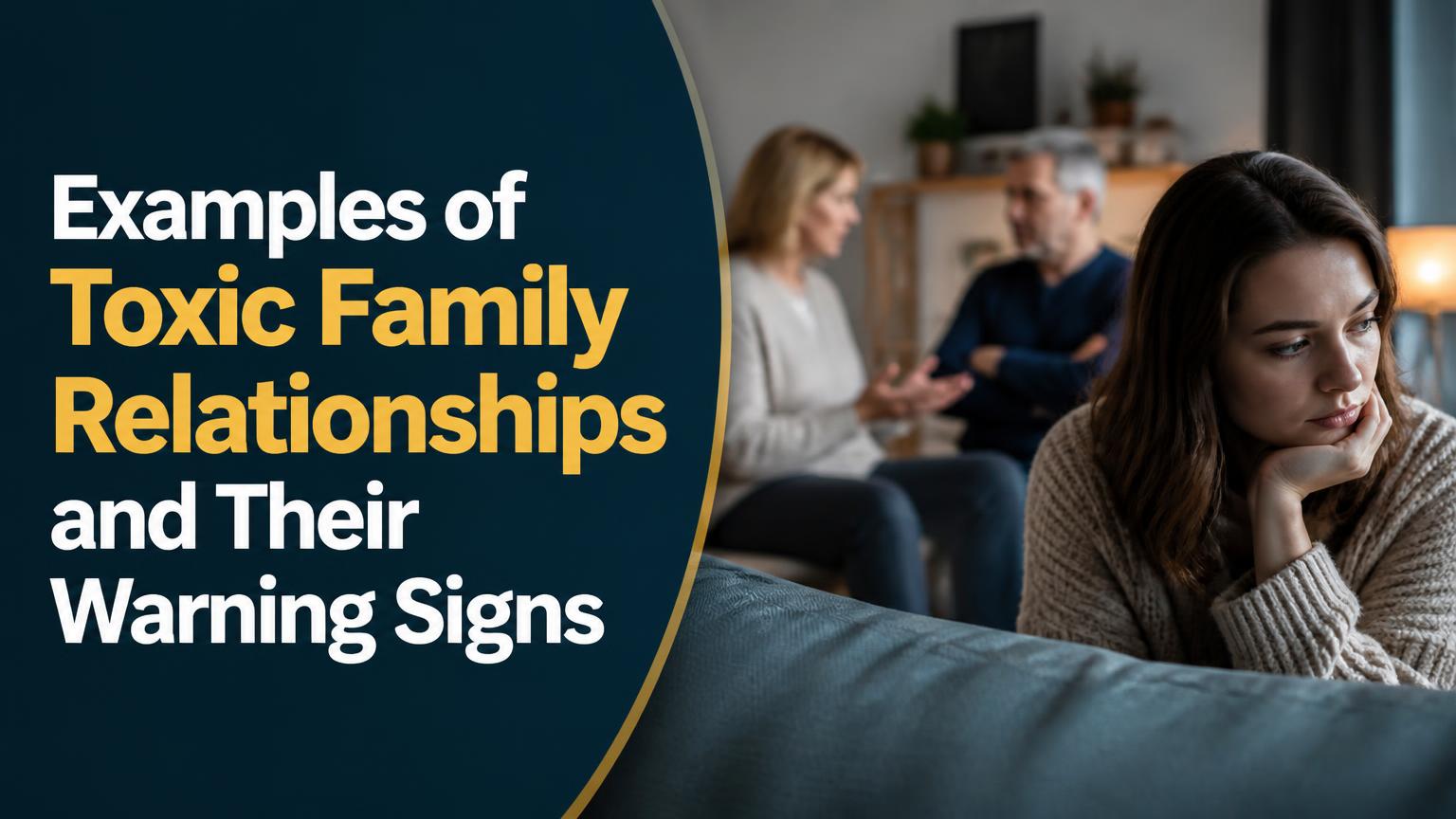
Toxic family relationships involve recurring patterns of behavior that undermine trust, emotional security, personal autonomy, or mutual respect. These patterns can develop between parents and children, siblings, spouses, extended relatives, or other family members. They may involve constant criticism, manipulation, controlling behavior, emotional neglect, or repeated violations of personal boundaries.
Unlike occasional disagreements, toxic family dynamics tend to persist over time and leave one or more family members feeling consistently dismissed, pressured, intimidated, or emotionally exhausted.
Recognizing examples of toxic family relationships helps distinguish ordinary family difficulties from harmful patterns. It also makes it easier to understand how these relationships function, why certain behaviors are damaging, and what responses may be appropriate.
Examples of Toxic Family Relationships
Toxic family relationships can take many forms. Some involve openly hostile behavior, while others operate through subtle expectations, emotional pressure, or unequal family roles. The defining concern is not simply that family members disagree, but that harmful behaviors become recurring features of their interactions.
The following examples illustrate common patterns and their warning signs.
1. A Parent Who Constantly Criticizes Their Child
A consistently critical parent repeatedly focuses on a child’s perceived shortcomings while offering little recognition, encouragement, or constructive support.
For example, a parent might dismiss excellent academic results because the child did not achieve the highest grade, criticize their appearance, or compare them unfavorably with siblings.
Constructive criticism addresses specific behaviors and helps someone improve. Harmful criticism attacks personal worth, creates unrealistic expectations, or makes affection appear dependent on achievement.
Common warning signs include:
- Frequent insults disguised as advice or concern.
- Comparing children to siblings or other people.
- Dismissing accomplishments while emphasizing mistakes.
- Using humiliation to encourage obedience or achievement.
- Making approval conditional on meeting expectations.
Over time, persistent criticism may contribute to self-doubt, perfectionism, or difficulty trusting personal judgment. Its effects depend on factors such as the child’s age, available emotional support, and the severity of the behavior.
2. A Family Member Who Uses Guilt to Control Decisions
Guilt-based manipulation occurs when a family member uses another person’s sense of obligation, loyalty, or responsibility to influence their decisions.
Consider an adult daughter who declines a family gathering because of work commitments. Her mother responds, “After everything I’ve sacrificed for you, this is how you repay me.”
The problem is not that the mother feels disappointed. Family members can express disappointment legitimately. The unhealthy element is using past sacrifices to suggest that the daughter has no right to make an independent decision.
Warning signs include repeated references to sacrifices, accusations of selfishness, emotional withdrawal after refusal, and demands that personal needs be subordinated to family expectations.
This pattern can make ordinary choices feel like moral failures. The person experiencing it may begin making decisions primarily to avoid guilt rather than considering their own responsibilities and preferences.
3. A Controlling Parent Who Refuses to Respect Independence
Parental guidance is appropriate during childhood, but healthy family relationships generally allow increasing independence as children mature.
A controlling parent may resist this transition by insisting on making decisions about an adult child’s career, friendships, marriage, finances, or living arrangements.
For example, a father might repeatedly threaten to withdraw financial assistance unless his adult son chooses an approved profession.
The warning signs include:
- Demanding access to private communications.
- Making financial support conditional on unrelated personal choices.
- Treating disagreement as disrespect or disloyalty.
- Interfering with relationships or career decisions.
- Refusing to acknowledge age-appropriate independence.
There is a meaningful difference between offering advice, setting legitimate conditions on one’s own resources, and using dependency to control another person’s life.
Control becomes especially concerning when threats, intimidation, surveillance, or restrictions on access to essential resources prevent someone from exercising reasonable freedom.
4. Siblings Who Repeatedly Humiliate or Undermine Each Other
Sibling rivalry is common, particularly during childhood. However, persistent humiliation, intimidation, or deliberate exclusion can create an unhealthy sibling relationship.
One sibling might repeatedly ridicule another’s appearance, disclose private information to embarrass them, or undermine their achievements during family gatherings.
Another example involves an older sibling who uses physical intimidation to obtain money, possessions, or compliance from a younger sibling.
Warning signs include persistent bullying, threats, public humiliation, destructive competition, and disregard for requests to stop.
The distinction between ordinary rivalry and harmful behavior often involves frequency, severity, power differences, and whether both siblings can participate without fear.
Repeated aggression should not automatically be dismissed as normal sibling behavior, particularly when one sibling consistently has less power or cannot protect themselves.
5. Parents Who Favor One Child and Blame Another
Some families develop unequal roles in which one child receives disproportionate praise and protection while another is repeatedly blamed or criticized.
For example, parents may excuse one child’s misconduct but punish another for similar behavior. The favored child might be described as responsible and successful, while the other becomes the default explanation for family problems.
This dynamic is sometimes described through the informal terms golden child and scapegoat. These are descriptive labels, not clinical diagnoses.
Warning signs include:
- Consistently unequal standards of discipline.
- Assigning blame to the same child regardless of circumstances.
- Excusing harmful behavior by favored family members.
- Comparing siblings in ways that create resentment.
- Ignoring one child’s needs while prioritizing another’s.
Not every difference in parental treatment represents favoritism. Children have different ages, abilities, and needs, and fair parenting does not always mean identical treatment.
The concern arises when unequal treatment becomes entrenched, unjustified, and damaging to family relationships.
6. A Family Member Who Uses the Silent Treatment as Punishment
Taking time away from an argument can be a constructive way to manage strong emotions. The silent treatment becomes harmful when someone deliberately withdraws communication to punish, intimidate, or pressure another person.
For example, a parent might refuse to speak to an adult child for several weeks after the child makes an independent decision.
The silence may end only when the child apologizes or complies with the parent’s demands.
Warning signs include unexplained communication withdrawal, repeated refusal to address disagreements, and an expectation that the other person must surrender their position to restore contact.
Unlike a healthy cooling-off period, punitive silence offers no reasonable path toward discussion or resolution.
The resulting uncertainty can create pressure to comply, even when the original decision was reasonable.
7. A Family That Consistently Violates Personal Boundaries
Personal boundaries define what individuals are comfortable sharing, accepting, or participating in. They may concern privacy, physical space, finances, time, communication, or personal decisions.
In an unhealthy family relationship, boundaries may be repeatedly ignored or treated as insults.
For example, relatives might enter someone’s home without permission, read private messages, pressure family members to disclose sensitive information, or insist on attending events despite being asked not to.
Warning signs include:
- Ignoring clear requests for privacy.
- Sharing confidential information without consent.
- Expecting unrestricted access to someone’s time or property.
- Mocking family members for having personal limits.
- Responding to reasonable boundaries with threats or retaliation.
A boundary is not a guarantee that others will cooperate. It identifies what a person will accept and what actions they can take if a limit is disregarded.
Healthy family relationships allow people to express reasonable limits without automatically treating those limits as rejection.
8. A Parent Who Makes a Child Responsible for Their Emotions
Children benefit from supportive relationships with their parents, but they should not be expected to function as a parent’s primary emotional caretaker.
An unhealthy pattern can develop when a parent regularly depends on a child to manage adult distress, mediate marital conflicts, or provide reassurance beyond the child’s developmental capacity.
For example, a mother might repeatedly discuss intimate marital problems with her young daughter and expect the daughter to comfort her, take sides, or help resolve the marriage.
This can be a form of emotional parentification, in which a child assumes responsibilities that ordinarily belong to adults.
Warning signs include excessive emotional disclosures, pressure to solve adult problems, and making a child feel responsible for a parent’s happiness or stability.
Ordinary household responsibilities and age-appropriate emotional support are not inherently harmful. The concern is a persistent reversal of caregiving roles that places excessive demands on the child.
9. Relatives Who Spread Rumors and Create Family Divisions
Some family relationships become unhealthy through repeated gossip, misrepresentation, and attempts to turn relatives against one another.
For example, an aunt might tell different family members conflicting accounts of a disagreement, encouraging each person to distrust the others.
A related pattern, sometimes called triangulation, occurs when tension between two people is managed by drawing a third person into the conflict rather than addressing the issue directly.
Triangulation is not always deliberate or malicious. Nevertheless, it can become damaging when relatives are repeatedly pressured to take sides, carry hostile messages, or maintain competing loyalties.
Warning signs include distorted accounts of private conversations, pressure to choose sides, and persistent attempts to damage relationships between other family members.
The practical consequence is that family members may become less willing to communicate openly because they cannot trust how their words will be represented.
10. A Family Member Who Never Accepts Responsibility
An unhealthy family dynamic may involve someone who repeatedly denies wrongdoing, shifts blame, or dismisses the consequences of their actions.
For example, a brother who insults his sister during an argument might later insist that she caused the problem by being too sensitive.
When confronted, he may focus exclusively on her reaction rather than acknowledging his own behavior.
Warning signs include repeated blame-shifting, insincere apologies, minimizing harm, and refusing to discuss specific conduct.
Occasional defensiveness is common. The concern is a persistent pattern in which accountability is avoided and other family members are expected to absorb the consequences.
Meaningful accountability involves acknowledging the behavior, recognizing its effects, and making reasonable efforts to prevent repetition.
11. A Family That Uses Financial Dependence as Leverage
Financial relationships within families can provide valuable support, but money can also become a means of control.
For example, parents may offer to pay an adult child’s rent but threaten to withdraw that support whenever the child disagrees with their personal preferences.
In more serious situations, a family member might take another person’s earnings, restrict access to their bank accounts, or pressure them into debt.
Warning signs include financial threats, unauthorized use of money, forced financial dependence, and demands for obedience unrelated to legitimate financial arrangements.
Family members have the right to decide whether and how to provide voluntary financial assistance. The concern is the use of financial power to intimidate, exploit, or deprive another person of reasonable autonomy.
Severe financial control may form part of a broader pattern of coercive or abusive behavior.
12. A Family That Dismisses or Invalidates Emotions
Emotional invalidation occurs when someone’s feelings or experiences are consistently dismissed, ridiculed, or treated as unacceptable.
For example, a teenager who expresses sadness about being excluded at school might repeatedly hear, “Stop being dramatic. You have nothing to complain about.”
Family members do not have to agree with every interpretation of an event to acknowledge another person’s emotions.
A more supportive response could recognize the disappointment while helping the teenager consider what happened and how to respond.
Warning signs include mocking emotional expression, routinely minimizing distress, and discouraging family members from discussing legitimate concerns.
Persistent invalidation may make people reluctant to share their experiences and can weaken emotional closeness within the family.
How to Recognize a Toxic Family Relationship
The word toxic is an informal description of a harmful relationship pattern, not a medical or psychological diagnosis. Its usefulness depends on identifying specific behaviors rather than applying a broad label to someone.
Several considerations help distinguish an unhealthy relationship from ordinary family friction.
Frequency and persistence: An isolated argument does not necessarily establish a toxic pattern. Repeated humiliation, manipulation, intimidation, or disregard for personal limits deserves closer attention.
Severity: Some behaviors are serious even when they happen once. Physical violence, credible threats, sexual coercion, and severe intimidation should not be dismissed simply because they are not frequent.
Power imbalance: Harmful patterns may be especially consequential when one person controls housing, money, caregiving, or access to essential resources.
Response to concerns: In healthier relationships, family members can sometimes acknowledge mistakes, listen, and make adjustments. Persistent retaliation or refusal to recognize harm may indicate a more entrenched problem.
Effect on everyday life: Ongoing fear, isolation, loss of independence, and pressure to suppress reasonable needs can indicate that a family relationship is damaging.
No single checklist can determine the nature of every relationship. Context, the behavior itself, and its consequences matter more than whether a family fits a particular label.
The Difference Between Toxic Family Dynamics and Normal Family Conflict
All families experience disagreement, disappointment, and occasional insensitive behavior. These experiences become more concerning when destructive interactions dominate the relationship or prevent reasonable resolution.
| Normal Family Conflict | Toxic Family Dynamics |
|---|---|
| Disagreements arise over specific issues. | The same harmful behaviors recur across situations. |
| Family members can express different opinions. | Disagreement repeatedly leads to intimidation, punishment, or humiliation. |
| Individuals may acknowledge mistakes and apologize. | Responsibility is consistently denied or shifted onto others. |
| Personal boundaries can be discussed and negotiated. | Reasonable boundaries are repeatedly ignored or punished. |
| Conflict may be uncomfortable but does not necessarily threaten autonomy. | Family members may feel compelled to comply to avoid retaliation. |
A relationship can also contain both supportive and harmful interactions. A relative may be generous in some circumstances while repeatedly violating privacy or using threats in others.
Positive behavior does not automatically cancel out harmful behavior, just as a single unpleasant interaction does not define an entire relationship.
Why Toxic Family Relationships Can Be Difficult to Recognize
Harmful family patterns can be difficult to identify because family relationships involve longstanding expectations, emotional attachments, shared histories, and practical responsibilities.
Behaviors that have existed for years may appear normal to those who grew up with them. Constant criticism, for example, might be described as motivation, while intrusive monitoring may be presented as parental concern.
Family loyalty can also complicate recognition. A person may appreciate the care or sacrifices of a relative while recognizing that some of the relative’s behavior is harmful.
Financial dependence, caregiving obligations, and shared housing can make the situation more complicated. Someone may recognize an unhealthy dynamic but have limited ability to change their circumstances immediately.
These factors help explain why recognizing harmful behavior and deciding how to respond are separate tasks. Understanding a relationship does not automatically provide the resources or freedom needed to change it.
How Toxic Family Relationships Can Affect Individuals
The effects of unhealthy family relationships vary according to the severity and duration of the behavior, the person’s developmental stage, and the support available elsewhere.
Persistent criticism or humiliation may contribute to low confidence and excessive sensitivity to disapproval. Repeated manipulation can make independent decision-making more difficult, particularly when someone has learned to associate disagreement with guilt or punishment.
Chronic family conflict may also contribute to stress, emotional exhaustion, sleep difficulties, and problems concentrating.
Relationships outside the family can be affected. Someone accustomed to having their boundaries ignored may struggle to express preferences or recognize when another person’s demands are unreasonable.
However, these outcomes are not inevitable. People respond differently to difficult family environments, and supportive relationships, personal resources, and changes in circumstances can influence their experiences.
It is also important to distinguish emotional discomfort from evidence of abuse. Feeling upset after a family disagreement does not automatically mean the relationship is abusive. Conversely, serious mistreatment does not become acceptable simply because the person experiencing it appears resilient.
How to Respond to Toxic Family Relationships
Responding to an unhealthy family relationship begins with identifying the specific behavior that needs to change and considering what is realistically within one’s control.
Address Specific Behaviors Rather Than Applying Labels
Calling a relative toxic may express frustration, but it often provides little guidance about the actual problem.
A more productive approach, when discussion is safe, is to identify observable behavior.
For example: “When you criticize my appearance in front of other relatives, I feel embarrassed. I don’t want comments about my appearance during family gatherings.”
This identifies the conduct, its effect, and the requested change without speculating about the other person’s motives.
Establish Boundaries That Can Be Maintained
A useful boundary specifies what behavior is unacceptable and how the person setting the boundary will respond.
For instance, someone dealing with repeated verbal insults might decide to end telephone conversations when insults begin.
The boundary could be expressed as: “I’m willing to discuss this, but I’ll end the call if the conversation becomes insulting.”
The person cannot force a relative to speak respectfully, but they may be able to control whether they continue participating in the conversation.
Boundaries should reflect practical circumstances. Someone financially dependent on a controlling relative may need a more gradual approach than someone who lives independently.
Avoid Being Drawn Into Repeated Family Conflicts
When relatives repeatedly pressure someone to take sides, it may help to decline the role of messenger or intermediary.
A person might explain that they are unwilling to carry hostile messages between family members and encourage direct communication when appropriate.
This approach can reduce involvement in unnecessary disputes, although it may not resolve the underlying conflict.
It is also inappropriate to insist on direct confrontation when threats, intimidation, or other safety concerns make communication dangerous.
Evaluate Whether the Relationship Is Changing
An apology can be a constructive beginning, but lasting improvement depends on behavior.
Useful questions include whether the harmful conduct becomes less frequent, whether boundaries are respected, and whether family members demonstrate greater accountability over time.
Repeated promises without corresponding changes may indicate that additional distance or different expectations are necessary.
Consider Outside Support When Necessary
Support from a trusted person, counselor, or appropriate community service can help someone assess their circumstances and consider available options.
Where violence, coercive control, or credible threats are present, personal safety takes priority over attempts to repair communication. A confidential domestic abuse service or other qualified local support organization may help with safety planning.
Reducing contact, limiting certain interactions, or ending contact may be appropriate in some situations, but these are individual decisions rather than universal requirements.
Can Toxic Family Relationships Improve?
Some unhealthy family relationships can improve when the people involved recognize harmful patterns and consistently change their behavior.
Improvement may involve acknowledging past conduct, respecting privacy, resolving disagreements without intimidation, and developing more realistic expectations.
However, progress generally requires cooperation. One family member cannot independently create a healthy relationship while another continues persistent threats, manipulation, or mistreatment.
The possibility of reconciliation should therefore be evaluated through observable changes rather than promises alone.
Family ties may provide reasons to work toward improvement, but they do not create an unlimited obligation to tolerate harmful behavior.
Conclusion
Examples of toxic family relationships include persistent criticism, guilt-based manipulation, controlling behavior, sibling bullying, favoritism, emotional invalidation, financial coercion, and repeated boundary violations.
What distinguishes these patterns from ordinary family difficulties is their nature, persistence, severity, and effect on the people involved.
Recognizing specific behaviors provides a more reliable basis for understanding a family relationship than simply labeling a relative as toxic. It also helps individuals make informed decisions about communication, expectations, personal boundaries, and the level of contact that is appropriate for their circumstances.