
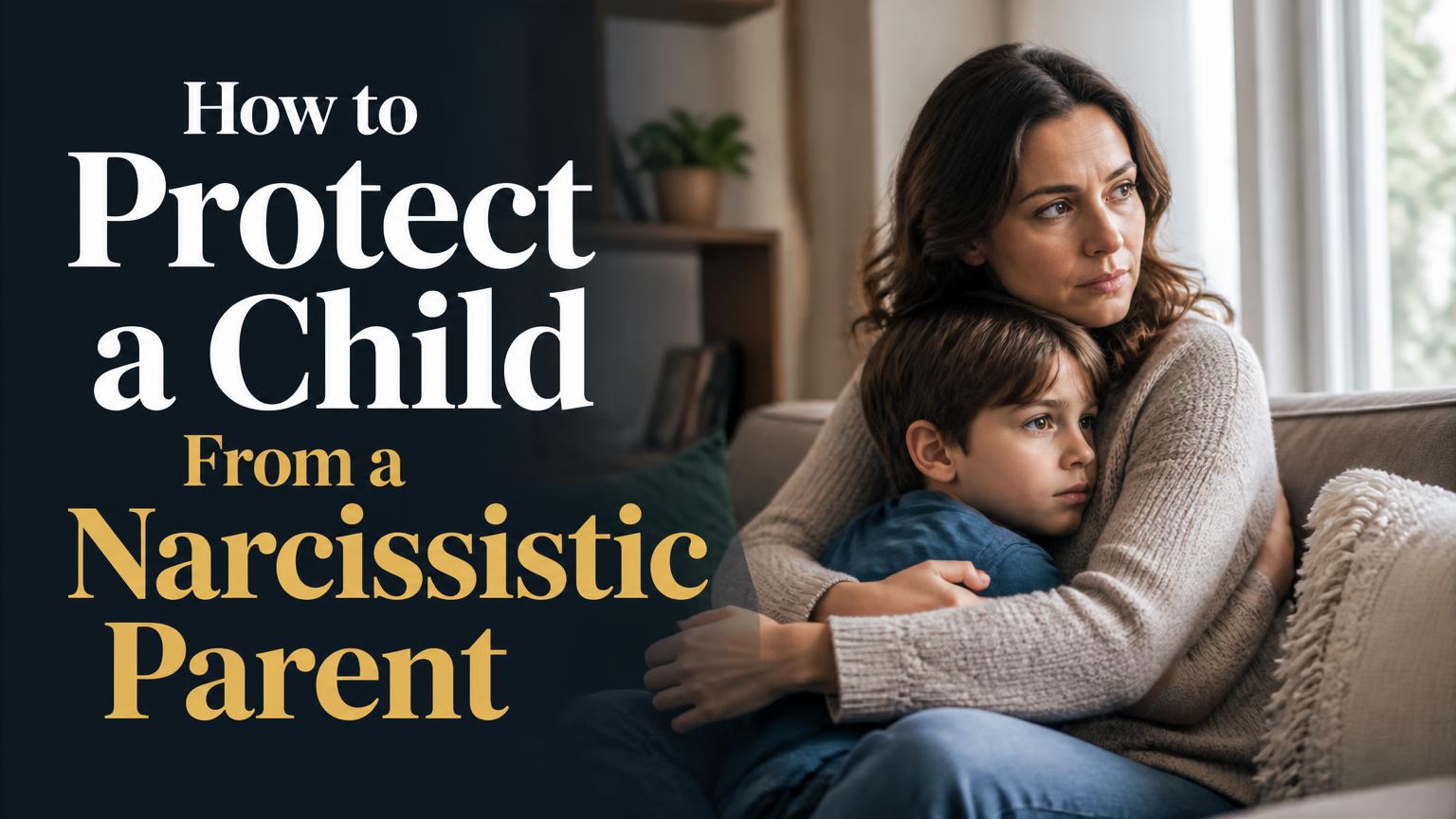
Protecting a child from a narcissistic parent involves creating a safe, emotionally supportive environment, recognizing harmful parenting behaviors, teaching healthy relationship skills, and taking appropriate action when the child’s well-being is threatened. The goal is not necessarily to eliminate the child’s relationship with the other parent, but to reduce exposure to harmful behavior and strengthen the child’s emotional security.
A parent who consistently demands admiration, dismisses feelings, uses guilt to control behavior, or makes affection conditional can affect a child’s confidence and sense of safety. However, narcissistic traits do not automatically mean someone has narcissistic personality disorder, and a diagnosis alone does not establish that a parent is abusive.
What matters most is how the parent behaves toward the child, how those behaviors affect the child, and what protective measures are available. Understanding these distinctions helps caregivers respond effectively without placing the child in the middle of adult conflict.
How to Protect a Child From a Narcissistic Parent
Protecting a child requires more than recognizing problematic behavior. It involves consistent actions that help the child feel secure, understand appropriate treatment, develop independence, and maintain healthy relationships.
The following strategies address common challenges associated with highly self-centered, emotionally controlling, or manipulative parenting.
1. Create a Stable and Emotionally Safe Home Environment
A predictable home environment gives children a reliable foundation when another parent’s behavior is inconsistent or emotionally unsettling.
Children benefit from knowing that their basic needs will be met, their feelings will be taken seriously, and mistakes will not threaten their caregiver’s affection.
Establish regular routines around meals, schoolwork, bedtime, and family activities. Maintain reasonable expectations and explain household rules clearly.
Emotional stability also requires consistency in how adults respond to difficulties. If a child receives a poor grade, for example, focus on understanding what happened and identifying ways to improve rather than criticizing the child’s intelligence or character.
A stable environment cannot erase every harmful experience, but it can provide an important source of security and demonstrate that relationships do not have to depend on fear, approval, or perfection.
2. Validate the Child’s Feelings Without Attacking the Other Parent
Children may struggle to understand their emotions when a parent regularly dismisses, mocks, or contradicts their experiences.
If a child says a parent made them feel worthless, avoid minimizing the experience or immediately offering explanations for the parent’s behavior.
Instead, acknowledge the child’s emotional response:
- “It makes sense that you felt hurt when that happened.”
- “You are allowed to feel upset, even when someone disagrees with you.”
- “Your feelings matter, and we can talk about what happened.”
- “Adults are responsible for how they treat children.”
Validation does not require agreeing with every interpretation of an event. It means recognizing the child’s experience while helping them understand the situation accurately.
Avoid responding with statements such as “Your father is a narcissist” or “Your mother only cares about herself.” Such comments may intensify loyalty conflicts and make the child feel responsible for choosing sides.
Focus on the behavior rather than labeling the parent. A child can learn that humiliation is unacceptable without being encouraged to hate the person who humiliated them.
3. Teach the Child That Love Should Not Depend on Performance
Some parents make children feel valued primarily when they achieve something, obey without question, or reflect positively on the parent.
A child exposed to this pattern may begin to associate love with achievement, compliance, or meeting someone else’s emotional needs.
Counter this message by demonstrating unconditional care.
Celebrate accomplishments without making them the foundation of the child’s worth. Offer affection during ordinary moments, including when the child has made mistakes or disappointed someone.
For example, when a child loses a competition, emphasize effort, enjoyment, and learning rather than treating the outcome as a personal failure.
Explain that people can feel disappointed, angry, or frustrated with one another while continuing to care about each other.
This distinction helps children understand that disagreement and imperfection do not automatically threaten a healthy relationship.
4. Establish Appropriate Boundaries Around Harmful Behavior
Boundaries protect children by defining acceptable conduct and clarifying what a caregiver will do when behavior becomes harmful.
The appropriate response depends on the child’s age, the seriousness of the conduct, existing custody arrangements, and whether the parent respects limits.
Examples include:
- Ending a telephone conversation when a parent begins insulting or threatening the child, when the caregiver has the authority to do so.
- Declining to use the child as a messenger during parental disagreements.
- Keeping adult financial disputes and relationship problems away from the child.
- Preventing the disclosure of private information that could expose the child to retaliation or humiliation.
- Seeking professional or legal guidance when repeated behavior creates emotional or physical safety concerns.
A boundary should describe an action within the protective caregiver’s control rather than demand a personality change from the other parent.
For instance, “I will discuss scheduling directly with you rather than through our child” establishes a practical limit.
Where custody orders apply, caregivers should obtain appropriate legal advice before making unilateral changes to contact arrangements, except where immediate protective action is necessary.
5. Avoid Making the Child Responsible for Adult Emotions
A child should not have to manage a parent’s anger, loneliness, self-esteem, or relationship problems.
Some children experience parentification, a pattern in which they take on emotional or practical responsibilities that exceed what is appropriate for their developmental stage.
A parent might repeatedly tell a child that they are the only person who understands them or that the parent’s happiness depends on the child’s loyalty.
Children exposed to such expectations may suppress their own needs to keep the parent emotionally satisfied.
Help the child understand that adults are responsible for managing adult problems.
Explain that they can care about a parent without being responsible for fixing that parent’s feelings, relationships, or personal difficulties.
A useful message is: “You can love someone and still say no to something that makes you uncomfortable.”
Children should also know that they can seek help from a trusted adult when an interaction feels overwhelming.
6. Strengthen the Child’s Confidence and Independent Identity
A highly controlling parent may discourage independence, criticize personal preferences, or treat the child’s achievements as reflections of the parent’s status.
Children need opportunities to discover their own interests, values, strengths, and opinions.
Encourage age-appropriate choices about hobbies, friendships, clothing, activities, and personal goals. Support interests even when they differ from family expectations.
Avoid making every decision for the child in an attempt to compensate for the other parent’s controlling behavior.
Instead, offer choices within reasonable limits and allow manageable mistakes.
For example, a teenager choosing an extracurricular activity should have room to express genuine preferences rather than automatically following a parent’s ambitions.
Developing independence helps children recognize that they are separate individuals whose identities do not depend entirely on parental approval.
7. Teach Healthy Communication and Relationship Skills
Children often learn relationship patterns by observing how adults communicate.
If a parent regularly interrupts, insults, blames, or dismisses others, the child may come to regard those behaviors as normal.
Demonstrate alternatives through everyday interactions.
Show the child how to express disagreement respectfully, apologize after making mistakes, listen without interrupting, and ask for clarification when confused.
Explain the difference between respectful disagreement and personal attacks.
For example:
“I disagree with your decision” addresses a specific issue.
“You are useless and always disappoint me” attacks a person’s worth.
Children can also learn simple responses to uncomfortable interactions, such as “I don’t like being called that” or “I need a break from this conversation.”
However, children should not be expected to confront an intimidating parent or manage potentially abusive situations independently. When speaking up could lead to retaliation, seeking help from a safe adult is more appropriate.
8. Protect the Child From Parental Conflict and Loyalty Tests
A child may feel pressured to demonstrate loyalty when parents criticize each other, compete for affection, or demand information about the other household.
These situations can create anxiety because the child may believe that loving one parent means betraying the other.
Avoid asking the child to report on the other parent’s private life, carry hostile messages, or decide which adult is right.
If the child describes something concerning, listen carefully without turning the conversation into an investigation designed to prove a point.
Reassure the child that relationships with parents are not competitions.
For example, explain that enjoying time with one parent does not mean loving the other parent less.
Where contact is safe, allow the child to form their own understanding of each parent without pressure to adopt an adult’s judgment.
Protecting children from loyalty conflicts does not mean concealing abuse or insisting that both parents behave equally well. It means addressing harmful conduct without making the child responsible for the dispute.
9. Maintain Supportive Relationships Outside the Immediate Family
Children benefit from relationships with trustworthy adults who provide encouragement, perspective, and emotional support.
Grandparents, relatives, teachers, coaches, mentors, and family friends may offer additional examples of respectful relationships.
These connections can be particularly valuable when a child experiences criticism or unpredictable treatment at home.
Encourage friendships and participation in activities that promote belonging and competence.
Avoid isolating the child from supportive people merely because family relationships are strained.
If a parent attempts to restrict appropriate social connections or monitor every interaction, consider whether the behavior is part of a broader pattern of control.
The objective is not to recruit people against the parent. It is to ensure the child has a healthy support network and knows where to seek help.
10. Document Serious Concerns and Seek Appropriate Intervention
When harmful behavior is repeated or escalating, accurate documentation can help caregivers recognize patterns and communicate concerns to professionals.
Record significant incidents factually, including dates, observable behavior, the child’s spontaneous statements, and any immediate consequences.
Distinguish direct observations from interpretations.
For example, “The child reported being called stupid after receiving a low grade” is more useful than “The parent was deliberately destroying the child’s confidence.”
Preserve relevant messages or other records lawfully, and avoid repeatedly questioning the child or encouraging rehearsed accounts.
If the child shows persistent distress, a qualified child mental health professional may help assess their needs and provide appropriate support.
Where there are credible concerns about abuse, threats, or neglect, contact the relevant child protection service or seek legal guidance. Immediate danger requires urgent assistance from local emergency services.
Documentation should support protection and informed decision-making, not turn the child into a witness in an ongoing parental battle.
How Narcissistic Parenting Can Affect a Child
Narcissistic parenting is an informal description of parenting patterns associated with pronounced self-centeredness, entitlement, a strong need for admiration, or limited responsiveness to a child’s emotional needs.
It is not a separate clinical diagnosis.
Narcissistic personality disorder is a recognized mental health condition that requires professional assessment. A parent can exhibit harmful behavior without having the disorder, and a diagnosis does not establish how that person treats their child.
The potential effects depend on the behavior’s frequency, intensity, duration, the child’s developmental stage, and the presence of protective relationships.
Emotional Insecurity and Low Self-Esteem
Repeated criticism, humiliation, or conditional affection may undermine a child’s confidence.
Some children become unusually sensitive to mistakes or constantly seek reassurance that they have performed well enough.
Others may respond with anger, withdrawal, or resistance.
These reactions are not unique to narcissistic parenting and should be understood in the context of the child’s broader circumstances.
Difficulty Recognizing Personal Needs
When a parent’s preferences consistently dominate family life, a child may learn to ignore their own feelings to avoid conflict.
Over time, this can make it harder to express disagreement, ask for help, or recognize when someone crosses a personal boundary.
Providing opportunities for independent decision-making and respectful disagreement can help counter these patterns.
Anxiety Around Unpredictable Reactions
Children may become watchful when a parent’s response changes dramatically depending on mood, perceived disrespect, or expectations.
They might avoid discussing ordinary mistakes or become excessively concerned about keeping everyone happy.
A consistent caregiver can reduce some of this uncertainty by offering predictable reactions and clear expectations.
Confusion About Healthy Relationships
Children who frequently encounter blame, guilt, or emotional pressure may struggle to distinguish care from control.
For example, a child might interpret possessiveness as evidence of love or believe that disagreement justifies punishment.
Age-appropriate discussions about respect, privacy, autonomy, and accountability can help establish healthier expectations.
These outcomes are possibilities, not inevitable consequences. Children respond differently, and supportive relationships can substantially influence their development.
Recognizing Harmful Parenting Without Mislabeling Ordinary Conflict
Not every self-centered or emotionally immature parental behavior indicates narcissism or abuse.
Parents sometimes become defensive, react poorly to stress, make unfair decisions, or fail to acknowledge their children’s feelings. Isolated mistakes should be considered alongside the parent’s overall behavior and willingness to take responsibility.
More concerning patterns include repeated humiliation, intimidation, threats, manipulation through guilt, persistent disregard for the child’s needs, and punishment for expressing independent opinions.
The distinction is not simply whether a parent behaves badly, but whether the behavior is recurring, harmful, and accompanied by a lack of meaningful repair or accountability.
| Parenting Behavior | What to Consider |
|---|---|
| Occasional criticism followed by an apology and changed behavior | May reflect an ordinary parenting mistake |
| Repeated insults about intelligence, appearance, or worth | Raises concerns about emotional mistreatment |
| Age-appropriate rules and consequences | Can be part of responsible parenting |
| Threats, humiliation, or punishment for expressing feelings | May indicate emotionally abusive behavior |
| Wanting appreciation from a child | Not inherently harmful |
| Demanding that a child manage the parent’s emotional needs | May create inappropriate emotional responsibility |
| Disagreement about parenting decisions | Does not by itself establish narcissism or abuse |
| Using a child to threaten, punish, or control another parent | Can be part of a harmful or coercive pattern |
The most useful assessment focuses on observable behavior, its effects, and whether the child is safe.
How to Co-Parent With a Parent Who Displays Narcissistic Traits
Co-parenting can become difficult when one parent repeatedly ignores agreements, creates conflict, or uses the child to influence the other adult.
The goal is to establish workable arrangements that protect the child rather than attempting to change the other parent’s personality.
Where cooperation is possible, communicate directly about practical matters such as school schedules, healthcare, transportation, and activities.
Written communication may reduce misunderstandings and provide a reliable record of agreements. Keep messages factual, brief, and focused on the child’s needs.
Avoid prolonged arguments about motives or personal character.
When collaborative co-parenting repeatedly leads to conflict, parallel parenting may be an alternative. This arrangement limits unnecessary interaction between parents while maintaining clear responsibilities, schedules, and communication procedures.
Parallel parenting is not appropriate for every family and does not resolve abuse or safety concerns. Existing court orders and the child’s needs must guide any arrangement.
When a parent uses threats, intimidation, stalking, or coercive control, ordinary communication strategies may be inadequate. Specialized legal and safety support may be necessary.
What to Do When a Child Defends or Idealizes the Harmful Parent
Children may defend a parent who treats them poorly, minimize upsetting experiences, or continue seeking that parent’s approval.
This does not necessarily mean the child is unaware of the behavior or that the behavior is harmless.
Children often want to preserve attachment to their parents. They may also have positive experiences with a parent whose behavior is sometimes harmful.
Avoid demanding that the child acknowledge the parent’s faults.
Instead, remain available, respond calmly to disclosures, and help the child identify specific behaviors that are acceptable or unacceptable.
If the child says, “Dad only shouted because I made him angry,” a caregiver might respond, “Adults can feel angry, but they are still responsible for how they speak to children.”
This approach corrects the harmful assumption without forcing the child to reject the parent.
Children should not have to choose between acknowledging mistreatment and maintaining affection for someone important to them.
When Professional or Legal Protection May Be Necessary
Support becomes particularly important when a child’s emotional or physical safety is at risk.
Persistent fear of a parent, severe withdrawal, significant changes in functioning, repeated humiliation, threats, or disclosures of abuse warrant careful attention.
A child mental health professional can assess emotional and behavioral concerns without assuming that a particular parental diagnosis explains them.
For custody or visitation disputes, a family law professional can clarify available protective measures and the legal requirements that apply.
Depending on the jurisdiction and circumstances, options may include modified contact arrangements, supervised visitation, protective orders, or involvement from child protection authorities.
A child should not be pressured to attend joint counseling or confront a parent when doing so could increase intimidation or retaliation.
If abuse is suspected, prioritize immediate safety, appropriate professional assessment, and lawful protective action over attempts to persuade the parent to admit wrongdoing.
Can a Child Have a Healthy Relationship With a Narcissistic Parent?
A child may maintain a positive or meaningful relationship with a parent who has narcissistic traits, particularly when that parent can respect the child’s needs, accept limits, and take responsibility for harmful behavior.
The presence of personality traits alone does not determine the quality or safety of the relationship.
However, a healthy relationship requires more than occasional affection or enjoyable experiences. The parent must also demonstrate adequate emotional responsiveness, respect for the child’s developing independence, and behavior that does not expose the child to ongoing harm.
If a parent consistently refuses accountability or engages in abusive conduct, preserving contact at any cost should not take priority over the child’s safety.
The appropriate level of contact depends on the actual circumstances, professional assessment where needed, and applicable legal arrangements.
Conclusion
Protecting a child from a narcissistic parent means focusing on the child’s safety, emotional security, independence, and healthy development rather than attempting to prove or change the parent’s diagnosis.
Consistent affection, emotional validation, appropriate boundaries, supportive relationships, and protection from adult conflict can help reduce the effects of harmful parenting.
The central distinction is between a parent’s personality traits and their actual behavior. When behavior becomes threatening, abusive, or persistently damaging, protection may require professional intervention or legal safeguards. Throughout the process, the child’s needs and well-being must remain the priority.