
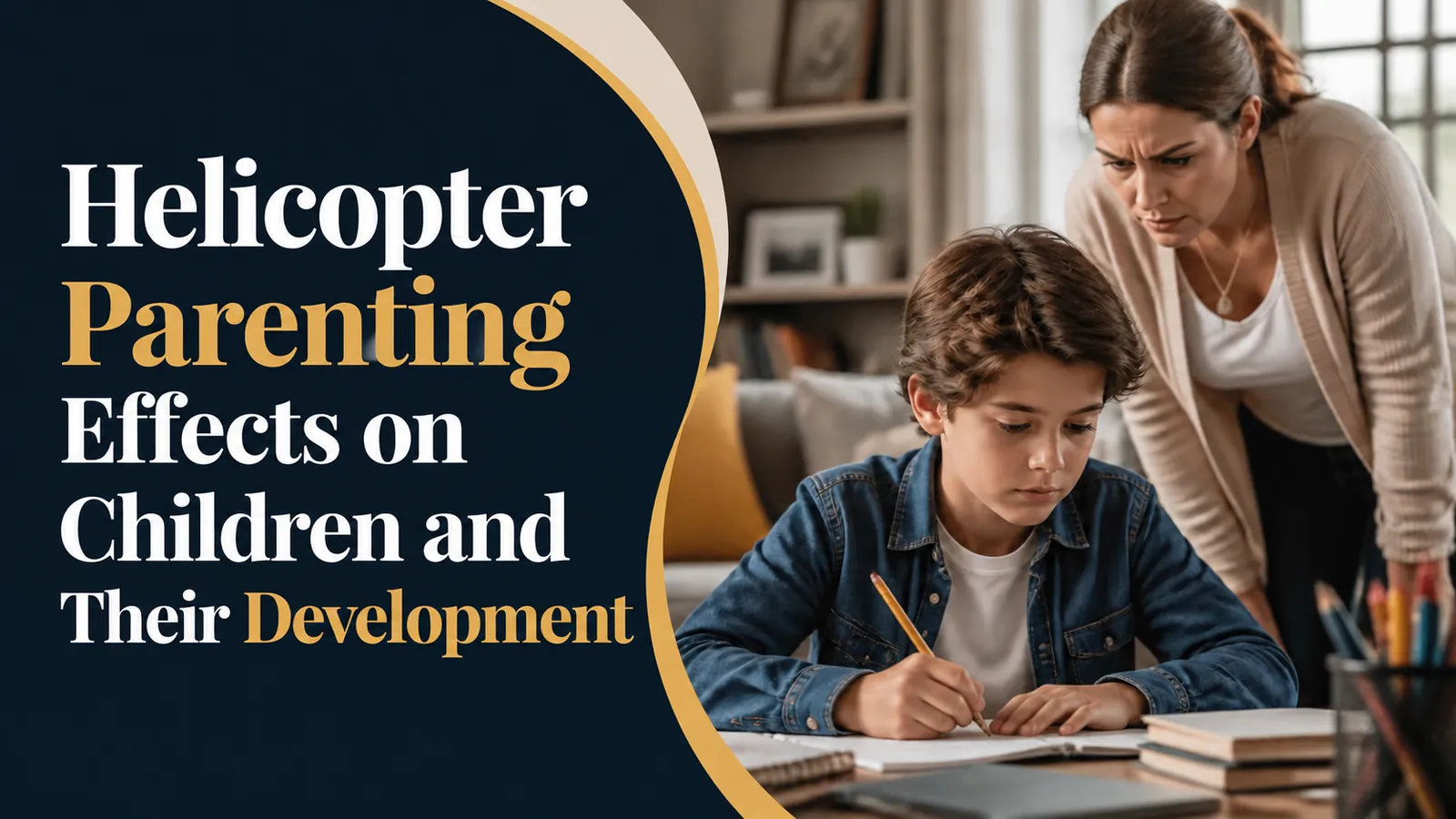
Helicopter parenting can affect children’s emotional well-being, independence, confidence, and ability to handle everyday challenges. Although this parenting style often comes from a desire to protect children and help them succeed, excessive involvement can limit opportunities to develop essential life skills.
The effects of helicopter parenting depend on the child’s age, temperament, circumstances, and the extent of parental control. Supportive involvement can benefit children, but consistently making decisions for them, preventing ordinary mistakes, or intervening whenever difficulties arise may interfere with their development.
Understanding these effects helps distinguish healthy parental guidance from overprotective behavior that can undermine a child’s growing autonomy.
Helicopter Parenting Effects on Children
Helicopter parenting is characterized by excessive parental involvement, monitoring, and intervention in a child’s activities, decisions, and problems. Parents may closely supervise schoolwork, manage friendships, resolve conflicts, or make decisions that children could reasonably handle themselves.
Research has linked overcontrolling parenting with several developmental difficulties, particularly in emotional regulation, autonomy, and psychological adjustment. However, many findings are correlational, meaning they do not establish that helicopter parenting directly causes every associated outcome.
1. Reduced Independence and Autonomy
One of the most significant potential effects of helicopter parenting is reduced independence.
Children develop autonomy by making age-appropriate decisions, accepting responsibility, and learning from the consequences of their actions. When parents consistently take over these experiences, children have fewer opportunities to practice managing their own lives.
For example, a parent who always organizes a child’s homework schedule may unintentionally prevent the child from developing personal planning skills.
Over time, some children become accustomed to relying on parental direction, even when they are capable of acting independently.
This does not mean children should be left to manage situations beyond their developmental abilities. Independence develops most effectively when parents provide appropriate support while gradually transferring responsibility.
2. Increased Anxiety and Emotional Distress
Helicopter parenting has been associated with higher levels of anxiety and other internalizing difficulties in some studies.
One possible explanation involves how children interpret parental intervention. When adults repeatedly step in to prevent ordinary problems, children may receive the unintended message that challenges are dangerous or that they cannot manage difficulties without help.
A child whose parents continually intervene in minor social disagreements, for instance, may have fewer opportunities to discover that uncomfortable conversations can be resolved independently.
However, the relationship can work in both directions. Parents may become more protective because their children already experience anxiety, emotional difficulties, or heightened sensitivity to stress.
Consequently, helicopter parenting should not be treated as the sole explanation for childhood anxiety.
3. Lower Self-Confidence and Self-Efficacy
Self-efficacy refers to a person’s belief in their ability to accomplish tasks and manage challenges.
Children develop this belief partly through successful experiences that require personal effort.
When parents routinely complete difficult tasks, make decisions, or remove obstacles, children may miss opportunities to experience their own competence.
Consider a child who struggles with a school assignment. A parent who offers guidance while allowing the child to solve the problem supports skill development. A parent who completes the assignment removes that opportunity.
The distinction matters because confidence develops through experience, not simply through reassurance.
Children need evidence that they can handle challenges. Repeatedly overcoming manageable difficulties helps provide that evidence.
4. Difficulty Managing Emotions
Emotional regulation involves recognizing, understanding, and managing emotional responses.
Children gradually develop these abilities through interactions with caregivers and experiences involving frustration, disappointment, uncertainty, and conflict.
Helicopter parenting may interfere with this process when parents consistently remove emotionally uncomfortable situations before children can practice responding to them.
For example, immediately changing the rules of a game whenever a child becomes upset may prevent opportunities to practice tolerating disappointment.
Supportive parenting takes a different approach. Parents acknowledge feelings, provide reassurance when needed, and help children develop appropriate responses without automatically eliminating every source of discomfort.
Importantly, children should not be expected to regulate overwhelming emotions without support. Emotional independence develops through repeated experiences of appropriate assistance followed by increasing personal responsibility.
5. Weaker Problem-Solving and Decision-Making Skills
Problem-solving requires identifying a difficulty, considering possible solutions, evaluating consequences, and selecting an appropriate response.
These abilities improve through practice.
When parents routinely solve problems on behalf of their children, opportunities for independent reasoning become limited.
A teenager whose parent always negotiates disagreements with teachers, for example, may reach adulthood with relatively little experience communicating concerns to authority figures.
This can become particularly noticeable during transitions into higher education, employment, or independent living.
Parents can encourage problem-solving by asking questions such as, “What options have you considered?” or “What do you think might happen if you choose that approach?”
Such questions promote independent thinking while keeping parental guidance available.
6. Greater Dependence on Parental Approval
Excessive parental involvement may encourage some children to rely heavily on external reassurance before making decisions.
This can happen when parents frequently evaluate choices, correct minor mistakes, or communicate that there is one acceptable way to complete a task.
Children may begin seeking confirmation even when they already possess the necessary knowledge or skills.
For example, an adolescent might repeatedly ask a parent to approve routine clothing choices, academic decisions, or social plans rather than developing personal judgment.
Parental approval is naturally important to children. The concern arises when the need for reassurance becomes so strong that it interferes with ordinary independent functioning.
7. Difficulties Developing Resilience
Resilience involves adapting to setbacks, recovering from difficulties, and continuing to function when circumstances are challenging.
Children build resilience through a combination of supportive relationships, coping skills, and manageable experiences of adversity.
When parents attempt to eliminate every obstacle, children may have fewer opportunities to practice recovering from disappointment or adjusting their approach after failure.
For instance, a child who is never allowed to experience the consequences of forgetting a nonessential school item may have fewer opportunities to develop strategies for remembering responsibilities.
Nevertheless, resilience does not require exposing children to unnecessary danger, humiliation, or severe distress.
The goal is to allow manageable challenges while maintaining a reliable foundation of emotional and practical support.
8. Strained Parent-Child Relationships
Helicopter parenting can create tension when children perceive parental involvement as intrusive or controlling.
This may become especially apparent during adolescence, when the desire for privacy and personal decision-making typically increases.
Parents may interpret frequent monitoring as an expression of care, while teenagers may experience the same behavior as a lack of trust.
Disagreements can develop around friendships, academic performance, technology use, and personal choices.
Some children respond through open resistance. Others avoid conflict by withholding information or appearing compliant while privately making different decisions.
These outcomes are not inevitable. Warmth, respectful communication, and willingness to adjust parental involvement can help preserve trust.
9. Reduced Social Confidence and Conflict-Resolution Experience
Social competence develops partly through interacting with peers, negotiating disagreements, and learning how relationships work.
Parents who intervene in every friendship problem may unintentionally limit these experiences.
A child whose parent routinely contacts other parents to resolve minor disputes may have fewer opportunities to practice expressing concerns, apologizing, negotiating, or accepting that friendships sometimes involve disappointment.
Over time, limited practice can make independent social situations feel more intimidating.
However, parental intervention remains appropriate when children face bullying, serious exclusion, threats, exploitation, or situations beyond their ability to manage safely.
The developmental objective is not to leave children alone with every social problem, but to distinguish ordinary disagreements from circumstances requiring adult protection.
10. Challenges During the Transition to Adulthood
The effects of helicopter parenting may become particularly visible when young adults encounter responsibilities previously managed by their parents.
These responsibilities can include scheduling appointments, managing finances, resolving academic problems, communicating with employers, and organizing daily routines.
Young adults who have had limited opportunities to practice these tasks may initially struggle with independent living.
Some may continue relying heavily on parents for decisions that their peers increasingly manage themselves.
Others may experience conflict as they attempt to establish greater autonomy.
Nevertheless, developmental skills remain learnable. Young adults can strengthen independence through gradual responsibility, practical experience, and supportive relationships.
How Helicopter Parenting Affects Children at Different Ages
The consequences of excessive parental involvement vary according to developmental stage. Behavior that is appropriate for a young child may become unnecessarily restrictive as that child matures.
| Developmental Stage | Potential Effects of Excessive Parental Control |
|---|---|
| Early childhood | Fewer opportunities to practice simple choices, tolerate frustration, and attempt tasks independently |
| Elementary school years | Reduced practice with organization, responsibility, peer disagreements, and problem-solving |
| Adolescence | Increased conflict over privacy, decision-making, identity, and independence |
| College and young adulthood | Difficulty managing responsibilities, setbacks, and decisions without parental assistance |
These are potential patterns rather than predictable outcomes for every child.
A preschooler naturally requires close supervision and considerable assistance. An older teenager generally needs greater decision-making freedom, although safety, maturity, and individual support needs remain relevant.
Effective parenting adjusts the balance between guidance and autonomy as children develop.
Why Helicopter Parenting Can Interfere With Development
The developmental concern is not parental involvement itself. It is the possibility that excessive intervention replaces experiences children need in order to become capable and independent.
Three mechanisms help explain this relationship.
Reduced Opportunities for Mastery
Mastery experiences occur when children successfully complete tasks through their own efforts.
A child who learns to prepare a schoolbag, resolve a manageable disagreement, or complete a difficult project gains practical skills and evidence of personal competence.
When parents repeatedly take over these tasks, children may receive the benefit of a successful outcome without acquiring the experience that produced it.
Limited Tolerance for Uncertainty and Mistakes
Learning often involves uncertainty, frustration, and imperfect results.
Children who are permitted to make manageable mistakes can discover that errors are usually correctable and that disappointment does not necessarily signal failure.
Excessive parental protection may restrict opportunities to develop this understanding.
The issue is not whether parents should prevent serious mistakes. It is whether preventing every minor mistake deprives children of valuable learning experiences.
Interference With Developing Autonomy
Autonomy means having an appropriate degree of personal choice and ownership over one’s actions.
Children need opportunities to develop preferences, evaluate options, and make decisions within reasonable limits.
Highly controlling parenting may reduce their sense of ownership, particularly when parental expectations consistently override personal interests or judgment.
This can affect motivation as well as independence. A child who studies only because a parent supervises every assignment may have difficulty developing self-directed learning habits.
Helicopter Parenting vs. Supportive Parenting
Helicopter parenting should not be confused with being attentive, involved, or protective.
Supportive parents remain interested in their children’s lives, establish reasonable expectations, provide emotional reassurance, and intervene when necessary.
The difference concerns how much responsibility parents assume and whether their involvement supports or replaces the child’s developing abilities.
| Situation | Helicopter Parenting | Supportive Parenting |
|---|---|---|
| Homework difficulty | Takes over or repeatedly corrects the work | Explains concepts and encourages independent effort |
| Friendship disagreement | Immediately contacts others to resolve the issue | Helps the child consider possible responses |
| Making decisions | Chooses on the child’s behalf unnecessarily | Offers guidance and age-appropriate choices |
| Experiencing failure | Attempts to prevent every disappointing outcome | Helps the child learn and recover |
| Managing responsibilities | Constantly monitors and organizes tasks | Gradually transfers responsibility |
| Encountering challenges | Removes obstacles whenever possible | Provides assistance proportionate to the difficulty |
Supportive parenting does not require withholding help. A child with a disability, developmental difference, significant anxiety, or another support need may require more direct assistance than peers of the same age.
The relevant question is whether parental involvement matches the child’s actual needs while supporting as much autonomy as reasonably possible.
Can Helicopter Parenting Have Positive Effects?
Some behaviors associated with helicopter parenting, such as close attention, frequent communication, and active participation in education, can be beneficial when practiced appropriately.
Children often benefit from knowing that their parents are available, interested, and willing to provide assistance.
Parental involvement can help identify academic difficulties, protect children from genuine threats, and connect them with necessary resources.
However, these benefits should not be attributed automatically to excessive control.
Research distinguishing parental warmth and support from intrusive or overcontrolling behavior suggests that the quality and form of involvement matter.
A parent can be highly involved without being overprotective.
Similarly, frequent communication is not necessarily intrusive if children experience it as respectful, supportive, and appropriate to their circumstances.
The objective is therefore not minimal involvement, but involvement that promotes competence rather than unnecessary dependence.
What Factors Influence the Effects of Helicopter Parenting?
Not every child exposed to overprotective parenting experiences the same developmental outcomes.
Several factors can influence the relationship between parenting behavior and adjustment.
Child temperament: Children differ in sensitivity, confidence, emotional reactivity, and willingness to approach unfamiliar situations. These differences can influence both how parents respond and how children experience that response.
Age and developmental abilities: The same degree of supervision can be appropriate for one developmental stage and restrictive for another.
Parental warmth: Control accompanied by affection and responsiveness may be experienced differently from control accompanied by criticism, hostility, or rejection. Warmth does not necessarily eliminate the disadvantages of excessive control.
Family circumstances: Safety concerns, disability-related needs, financial pressures, and environmental risks can change what constitutes reasonable supervision.
Cultural expectations: Families and communities differ in their expectations regarding interdependence, family obligations, and individual decision-making. Cultural context matters, although it does not automatically make intrusive behavior beneficial or harmful.
Direction of influence: Children can influence parenting behavior. For example, a child experiencing substantial difficulties may prompt greater parental monitoring, making it difficult to determine which behavior developed first.
These factors explain why research findings should be interpreted as patterns across groups rather than predictions about individual children.
How Parents Can Reduce the Negative Effects of Helicopter Parenting
Parents who recognize overly controlling habits can gradually change how they provide support. The objective is to maintain a caring relationship while allowing children more opportunities to develop competence.
Give Children Age-Appropriate Responsibilities
Begin with tasks children can reasonably manage, such as preparing school materials, organizing personal belongings, or communicating about simple problems.
As competence improves, increase responsibility.
Parents can remain available for assistance without supervising every detail.
Allow Manageable Mistakes
Distinguish between mistakes that present serious risks and those that offer ordinary learning opportunities.
Forgetting a minor item, making an imperfect choice, or receiving constructive criticism may provide useful experience.
Afterward, discuss what happened and what the child might do differently, rather than immediately taking control.
Replace Immediate Intervention With Guidance
Before solving a problem, consider whether the child can attempt a solution independently.
Ask what they have already tried, what options they see, and what assistance they actually need.
If the task remains beyond their abilities, provide more direct help.
This approach gradually transfers responsibility instead of treating independence as an all-or-nothing expectation.
Respect Growing Privacy and Decision-Making
Older children and adolescents generally benefit from increasing opportunities to make personal choices.
Parents can establish clear limits involving safety and important family responsibilities while allowing flexibility in lower-risk decisions.
Explaining the reasons for necessary restrictions can also reduce the perception that parental authority is arbitrary.
Respond to Difficult Emotions Without Removing Every Challenge
When children become frustrated or disappointed, acknowledge their experience and help them identify constructive responses.
A parent might say, “I understand that you’re disappointed. What would help you handle this situation?”
This communicates support without assuming that every uncomfortable experience must be eliminated.
Adjust Support to Actual Needs
Reducing helicopter parenting does not mean withdrawing assistance suddenly.
Some children need structured guidance, accommodations, or closer supervision to function successfully.
The appropriate goal is to provide enough support for meaningful participation while encouraging independence wherever practical.
Can Children Recover From the Effects of Helicopter Parenting?
Children and young adults can develop skills they have had limited opportunities to practice. Development is not fixed by earlier parenting experiences.
Someone who struggles with independent decision-making can begin with manageable choices, evaluate the results, and gradually take responsibility for more consequential decisions.
Similarly, problem-solving, emotional regulation, organization, and communication can improve through practice and appropriate support.
Progress may involve setbacks, particularly when family habits have developed over many years.
Parents can contribute by respecting growing autonomy, tolerating reasonable differences of opinion, and allowing responsibilities to shift gradually.
For individuals experiencing persistent anxiety, severe family conflict, or substantial impairment in daily functioning, professional support may help clarify the contributing factors and develop appropriate strategies.
Conclusion
Helicopter parenting can affect children’s independence, emotional regulation, confidence, resilience, and ability to manage everyday responsibilities. These effects are not inevitable, and the relationship between parental behavior and child development is influenced by individual and family circumstances.
The central distinction is between providing support and unnecessarily taking control. Children benefit from protection, guidance, and reliable relationships, but they also need opportunities to make decisions, solve problems, experience manageable setbacks, and develop confidence in their own abilities.
Effective parental involvement evolves as children grow, providing the support they need while gradually making room for greater independence.