
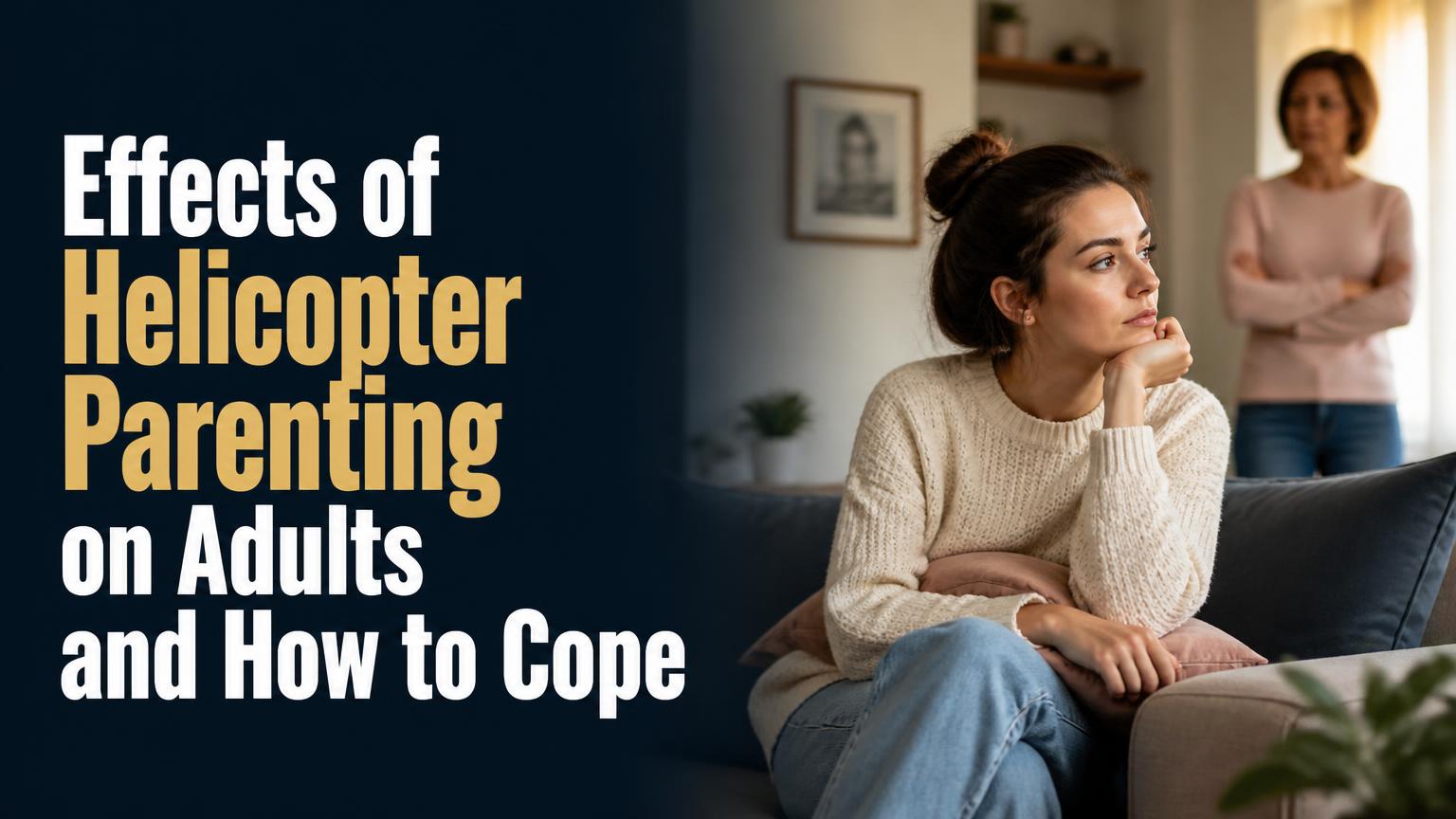
Helicopter parenting can have lasting effects on adults, particularly in their confidence, independence, decision-making abilities, and relationships. When parents remain excessively involved in their children’s lives, frequently intervene in their problems, or attempt to control important decisions, their children may have fewer opportunities to develop the skills needed for independent adulthood.
Although helicopter parenting often comes from genuine concern and a desire to protect, excessive parental involvement can make it harder for adult children to trust their judgment, tolerate uncertainty, and establish personal boundaries. Some adults experience anxiety, guilt, or difficulty making decisions without parental approval. Others struggle to balance their desire for independence with maintaining a close relationship with their parents.
These outcomes are not inevitable. The effects depend on the nature of the parenting, the individual’s experiences, and other influences. Understanding how overprotective parenting affects adult development can help individuals recognize unhelpful patterns and build greater autonomy.
Effects of Helicopter Parenting on Adults
The effects of helicopter parenting on adults often become apparent when individuals begin managing responsibilities that previously involved significant parental guidance or intervention. These effects can influence personal development, emotional well-being, professional life, and interpersonal relationships.
1. Difficulty Making Independent Decisions
Adults raised by helicopter parents may struggle to make decisions without seeking reassurance or approval.
When parents routinely select activities, resolve disagreements, manage schedules, or make important choices for their children, those children have fewer opportunities to practice evaluating alternatives and accepting the consequences of their decisions.
As adults, they may experience:
- Excessive uncertainty when making everyday decisions.
- Fear of choosing incorrectly, even when the consequences are minor.
- Repeatedly seeking parental approval before acting.
- Difficulty identifying their own preferences and priorities.
- Avoiding decisions until someone else provides direction.
For example, an adult might hesitate to accept a job offer without first consulting their parents, even when the position aligns with their professional goals.
Seeking advice from family members is not inherently problematic. The difficulty arises when reassurance becomes necessary before an individual feels capable of making reasonable decisions independently.
2. Lower Self-Confidence and Self-Efficacy
Helicopter parenting may undermine self-efficacy, which refers to a person’s belief in their ability to handle tasks and challenges successfully.
Confidence develops partly through experience. Individuals learn what they can accomplish by attempting difficult tasks, making mistakes, adjusting their approach, and eventually succeeding.
When parents consistently intervene before their children can resolve problems, they may unintentionally communicate that those children cannot manage challenges alone.
An adult who repeatedly received parental assistance with school assignments, interpersonal conflicts, or administrative responsibilities may enter adulthood with limited confidence in handling similar situations.
This does not necessarily mean the individual lacks ability. They may possess the necessary skills but doubt their capacity to use them without assistance.
Over time, this uncertainty can discourage initiative and reinforce dependence on external reassurance.
3. Increased Anxiety and Fear of Failure
Overprotective parenting has been associated with anxiety and other emotional difficulties in some studies of adolescents and emerging adults.
One possible explanation involves how individuals learn to respond to uncertainty.
When parents repeatedly remove obstacles, anticipate dangers, or prevent mistakes, children may have fewer opportunities to discover that setbacks are often manageable.
As adults, unfamiliar situations may consequently feel more threatening than they otherwise would.
Common experiences can include excessive worry about disappointing others, heightened concern about mistakes, discomfort with uncertainty, and avoidance of unfamiliar responsibilities.
However, the relationship between helicopter parenting and anxiety is not necessarily one-directional. Parents may become more protective in response to an already anxious child, and temperament, family circumstances, and other factors can influence both parenting behavior and emotional outcomes.
Helicopter parenting should therefore be understood as one possible contributing influence rather than a definitive cause of adult anxiety.
4. Difficulty Establishing Personal Boundaries
Adults with highly involved parents may find it challenging to distinguish parental concern from parental authority.
During childhood, parents generally make many decisions on behalf of their children. As children mature, that responsibility should gradually shift toward the individual.
In helicopter-parenting relationships, this transition may remain incomplete.
Parents might continue expecting detailed information about finances, relationships, career decisions, or daily activities. Adult children may feel obligated to provide that information, even when they would prefer greater privacy.
The resulting difficulties can include feeling guilty when saying no, allowing unwanted interference, or avoiding honest conversations to prevent parental disappointment.
For example, an adult may continue sharing private relationship disagreements with a parent who routinely offers unsolicited instructions about how to handle them.
The central issue is not whether parents remain involved. Healthy adult relationships can include considerable closeness and mutual support. The issue is whether involvement respects the adult child’s right to make personal decisions.
5. Reduced Problem-Solving and Coping Skills
Independent problem-solving develops through repeated experience with manageable challenges.
Children benefit from guidance, but they also need opportunities to identify problems, consider solutions, attempt different approaches, and learn from unsuccessful efforts.
Helicopter parenting can interrupt this process when parents consistently assume responsibility for resolving difficulties.
In adulthood, this may appear as:
- Becoming overwhelmed by unfamiliar administrative tasks.
- Relying heavily on others to resolve interpersonal disagreements.
- Avoiding challenging responsibilities.
- Struggling to recover emotionally from ordinary setbacks.
- Having difficulty developing alternative solutions when initial plans fail.
Consider an adult whose parents regularly contacted teachers, negotiated deadlines, and resolved school-related problems. That individual may initially find it difficult to communicate independently with an employer about workload or performance expectations.
These skills can still be learned. Limited practice during childhood does not permanently determine an adult’s ability to cope.
6. Challenges in Romantic Relationships
The effects of helicopter parenting can extend into romantic relationships, particularly when parental involvement continues into adulthood.
An adult who has learned to prioritize parental expectations may struggle to balance those expectations with the needs of a romantic partner.
Problems may arise when parents expect influence over dating choices, marriage decisions, living arrangements, or private disagreements.
For example, a parent might repeatedly criticize their adult child’s partner or expect to participate in decisions that should primarily belong to the couple.
The adult child may feel caught between maintaining parental approval and protecting the independence of the romantic relationship.
Other difficulties may include relying excessively on a partner for reassurance or struggling to express disagreement.
However, these patterns are not universal. Some adults respond to intrusive parenting by becoming highly independent or particularly protective of their privacy.
7. Dependence on External Validation
When parents frequently evaluate, correct, or direct their children’s choices, those children may learn to judge their decisions primarily through other people’s reactions.
In adulthood, this can create a strong dependence on external validation.
A person may feel satisfied with an accomplishment only after receiving approval or may question an otherwise reasonable decision because a parent disagrees.
This pattern can extend beyond family relationships into friendships, romantic partnerships, and professional environments.
For instance, an employee may repeatedly seek confirmation from a supervisor before completing tasks they are qualified to handle.
The distinction between useful feedback and excessive reassurance is important. Feedback helps individuals improve their judgment. Dependence on reassurance can prevent them from trusting that judgment.
8. Difficulty Developing a Clear Personal Identity
Adulthood involves developing personal values, interests, ambitions, and beliefs.
When parents exert substantial influence over education, career choices, friendships, and lifestyle decisions, adult children may have fewer opportunities to explore what they genuinely want.
Some individuals consequently struggle to distinguish their preferences from expectations they have internalized.
An adult might pursue a particular profession because it was strongly encouraged by their parents, only to discover later that it does not reflect their interests.
Others may experience guilt when their priorities differ from family expectations.
Developing an independent identity does not require rejecting family values. It involves deciding which values and goals to embrace through personal reflection rather than obligation alone.
9. Difficulty Handling Criticism and Setbacks
Adults who experienced frequent parental intervention may have had limited opportunities to manage disappointment independently.
If parents regularly prevented failure or immediately corrected uncomfortable situations, ordinary setbacks can initially feel unusually discouraging.
A rejected job application, workplace criticism, or unsuccessful personal project might be interpreted as evidence of personal inadequacy rather than a normal part of learning.
Some individuals respond by avoiding challenges. Others become perfectionistic, attempting to prevent mistakes that could attract criticism or disappointment.
Nevertheless, perfectionism and sensitivity to criticism have multiple possible origins. Helicopter parenting is not sufficient to explain these characteristics in every individual.
10. Career and Workplace Difficulties
Professional environments often require independent judgment, initiative, accountability, and the ability to respond constructively to feedback.
Adults who have experienced excessive parental management may initially struggle with some of these expectations.
They might hesitate to make decisions without approval, avoid taking professional risks, or become uncomfortable when supervisors provide limited direction.
In some cases, parental involvement continues into professional life through unsolicited career advice, pressure about job choices, or attempts to intervene in workplace matters.
These behaviors can create tension between an adult’s professional autonomy and family expectations.
Importantly, helicopter parenting does not necessarily lead to poor career outcomes. Some individuals raised by highly involved parents become academically successful and professionally accomplished. The more relevant question is whether they can function confidently and independently without constant external direction.
Why Helicopter Parenting Can Affect Adult Development
The potential effects of helicopter parenting are best understood through the relationship between parental involvement and opportunities for autonomy.
Children need both support and increasing responsibility. Appropriate parental guidance provides security while allowing them to develop judgment through experience.
Excessive intervention can interfere with this balance in several ways.
First, it reduces opportunities for independent practice. A child who rarely manages responsibilities alone may reach adulthood with less experience performing those tasks.
Second, it can influence beliefs about competence. Repeated parental intervention may be interpreted as evidence that challenges are too difficult to handle independently.
Third, it can reinforce reassurance-seeking. If uncertainty is consistently resolved through parental approval, seeking that approval may become a habitual response to difficult decisions.
Finally, it may complicate the transition from a parent-child authority relationship to a more equal adult relationship.
These are plausible developmental pathways, not universal outcomes. Much of the research on helicopter parenting examines associations, often using self-reported experiences, rather than establishing that parenting behavior alone caused later difficulties.
Helicopter Parenting vs. Supportive Parenting
Helicopter parenting is not the same as being loving, attentive, or involved.
The distinction concerns whether parental involvement supports growing independence or unnecessarily replaces the individual’s judgment and responsibility.
| Supportive Parenting | Helicopter Parenting |
|---|---|
| Offers advice while respecting age-appropriate decisions | Frequently directs or overrides decisions |
| Allows manageable mistakes and learning experiences | Intervenes repeatedly to prevent mistakes |
| Encourages independent problem-solving | Often resolves problems on the child’s behalf |
| Respects increasing privacy and autonomy | Expects continuing access to personal decisions |
| Provides help when appropriate or requested | May provide help without assessing whether it is needed |
| Builds confidence through guidance and practice | May unintentionally reinforce dependence |
The same parental action can have different meanings depending on context.
Helping an adult child manage a serious financial emergency may be appropriate and supportive. Taking control of every routine financial decision despite the adult child’s ability to manage independently may be intrusive.
Disability, illness, financial dependence, cultural expectations, and other circumstances can also influence what appropriate family support looks like.
The defining concern is not the amount of contact between parents and adult children, but whether the relationship allows appropriate personal autonomy.
How to Cope With the Effects of Helicopter Parenting as an Adult
Adults who recognize these patterns can develop greater independence without necessarily distancing themselves from their families.
The goal is to strengthen personal judgment, practical competence, and emotional resilience while establishing a healthier balance between support and autonomy.
Practice Making Decisions Without Immediate Reassurance
Begin with decisions that carry manageable consequences.
For example, choose a personal activity, make a routine purchase, or resolve a scheduling problem without requesting parental approval.
Before seeking advice on more significant decisions, identify the available options, consider their consequences, and determine which choice best reflects personal priorities.
Advice can still be useful. The objective is to move from needing permission toward making informed decisions independently.
Build Confidence Through Gradual Responsibility
Confidence often grows through successful experiences rather than positive thinking alone.
Identify responsibilities that have traditionally been managed by parents and begin handling them personally.
These might include scheduling appointments, managing household expenses, communicating with service providers, or addressing minor workplace problems.
Start with manageable tasks and gradually increase the level of responsibility.
Mistakes should be treated as opportunities to improve practical judgment, not as evidence that independence is impossible.
Establish Clear Boundaries With Parents
Boundaries clarify which decisions belong to the adult child and what forms of parental involvement are welcome.
A boundary might involve keeping certain relationship matters private, declining unsolicited advice, or making career decisions without seeking permission.
For example:
“I appreciate your concern about my career, but I need to make this decision myself. I’ll ask for advice if I need it.”
Effective boundaries require consistency. A parent may continue offering unwanted advice, but the adult child can decide how much information to share and whether to act on that advice.
When an adult depends on parents for housing or financial support, boundaries may require additional planning because some decisions involve shared resources or practical obligations.
Learn to Tolerate Disagreement and Disappointment
Independence sometimes means making decisions that parents dislike.
For adults accustomed to seeking approval, parental disappointment may trigger guilt or uncertainty even when their decisions are reasonable.
It helps to distinguish feeling guilty from having done something wrong.
A parent can disagree with a decision without that disagreement creating an obligation to reverse it.
Maintaining respect while accepting differences allows the relationship to develop beyond the expectation of constant agreement.
Strengthen Problem-Solving and Emotional Coping Skills
When confronted with a challenge, resist the immediate impulse to transfer responsibility to someone else.
Instead, define the problem, identify realistic options, consider possible outcomes, and choose a reasonable course of action.
Afterward, reflect on what worked and what could improve.
For emotional coping, practice recognizing uncomfortable feelings without treating them as emergencies that must be resolved immediately.
Uncertainty, disappointment, and frustration are normal parts of adult responsibility. Learning to experience these emotions while continuing to act constructively can strengthen resilience.
Seek Additional Support When Patterns Persist
Some adults find that difficulties with independence, anxiety, or family boundaries remain significant despite repeated efforts to change.
Individual counseling may help when these patterns interfere with relationships, employment, or everyday functioning.
Support can focus on developing decision-making confidence, understanding family expectations, managing anxiety, and practicing communication skills.
The purpose is not necessarily to blame parents or end family relationships. It is to help individuals develop greater freedom in how they think, act, and relate to others.
Can Helicopter Parents Change Their Behavior Toward Adult Children?
Parents can learn to adopt a less controlling approach, although change depends on their willingness to recognize and adjust their behavior.
Some parents remain heavily involved because they worry about their children’s safety or believe intervention is an expression of love. Others have difficulty adjusting to their children’s increasing independence.
Constructive change involves shifting from directing decisions to offering support when appropriate.
Parents can ask whether advice is wanted before providing it, respect privacy, allow adult children to manage consequences, and recognize that disagreement does not necessarily indicate irresponsibility.
Adult children can communicate their preferences clearly, but they cannot guarantee that parents will respond positively.
When parents resist change, the adult child’s focus may need to remain on managing their own choices, information-sharing, and responses rather than attempting to control parental behavior.
Are the Effects of Helicopter Parenting Permanent?
The effects of helicopter parenting are not necessarily permanent.
Adult development continues through new experiences, relationships, responsibilities, and opportunities for learning.
Someone who struggled with independent decision-making in early adulthood can become more confident through repeated practice. An individual who relied heavily on parental reassurance can learn to tolerate uncertainty and evaluate decisions using personal judgment.
Progress may be uneven, particularly when long-established family expectations remain in place.
It is also possible to recognize some effects of overprotective parenting while appreciating positive aspects of one’s upbringing.
The objective is not to reinterpret every childhood experience negatively, but to identify which current habits are limiting independence and determine how they can change.
Conclusion
The effects of helicopter parenting on adults can include reduced confidence, difficulty making decisions, anxiety, dependence on reassurance, challenges with personal boundaries, and complications in relationships or professional life.
These outcomes are possibilities rather than inevitable consequences, and parental involvement should not be confused with excessive control.
Adults who recognize unhelpful patterns can develop greater autonomy through independent decision-making, practical responsibility, clearer boundaries, and experience managing setbacks. A healthier relationship with parents does not require abandoning closeness. It requires allowing support and independence to coexist.