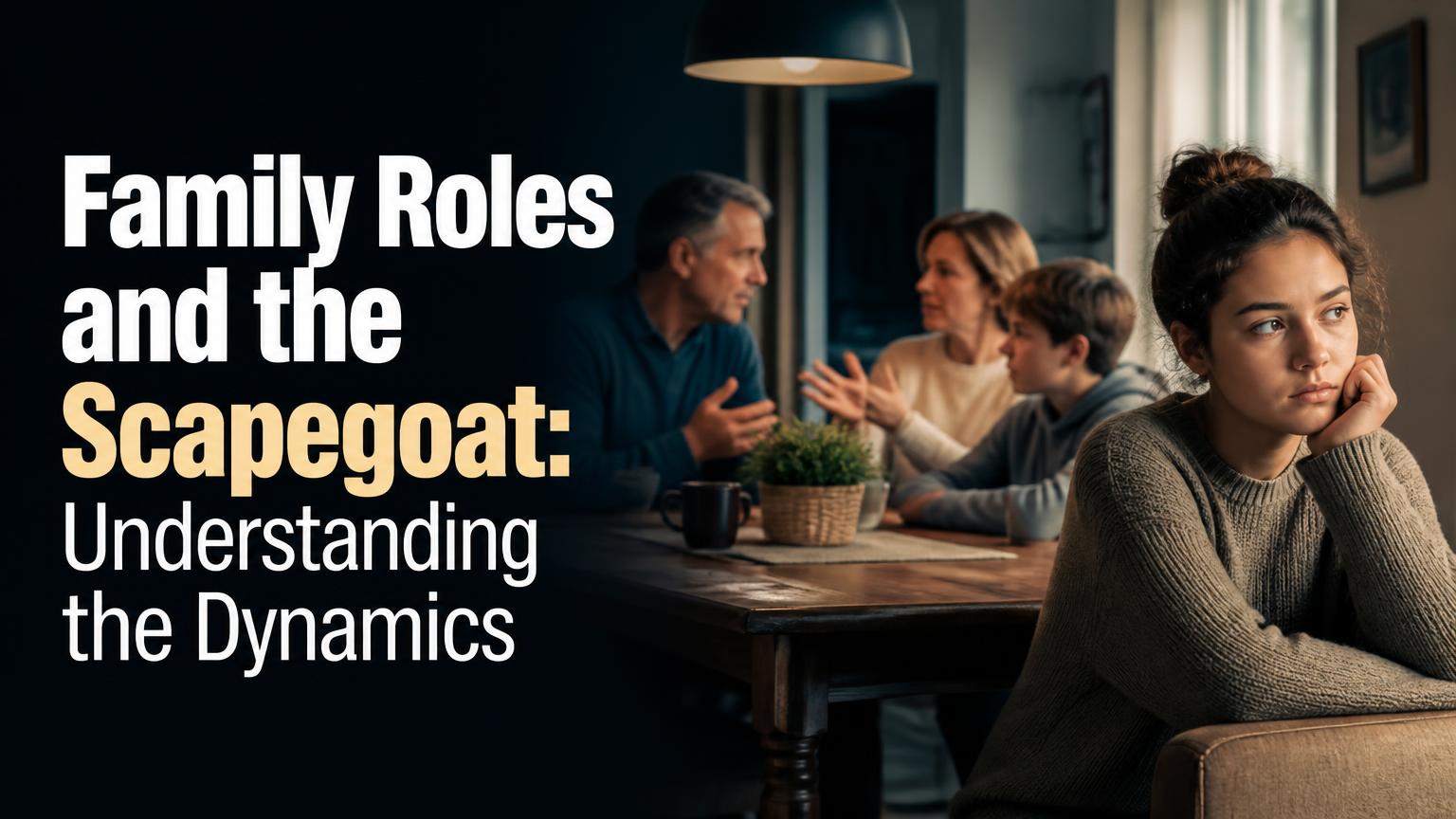
Family roles can shape how relatives communicate, resolve disagreements, distribute responsibilities, and respond to conflict. One particularly harmful pattern occurs when a single family member becomes the scapegoat—the person repeatedly blamed for problems that involve the wider family or are beyond their control.
The scapegoat role often develops in families where blame replaces accountability, criticism is unevenly distributed, or certain relationships are protected at another person’s expense. Although anyone can occasionally be blamed unfairly, persistent scapegoating can influence a person’s self-esteem, sense of belonging, and relationships long after childhood.
Understanding family roles and the scapegoat dynamic requires looking beyond individual disagreements. The central issue is how blame becomes concentrated on one person, why other family members may participate, and what can help change the pattern.
Family Roles and the Scapegoat: How the Dynamics Work
In family dynamics, the scapegoat is a person who is repeatedly assigned disproportionate responsibility for family difficulties. Their mistakes may receive intense scrutiny, their achievements may be dismissed, and conflicts involving several people may be presented as evidence that they are the source of the problem.
The scapegoat role is not a formal psychiatric diagnosis. It is a descriptive concept used to understand recurring patterns of blame and responsibility within families.
1. The Scapegoat Becomes the Family’s Identified Problem
A defining feature of scapegoating is the tendency to locate family problems in one individual rather than examining the interactions that contribute to them.
For example, parents experiencing ongoing marital conflict might focus heavily on a teenager’s behavior. The teenager may have genuine behavioral difficulties, but the family increasingly treats those difficulties as the explanation for tension throughout the household.
This creates an important distinction between holding someone accountable and scapegoating them.
Accountability involves identifying specific behavior, considering its consequences, and assigning responsibility proportionately. Scapegoating involves repeatedly interpreting broader problems through one person’s supposed faults.
The scapegoat may eventually become known as the difficult child, the troublemaker, or the family disappointment, even when their behavior does not justify such a sweeping characterization.
2. Other Family Members Reinforce the Role
Scapegoating rarely depends on one person’s actions alone. Other relatives may reinforce the pattern through criticism, silence, selective agreement, or unequal expectations.
One parent might regularly blame a child, while the other avoids intervening to prevent further arguments. Siblings may learn that agreeing with the criticism protects them from becoming targets themselves.
Over time, these responses can make the scapegoat role appear normal within the household.
Family members do not necessarily participate with deliberate harmful intentions. Some may believe the criticism is justified, while others may not recognize how their behavior contributes to the pattern.
Nevertheless, repeated participation can sustain an unfair distribution of blame.
3. The Scapegoat Is Judged by Different Standards
Unequal treatment is another common feature of scapegoating.
Consider two siblings who make similar mistakes. One receives reassurance and an opportunity to improve, while the other faces harsh criticism and reminders of previous failures.
The difference may extend beyond discipline. The scapegoated person might receive less emotional support, have their explanations dismissed, or be expected to apologize more frequently than other relatives.
Such unequal treatment can become especially damaging when the family interprets the scapegoat’s attempts to defend themselves as further evidence of their problematic character.
The person faces a difficult situation: remaining silent may allow unfair accusations to continue, while speaking up may attract additional criticism.
4. Family Members Develop Fixed Expectations
Once someone becomes identified as the family’s problem, relatives may begin interpreting new events through that established expectation.
If the scapegoat expresses frustration, others may describe them as aggressive. If they withdraw from family gatherings, relatives may call them selfish or antisocial.
Meanwhile, similar behavior from another family member may receive a more sympathetic explanation.
This pattern resembles a self-reinforcing cycle. The family expects problematic behavior, selectively notices information consistent with that expectation, and overlooks evidence that challenges it.
The scapegoated person may also respond to persistent criticism with anger, defensiveness, or withdrawal. Those responses can then be used to justify the original negative label.
The resulting cycle does not establish that the person caused the family’s underlying difficulties.
5. The Role Can Continue Into Adulthood
Family scapegoating does not necessarily end when children become independent adults.
An adult may continue to be blamed for family disagreements, excluded from important decisions, or criticized for establishing reasonable limits on family involvement.
For example, an adult daughter might decline a family gathering because of work commitments. Rather than accepting the scheduling conflict, relatives may interpret her absence as proof that she has always been inconsiderate.
Past family narratives can remain influential even when the person’s circumstances and behavior have changed considerably.
Adult scapegoating may become particularly visible during major family transitions, including marriages, caregiving arrangements, inheritance disputes, and decisions about elderly parents.
Why Does a Family Choose a Scapegoat?
Families do not always consciously choose a scapegoat. The role can emerge gradually through repeated interactions, unequal power, unresolved disagreements, and established expectations.
Several processes may contribute to its development.
Displacing Blame Away From More Difficult Problems
Some families concentrate on one person’s shortcomings because examining broader problems would require uncomfortable conversations or changes.
For example, acknowledging persistent conflict between parents may be more threatening to established family arrangements than describing one child as responsible for household tension.
Focusing on the child can temporarily redirect attention away from the marital relationship.
This does not mean every family scapegoats someone to conceal a particular problem. Rather, redirecting blame is one possible process through which the pattern develops.
Maintaining Established Family Relationships
Family systems can develop familiar ways of responding to tension. Even unhealthy patterns may persist because relatives know what to expect from one another.
If family members habitually unite in criticizing one person, that shared focus may temporarily reduce disagreements among the others.
Changing the pattern would require relatives to reconsider their own behavior and responsibilities.
Consequently, attempts by the scapegoated person to challenge their assigned role may initially meet resistance.
The resistance does not necessarily prove that everyone consciously benefits from the arrangement. Familiar expectations and reluctance to change can be sufficient to sustain it.
Favoritism and Unequal Parental Expectations
Parents sometimes hold different expectations for their children based on temperament, achievement, birth order, family circumstances, or perceived similarities to themselves.
Differences in treatment are not automatically evidence of scapegoating. Children have different needs, and fair parenting does not always mean identical treatment.
The concern arises when one child is consistently judged more harshly, assigned excessive responsibility, or denied the understanding routinely extended to siblings.
A parent might view one child as naturally responsible and another as inherently troublesome. These assumptions can shape how the parent interprets behavior, even when the children’s actions are comparable.
Conflict Over Independence and Family Expectations
Scapegoating may also develop when one family member challenges established expectations.
A person who questions family decisions, refuses an assigned responsibility, or pursues an unconventional life may attract disproportionate criticism.
However, disagreement alone does not establish scapegoating. Families can have legitimate concerns about someone’s decisions.
The distinction lies in whether criticism remains proportionate, specific, and open to discussion or becomes a persistent judgment of the person’s character regardless of the circumstances.
The Scapegoat and Other Common Family Roles
Family-role frameworks sometimes describe recurring positions that individuals occupy within a household. These labels can help explain certain patterns, but they are not universal classifications or formal clinical diagnoses.
A person may occupy several roles, change roles over time, or fit none of them.
| Family Role | Common Pattern | Relationship to the Scapegoat |
|---|---|---|
| Scapegoat | Receives disproportionate blame and criticism | Becomes identified as the source of family problems |
| Golden child | Receives unusually favorable treatment or expectations | May be contrasted with the scapegoat |
| Hero | Gains recognition through achievement and responsibility | May be praised for protecting the family’s reputation |
| Peacemaker | Attempts to reduce disagreements and restore harmony | May encourage the scapegoat to accommodate others |
| Caretaker | Takes responsibility for relatives’ emotional or practical needs | May absorb responsibilities that others avoid |
| Lost child | Withdraws or receives relatively little attention | May avoid involvement in scapegoating conflicts |
These descriptions are best understood as possible interaction patterns rather than fixed identities.
The Scapegoat and the Golden Child
The golden child and scapegoat are frequently discussed together because they illustrate contrasting forms of unequal treatment.
A favored child may receive praise, protection, and opportunities that another sibling does not. The scapegoated child may receive more criticism and fewer opportunities to demonstrate competence.
This contrast can encourage competition and resentment between siblings.
However, the favored child may also face pressure to maintain an idealized image. Approval might depend heavily on achievement, obedience, or meeting parental expectations.
Neither role automatically determines someone’s personality or future relationships.
The Scapegoat and the Peacemaker
A peacemaker may try to resolve family disagreements by encouraging compromise or reducing emotional tension.
In a family where scapegoating occurs, however, the peacemaker may unintentionally reinforce the pattern by repeatedly asking the blamed person to apologize, remain quiet, or accept unfair treatment.
For example, a sibling might tell the scapegoated family member to stop challenging a parent’s accusations because disagreement will upset everyone.
The intention may be to restore peace, but the result can be that responsibility for maintaining harmony falls disproportionately on the person already receiving criticism.
Genuine conflict resolution requires considering the conduct and responsibilities of everyone involved.
Signs of Scapegoating in a Family
Recognizing scapegoating requires examining recurring behavior rather than relying on a single disagreement.
Potential signs include:
- Disproportionate blame: One person is repeatedly held responsible for problems involving several relatives.
- Persistent negative labeling: Family members describe the person as difficult, selfish, irresponsible, or troublesome regardless of the specific situation.
- Unequal consequences: Similar mistakes produce significantly harsher reactions when committed by the scapegoated person.
- Dismissal of explanations: The person’s perspective is routinely rejected without meaningful consideration.
- Selective criticism: Their failures receive attention while their achievements and contributions are minimized.
- Pressure to accept responsibility: They are expected to apologize or restore harmony even when responsibility is shared.
- Resistance to changing perceptions: Improvements in behavior do little to change the family’s negative expectations.
- Social exclusion: Relatives may leave the person out of decisions or gatherings while blaming them for the resulting distance.
No single sign conclusively establishes a scapegoating dynamic. A more reliable assessment considers how frequently these behaviors occur, whether they follow a consistent pattern, and whether the standards applied to different relatives are reasonable.
It is also possible for a person to experience unfair blame while still being responsible for some harmful actions. Recognizing scapegoating does not require denying genuine mistakes.
How Scapegoating Can Affect a Person
Persistent scapegoating can influence emotional well-being, identity, and relationships. The effects vary depending on the severity and duration of the pattern, the person’s age, other family relationships, and access to support.
Self-Esteem and Personal Identity
Children often develop their understanding of themselves partly through repeated feedback from caregivers.
When a child consistently hears that they are responsible for family problems, they may begin to incorporate that judgment into their self-image.
They might become unusually sensitive to criticism, doubt their abilities, or assume that disagreements are automatically their fault.
Others may react differently, developing a strong determination to prove themselves or rejecting family expectations altogether.
These responses are possibilities, not inevitable consequences.
Trust and Emotional Security
Repeatedly receiving unfair blame can make family interactions feel unpredictable or unsafe.
A person may hesitate to share personal information because they expect their words to be criticized or used against them.
They may also become reluctant to ask for help, especially if previous requests were dismissed or interpreted as signs of weakness.
In adulthood, some individuals may struggle to distinguish constructive criticism from unfair personal attacks. Others may become highly attentive to changes in people’s reactions.
Such experiences can influence relationships, but they do not permanently determine a person’s ability to trust others.
Sibling Relationships
Scapegoating can create lasting tension between siblings, particularly when one receives favorable treatment while another is repeatedly criticized.
A sibling who participated in the criticism may later recognize the unfairness. Another may continue accepting the family’s established explanation of past events.
These differences can complicate adult relationships.
Rebuilding trust may require acknowledging specific experiences rather than insisting that every sibling remembers childhood in exactly the same way.
Stress and Mental Health
Persistent rejection, humiliation, or hostility within a family can contribute to emotional distress.
Depending on the circumstances, individuals may experience anxiety, sadness, shame, anger, or difficulties with self-worth.
Severe or prolonged mistreatment may have more substantial psychological consequences.
However, scapegoating is not itself a psychiatric diagnosis, and its presence does not establish that someone has developed a particular mental health condition.
How to Respond to Being the Family Scapegoat
Changing an established family dynamic can be challenging, particularly when relatives disagree about whether unfair treatment exists.
A useful starting point is separating what can be observed from what cannot be controlled.
Identify Specific Patterns Rather Than Relying on Labels
Instead of beginning with the conclusion that a family member is deliberately scapegoating someone, examine specific incidents.
Consider who was involved, what happened, how responsibility was assigned, and whether comparable situations received different responses.
For example, noticing that one sibling is repeatedly blamed for organizing unsuccessful family events while others receive no criticism provides a concrete basis for discussion.
Specific observations make it easier to assess whether a pattern exists and avoid arguments about broad character judgments.
Separate Genuine Responsibility From Unfair Blame
Being scapegoated does not mean a person never makes mistakes.
A constructive response involves acknowledging actual responsibilities without accepting accusations that extend beyond them.
Someone might reasonably say, “I should have communicated my plans earlier, but I am not responsible for everyone else’s disagreement about the gathering.”
This distinction protects personal accountability while challenging the assumption that one person must carry responsibility for the entire family’s reactions.
Establish Clear Limits on Unfair Interactions
Boundaries are most useful when they identify behavior a person will or will not participate in.
For example, someone might explain that they are willing to discuss a disagreement but will end a conversation if it turns into repeated insults.
The important element is following through on an action within their own control, such as leaving a conversation or declining to continue an argument.
Boundaries cannot guarantee that relatives will change. They can, however, clarify the conditions under which someone is willing to participate.
Where intimidation, threats, coercive control, or violence are present, direct confrontation may be unsafe. Safety planning and confidential support may be more appropriate than announcing new boundaries.
Seek Perspectives Outside the Established Family Narrative
Trusted friends, supportive relatives, counselors, or other appropriate sources of support can help someone examine family interactions more objectively.
Outside perspectives may reveal unfair patterns that have become normalized. They may also help identify situations where the person’s own behavior needs attention.
The purpose is not simply to find someone who agrees with every interpretation, but to develop a more balanced understanding of events.
Adjust Expectations About Family Change
Some relatives may respond constructively when unfair patterns are identified. Others may deny the problem or continue behaving as before.
A person can decide how much contact to maintain, which subjects to discuss, and what support they need without waiting for unanimous family agreement.
Reduced contact or distance may be appropriate in some circumstances, particularly when repeated mistreatment continues. In other situations, clearer communication and changes in everyday interactions may improve the relationship.
The appropriate response depends on the behavior involved, practical circumstances, personal preferences, and safety.
Can Family Scapegoating Change?
Family scapegoating can change, but meaningful improvement generally requires more than asking the scapegoated person to behave differently.
Relatives need to recognize how responsibility has been distributed, reconsider established assumptions, and respond to conflicts more fairly.
For parents, this may involve avoiding permanent character labels, applying consistent standards, listening to each child’s perspective, and acknowledging their own contributions to family disagreements.
Siblings may need to reconsider narratives they accepted during childhood and recognize how favoritism or repeated criticism influenced their relationships.
Family counseling can sometimes support these changes when participants are willing to engage honestly and it is safe to do so. It is not necessarily appropriate where abuse, intimidation, or coercive control makes open participation unsafe.
Improvement is best measured through sustained changes in behavior rather than promises or isolated apologies.
A family member who previously blamed one person for every disagreement might begin acknowledging shared responsibility, accepting different perspectives, and responding proportionately to mistakes.
Even when the wider family does not change, an individual may still develop a more independent sense of identity and healthier ways of relating to others.
Is Scapegoating Always a Form of Emotional Abuse?
Scapegoating can constitute emotional abuse when it involves persistent humiliation, degradation, intimidation, rejection, or other seriously harmful patterns of treatment.
However, not every instance of unfair blame or family favoritism automatically amounts to abuse.
The distinction depends on the nature, frequency, severity, and context of the behavior.
A parent unfairly blaming a child during an isolated argument is different from repeatedly humiliating that child, portraying them as worthless, and encouraging other relatives to reject them.
Both situations may require attention, but they should not be treated as identical.
Scapegoating can also occur without narcissistic personality disorder or any other diagnosed mental health condition. Although discussions of narcissistic family dynamics often mention scapegoat roles, the presence of scapegoating does not establish that a parent or another relative has a personality disorder.
The most useful focus is on observable behavior, its consequences, and what changes are needed.
Conclusion
The scapegoat role develops when a family repeatedly assigns disproportionate blame and responsibility to one member, often reinforcing negative expectations through unequal treatment and established patterns of interaction.
Understanding this dynamic means distinguishing genuine accountability from unfair blame, recognizing how other family roles may sustain the pattern, and examining behavior rather than assuming hidden motives or diagnoses.
Family roles are not permanent identities. Although changing longstanding expectations may require cooperation that is not always available, individuals can challenge unfair assumptions, take responsibility for their own actions, and make informed decisions about their relationships without accepting blame for problems that are not theirs to carry.