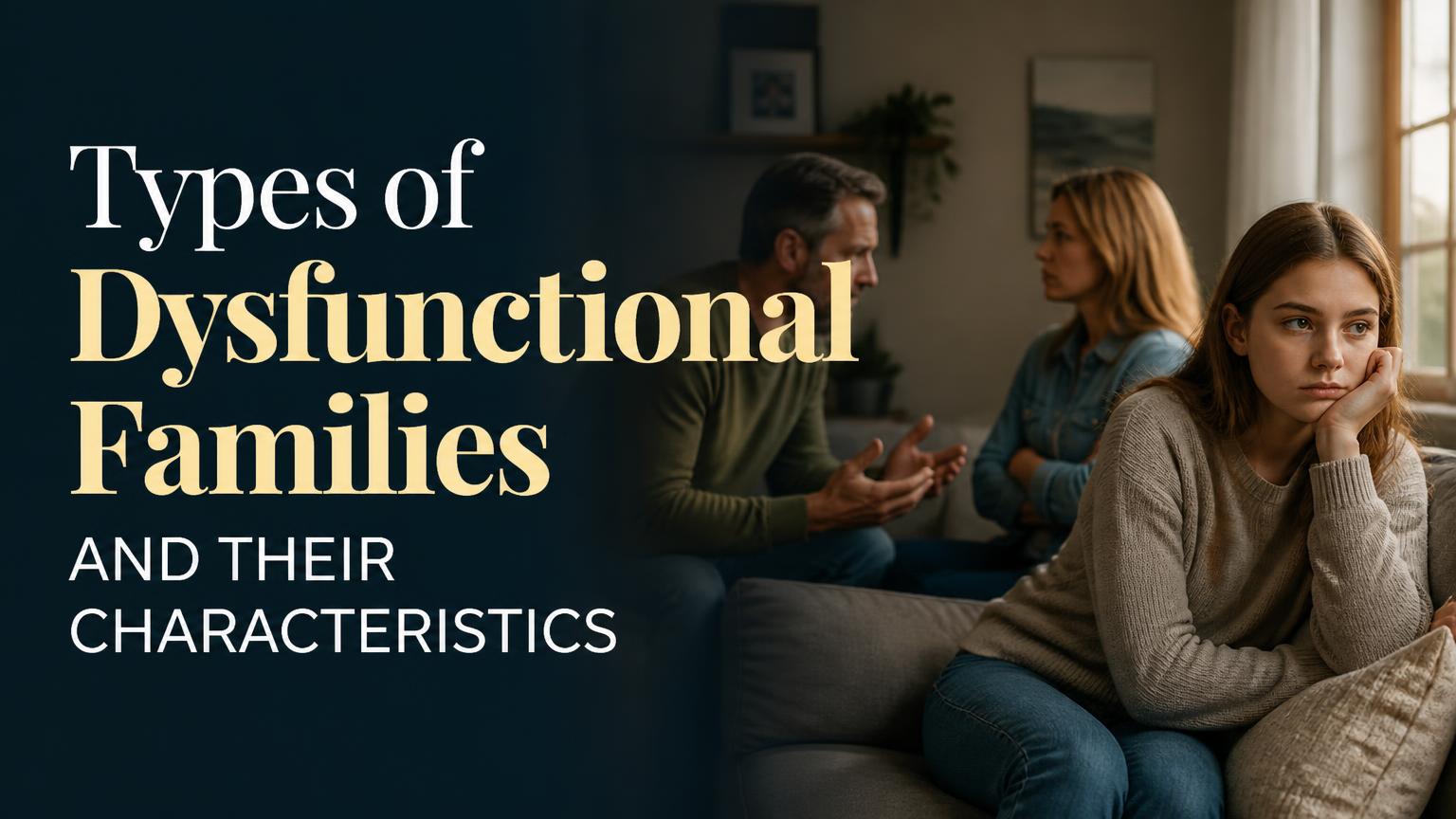
Dysfunctional families are families in which recurring patterns of unhealthy communication, unresolved conflict, emotional neglect, excessive control, or harmful behavior interfere with the well-being of family members. While every family experiences disagreements and difficulties, dysfunction becomes a concern when unhealthy patterns persist and prevent members from feeling respected, supported, or emotionally secure.
There are several types of dysfunctional families, each characterized by different relationship dynamics. Some revolve around controlling parents, while others struggle with emotional distance, unpredictable behavior, persistent conflict, or blurred personal boundaries. These patterns can affect how family members communicate, handle disagreements, express emotions, and develop relationships outside the home.
Understanding the different types of dysfunctional families helps distinguish ordinary family challenges from recurring patterns that can undermine emotional development, trust, independence, and healthy relationships.
Dysfunctional Family Types and Their Characteristics
Dysfunctional families can be classified according to their dominant patterns of interaction, communication, emotional support, and authority. There is no single universally accepted clinical classification of dysfunctional family types. Instead, the categories below describe recognizable family dynamics that may occur separately or overlap within the same household.
1. The Controlling Family
A controlling family operates through excessive authority, rigid expectations, and limited personal independence. One or more family members, often parents or caregivers, make decisions for others and discourage disagreement or independent thinking.
Unlike ordinary parental guidance, which gradually allows children greater responsibility as they mature, excessive control restricts autonomy beyond what is appropriate for a person’s age and circumstances.
Common characteristics include:
- Strict rules that leave little room for discussion or reasonable exceptions.
- Punishment, guilt, or withdrawal of affection when someone disagrees.
- Excessive involvement in personal decisions, relationships, or career choices.
- Expectations of unquestioning obedience.
- Limited respect for privacy and individual preferences.
For example, a parent may insist on choosing an adult child’s career and threaten to withdraw emotional support if the child makes a different decision.
Over time, members of controlling families may struggle with independent decision-making, expressing disagreement, or trusting their own judgment. Others may respond by becoming highly secretive or distancing themselves from family members.
The defining issue is not the existence of rules or authority but the persistent restriction of reasonable personal autonomy.
2. The Emotionally Neglectful Family
An emotionally neglectful family consistently fails to recognize, respond to, or adequately support the emotional needs of its members.
Physical necessities such as food, clothing, and housing may be provided, yet emotional connection, encouragement, reassurance, and understanding remain limited.
Common characteristics include:
- Little interest in discussing feelings or personal difficulties.
- Dismissive responses to sadness, fear, disappointment, or distress.
- Limited affection, praise, or emotional reassurance.
- Family members handling emotional problems alone.
- A household atmosphere in which emotional vulnerability feels unwelcome.
A child who expresses sadness might repeatedly hear, “Stop being so sensitive,” rather than receiving comfort or an opportunity to explain what happened.
Emotional neglect differs from occasional parental distraction or difficulty expressing affection. It involves an ongoing failure to provide developmentally appropriate emotional responsiveness.
Children in these environments may learn to suppress their feelings or believe their emotional needs are unimportant. In adulthood, some find it difficult to identify emotions, ask for support, or develop emotionally intimate relationships.
However, these outcomes are not inevitable. Supportive relationships and later experiences can help individuals develop emotional awareness and trust.
3. The Conflict-Ridden Family
A conflict-ridden family experiences frequent arguments, hostility, criticism, or unresolved disagreements that dominate everyday interactions.
Conflict itself does not make a family dysfunctional. Healthy families disagree, negotiate, apologize, and repair relationships. Dysfunction develops when conflict becomes persistent, destructive, or impossible to resolve constructively.
Common characteristics include:
- Frequent shouting, blaming, or hostile arguments.
- Repeated disputes over the same unresolved issues.
- Personal attacks rather than discussion of specific problems.
- Family members taking sides against one another.
- Little willingness to acknowledge mistakes or make repairs.
- An atmosphere of tension in which minor disagreements can escalate.
For example, a disagreement about household responsibilities may quickly turn into accusations about someone’s character, past mistakes, or loyalty to the family.
In these households, members may become unusually alert to changes in mood or avoid raising legitimate concerns because they expect an argument.
Some children develop conflict-avoidant habits, while others learn to use hostility as a normal method of expressing frustration.
When conflict involves threats, intimidation, physical violence, or coercive control, the situation goes beyond ordinary destructive disagreement and may constitute abuse.
4. The Enmeshed Family
An enmeshed family has excessively blurred emotional and interpersonal boundaries. Family members become so involved in one another’s lives that individual preferences, privacy, and independence are difficult to maintain.
Close family relationships are not inherently unhealthy. Enmeshment becomes problematic when emotional closeness is accompanied by pressure to surrender personal autonomy.
Common characteristics include:
- Family members feeling responsible for one another’s emotional states.
- Difficulty making independent decisions without family approval.
- Expectations that personal information must always be shared.
- Guilt or resentment when someone seeks privacy or independence.
- Family loyalty being interpreted as agreement or constant availability.
- Limited separation between parental concerns and children’s responsibilities.
For example, a mother may repeatedly involve her teenage daughter in adult relationship problems and expect the daughter to provide emotional reassurance.
This can place responsibilities on a child that exceed their developmental capacity.
Enmeshment may also make ordinary life transitions, such as moving away, choosing a partner, or establishing an independent household, unusually contentious.
The distinction between healthy closeness and enmeshment is whether family members can remain connected while respecting one another’s separate identities.
5. The Disengaged Family
A disengaged family is characterized by excessive emotional distance, limited involvement, and weak interpersonal connections.
Where enmeshed families have boundaries that are too diffuse, disengaged families often maintain boundaries so rigid that members struggle to access support or meaningful connection.
Common characteristics include:
- Minimal communication beyond practical necessities.
- Limited involvement in one another’s activities or difficulties.
- Little shared time or emotional engagement.
- Reluctance to offer or request assistance.
- Family members functioning largely as separate individuals.
- Emotional withdrawal during disagreements or stressful periods.
For example, family members may live together but rarely discuss personal experiences, celebrate achievements, or provide comfort during difficult times.
Independence itself is not dysfunction. Some families value privacy and maintain healthy relationships without frequent emotional expression.
Disengagement becomes concerning when emotional distance consistently prevents family members, especially dependent children, from receiving appropriate care, guidance, and support.
6. The Chaotic or Unpredictable Family
A chaotic family lacks consistent routines, reliable expectations, and stable patterns of caregiving or decision-making.
Family members may struggle to anticipate how others will respond, whether promises will be kept, or what rules will apply on a particular day.
Common characteristics include:
- Frequently changing household rules and expectations.
- Inconsistent discipline or caregiving.
- Unpredictable emotional reactions.
- Repeated disruptions to daily routines.
- Responsibilities being assigned or abandoned without explanation.
- Difficulty maintaining reliable commitments.
For example, a parent may respond calmly to a child’s mistake one day but react with intense anger to the same behavior the next.
This inconsistency can make it difficult for children to understand expectations or develop a dependable sense of security.
Family instability may arise from several circumstances, including untreated mental health difficulties, substance misuse, severe financial stress, or inconsistent caregiving arrangements. None of these circumstances automatically makes a family dysfunctional; the relevant issue is how they affect care, stability, and relationships.
Predictability matters because children benefit from knowing that caregivers will respond with reasonable consistency, even when circumstances are challenging.
7. The Perfectionistic or Achievement-Focused Family
A perfectionistic family places excessive emphasis on achievement, appearance, reputation, or meeting demanding standards.
Family members may receive recognition primarily when they perform well, behave flawlessly, or fulfill expectations.
Common characteristics include:
- Mistakes being treated as serious personal failures.
- Praise depending heavily on grades, accomplishments, or status.
- Frequent comparisons between siblings or other children.
- Limited acceptance of personal limitations.
- Pressure to protect the family’s reputation.
- Emotional needs receiving less attention than measurable success.
For example, a child who earns excellent grades may receive criticism for not achieving the highest possible score, with little recognition of their effort.
High expectations alone do not indicate dysfunction. Parents can encourage excellence while providing unconditional affection, realistic guidance, and room for mistakes.
The unhealthy pattern develops when a person’s sense of acceptance becomes dependent on achievement.
Some individuals raised in such environments develop persistent fears of failure, excessive self-criticism, or difficulty separating personal worth from performance.
8. The Parentified Family
A parentified family places developmentally inappropriate adult responsibilities on a child.
Parentification can involve practical responsibilities, emotional responsibilities, or both.
Instrumental parentification occurs when a child is expected to manage substantial adult tasks, such as regularly running the household or caring for siblings beyond what is reasonable for their age.
Emotional parentification occurs when a child becomes a parent’s confidant, mediator, or primary source of emotional support.
Common characteristics include:
- Children managing responsibilities normally handled by adults.
- Parents relying excessively on children for emotional reassurance.
- Children mediating adult conflicts.
- Personal needs being neglected because family duties come first.
- Praise for being unusually mature or self-sacrificing.
- Feelings of guilt when the child prioritizes age-appropriate activities.
For example, a twelve-year-old may routinely be expected to resolve disputes between parents while also managing younger siblings’ daily needs.
Ordinary household chores and occasional family assistance are not parentification. The distinction involves the child’s age, the intensity and duration of the responsibility, available adult support, and whether the arrangement interferes with healthy development.
9. The Addiction-Affected Family
An addiction-affected family experiences recurring disruptions associated with a family member’s problematic alcohol use, drug use, gambling, or another addictive behavior.
The presence of addiction does not automatically determine how every family member behaves. Dysfunction may emerge when the addiction contributes to unreliable caregiving, secrecy, financial instability, broken commitments, or persistent conflict.
Common characteristics include:
- Family routines revolving around one person’s substance use or addictive behavior.
- Repeated promises that are not fulfilled.
- Secrecy surrounding harmful behavior.
- Financial or practical responsibilities shifting unpredictably.
- Family members attempting to conceal or manage the consequences.
- Difficulty discussing the problem openly.
For example, children may learn not to invite friends home because they cannot predict whether a caregiver will be intoxicated.
Some family members respond by taking on excessive responsibilities, while others withdraw or attempt to avoid conflict.
Effective treatment, reliable caregiving, and external support can substantially improve family functioning. Addiction is a treatable condition, and its presence should not be confused with an assumption that recovery or healthy family relationships are impossible.
10. The Abusive or Intimidating Family
An abusive family involves recurring behavior that harms, threatens, exploits, or violates the safety and dignity of family members.
Abuse may be physical, emotional, sexual, or financial. It can also involve coercive control, in which intimidation, isolation, surveillance, or restrictions on autonomy create an ongoing pattern of domination.
Common characteristics include:
- Threats, intimidation, or physical violence.
- Persistent humiliation or degrading treatment.
- Punishment for expressing reasonable disagreement.
- Sexual violations or exploitation.
- Restricting access to money, communication, or outside relationships.
- Creating fear through unpredictable retaliation.
Unlike ordinary family disagreements, abuse involves violations of safety, rights, or personal integrity. It should not be reduced to poor communication or a mutual inability to compromise.
The responsibility for abusive behavior belongs to the person engaging in it.
In situations involving immediate danger, reaching a safe location and contacting emergency services may be necessary. Where ongoing coercion or violence is present, individualized safety planning and confidential support are generally more appropriate than assuming direct confrontation or family mediation will be safe.
How Different Dysfunctional Family Types Overlap
These categories describe patterns rather than mutually exclusive family identities.
A single household may be controlling and emotionally neglectful. Another may combine enmeshment with parentification, particularly when children are expected to manage adult emotional needs.
The relationship between these patterns can help explain why some family environments are particularly difficult to understand.
For example, a parent may demand constant emotional closeness while simultaneously dismissing the child’s independent feelings. The family appears highly connected, yet the child’s emotional needs receive little genuine attention.
Similarly, a household may appear orderly and successful from the outside while maintaining rigid expectations, emotional distance, and harsh consequences for mistakes.
The most useful way to identify dysfunction is therefore to examine recurring behaviors and their effects rather than trying to assign a family to one exclusive category.
Common Roles Within Dysfunctional Families
Family members sometimes adopt recurring roles in response to unhealthy relationship dynamics. These roles are informal descriptions, not clinical diagnoses or fixed personality types.
Some commonly discussed roles include:
- The caretaker: Assumes responsibility for other people’s emotional or practical needs, sometimes at the expense of personal development.
- The peacemaker: Attempts to prevent arguments, reduce tension, or reconcile conflicting family members.
- The scapegoat: Is repeatedly blamed for broader family difficulties, even when responsibility is shared or lies elsewhere.
- The high achiever: Attempts to maintain approval or stability through exceptional performance and compliance.
- The withdrawn member: Minimizes participation or emotional expression to avoid criticism or conflict.
- The challenger: Questions family expectations or openly resists rules perceived as unfair.
These roles can become self-reinforcing. For instance, when one child consistently resolves family disputes, other members may increasingly depend on that child rather than developing their own conflict-resolution skills.
However, not every dysfunctional family has these roles, and individuals may move between them depending on circumstances.
A person’s role within the family should not be mistaken for their permanent identity.
What Causes Dysfunctional Family Patterns?
Family dysfunction rarely has one universal cause. It generally develops through interactions among individual behavior, relationship habits, caregiving practices, and external pressures.
Several factors may contribute.
Learned relationship patterns: Adults may repeat communication or parenting approaches they experienced earlier in life, particularly when they have not encountered workable alternatives. This is a possible influence, not an inevitable cycle.
Poor conflict-resolution skills: Families may lack constructive ways to express disagreement, negotiate expectations, or repair relationships after conflict.
Chronic stress: Financial hardship, caregiving demands, serious illness, and other pressures can strain family functioning. Such stressors do not inherently create dysfunction, especially when members maintain supportive relationships.
Mental health and substance-related difficulties: Certain untreated or inadequately supported conditions may affect consistency, communication, and caregiving. A diagnosis alone does not establish dysfunctional parenting or family relationships.
Rigid beliefs about authority and family obligations: Expectations that discourage reasonable independence, emotional expression, or disagreement can contribute to unhealthy dynamics.
Unresolved relationship problems: Persistent resentment, distrust, or recurring conflict may influence interactions throughout the household.
These factors can help explain how patterns develop without excusing harmful behavior. Understanding a possible cause is different from deciding whether the behavior is acceptable or how someone should respond.
How Dysfunctional Families Affect Children and Adults
The effects of dysfunctional family environments depend on the severity, frequency, and duration of harmful patterns, as well as individual circumstances and access to supportive relationships.
Children who experience chronic instability, emotional neglect, or hostility may develop difficulties with emotional regulation, trust, self-esteem, or relationships.
For example, a child raised in an unpredictable household may become highly attentive to other people’s moods. This behavior can serve as an adaptation to uncertainty but may become exhausting when carried into relationships where such vigilance is unnecessary.
Adults raised in controlling families may find it difficult to make decisions without reassurance. Those raised in emotionally neglectful households may struggle to ask for help or express vulnerability.
Other individuals develop considerable independence, empathy, or problem-solving abilities despite difficult family experiences.
These outcomes should not be romanticized as benefits of dysfunction, nor should adverse experiences be treated as determining someone’s future.
Protective relationships, stable environments, personal experiences, and appropriate support can all influence development and recovery.
How to Distinguish a Dysfunctional Family From a Healthy Family
Healthy families are not free from disagreement, stress, or mistakes. Their defining advantage is the ability to respond to difficulties without consistently undermining safety, respect, or emotional connection.
| Area | Healthier Family Pattern | Dysfunctional Family Pattern |
|---|---|---|
| Communication | Members can express concerns and feel heard | Concerns are routinely dismissed, punished, or avoided |
| Conflict | Disagreements allow for repair and compromise | Conflicts repeatedly escalate or remain unresolved |
| Boundaries | Privacy and age-appropriate independence are respected | Boundaries are excessively rigid or frequently violated |
| Emotional support | Feelings are acknowledged even during disagreement | Emotional needs are consistently ignored or invalidated |
| Authority | Rules are reasonably consistent and appropriate | Authority is excessively controlling or unpredictable |
| Responsibility | Duties reflect age, ability, and circumstances | Responsibilities are unfairly imposed or neglected |
| Mistakes | Accountability includes opportunities for learning | Mistakes trigger humiliation, blame, or disproportionate punishment |
A particularly useful distinction is whether the family can recognize problems and make meaningful adjustments.
A parent who occasionally loses patience but apologizes, listens, and changes their behavior demonstrates a different pattern from one who repeatedly intimidates a child and refuses accountability.
Frequency, severity, power differences, and the consequences of behavior matter more than isolated incidents.
Can Dysfunctional Family Patterns Change?
Dysfunctional family patterns can change, although improvement depends on the specific behaviors involved and the willingness and ability of those responsible to act differently.
For families dealing with ordinary conflict, emotional distance, or inconsistent communication, progress may involve developing more reliable habits.
These can include discussing disagreements without personal attacks, establishing clear household expectations, respecting privacy, and following through on commitments.
A controlling parent, for example, may begin allowing an adolescent greater participation in age-appropriate decisions. An emotionally distant family may develop opportunities for conversation without demanding that everyone express feelings in the same way.
Meaningful change requires more than acknowledging a problem. It involves repeated behavioral adjustments that family members can observe over time.
Individual family members can also change how they participate in unhealthy dynamics, even when others remain unwilling to cooperate. An adult child might limit discussions about private decisions or decline responsibilities that properly belong to another adult.
However, individual efforts cannot guarantee that an entire family system will improve.
When serious abuse, threats, or coercive control are present, safety takes priority over preserving family harmony. Joint family counseling or confrontation may be inappropriate in such circumstances.
Conclusion
The main types of dysfunctional families include controlling, emotionally neglectful, conflict-ridden, enmeshed, disengaged, chaotic, perfectionistic, parentified, addiction-affected, and abusive families.
These categories describe different patterns of unhealthy family functioning, and several may exist within the same household.
The clearest indicators of dysfunction are not occasional disagreements or imperfect parenting but recurring behaviors that undermine emotional security, appropriate independence, reliable care, or personal safety.
Recognizing these patterns makes it easier to understand how family relationships operate, distinguish unhealthy dynamics from ordinary challenges, and identify what meaningful change would require.