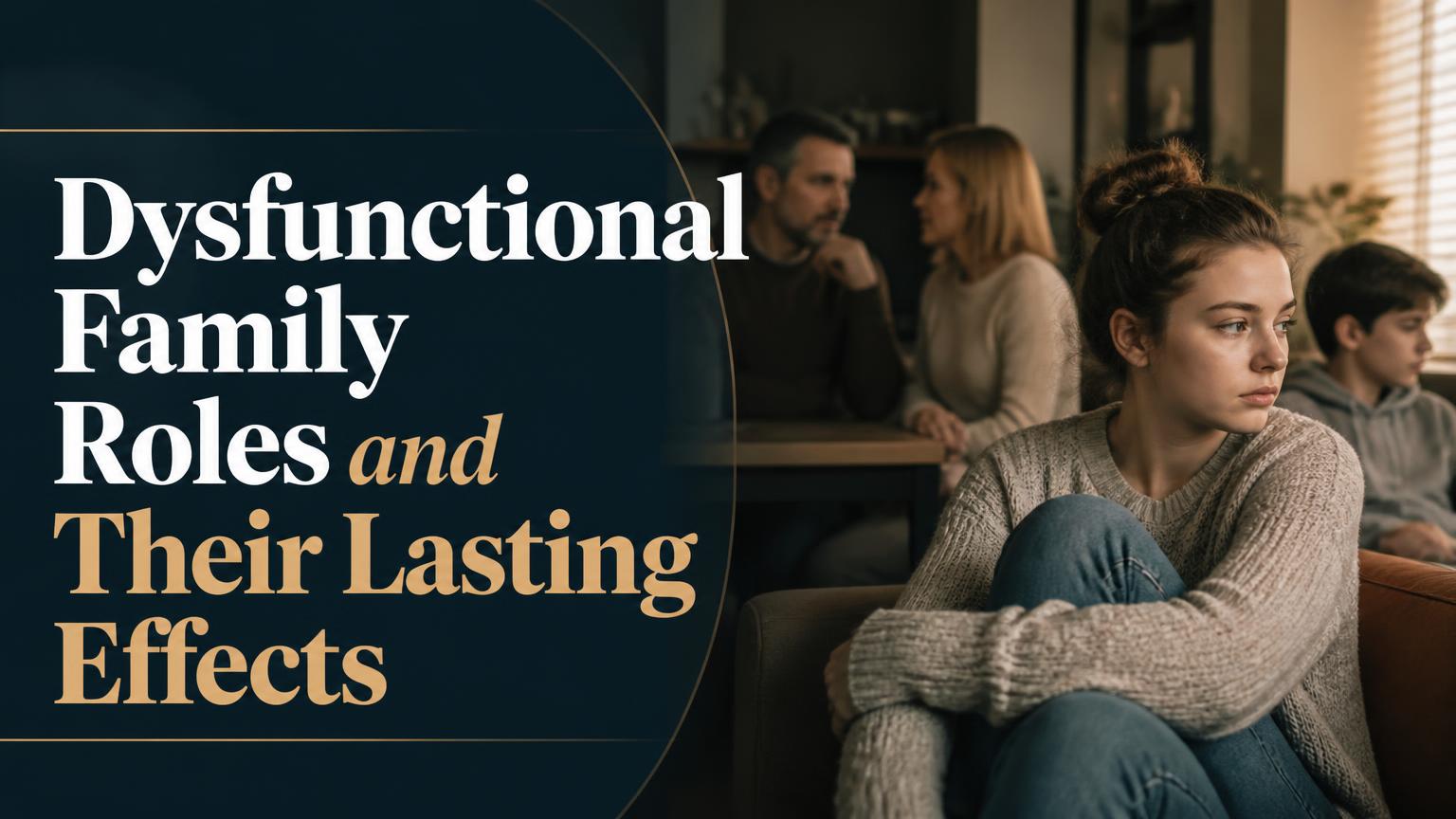
Dysfunctional family roles are recurring patterns of behavior that family members adopt or are expected to maintain in households where relationships, communication, responsibilities, or emotional needs are poorly managed. These roles may help a family maintain a sense of stability, but they can also place unfair expectations on individuals, especially children.
Common dysfunctional family roles include the hero, scapegoat, lost child, mascot, caretaker, and enabler. Each represents a different way of responding to family tension, unpredictability, or unmet emotional needs.
Understanding these roles helps explain why certain family dynamics persist and how childhood experiences may influence adult relationships, self-esteem, emotional expression, and personal boundaries. However, family roles are not fixed identities or clinical diagnoses. They are patterns that can change as people develop healthier ways of relating to themselves and others.
Dysfunctional Family Roles and Their Characteristics
Dysfunctional family roles describe patterns through which individuals respond to ongoing problems within a family system. Rather than addressing underlying difficulties directly, family members may develop predictable ways of managing conflict, preserving appearances, avoiding confrontation, or meeting emotional needs.
These roles are especially relevant in families experiencing chronic conflict, inconsistent caregiving, addiction, emotional neglect, rigid expectations, or other persistent difficulties. They can also emerge in less severe situations where certain behaviors are repeatedly rewarded or discouraged.
The following roles are commonly discussed in family systems literature and popular descriptions of dysfunctional family dynamics. They are useful interpretive models, not scientifically established personality categories. A person may occupy several roles, move between them, or fit none of them.
1. The Hero: The Responsible Achiever
The hero is the family member who attempts to create stability through achievement, responsibility, and exemplary behavior. This person may become the dependable child, successful student, or adult who appears capable of handling almost anything.
In a family struggling with conflict or instability, the hero’s accomplishments may provide reassurance that everything is functioning normally. Their achievements can become a source of family pride while drawing attention away from unresolved problems.
Common characteristics include:
- Taking responsibility beyond what is appropriate for their age.
- Pursuing academic, professional, or personal success.
- Feeling responsible for maintaining the family’s reputation.
- Avoiding mistakes or situations that might disappoint others.
- Struggling to ask for help or acknowledge personal limitations.
For example, a teenager might maintain excellent grades, supervise younger siblings, and manage household responsibilities while their parents deal with persistent conflict.
Although competence and ambition are positive qualities, difficulties arise when a person’s sense of worth becomes dependent on achievement.
As adults, people who have occupied this role may experience perfectionism, excessive responsibility, difficulty resting, or discomfort with vulnerability. They may believe that being loved requires being useful, successful, or consistently dependable.
The lasting difficulty is not achievement itself. It is the belief that personal needs must always come second to performance.
2. The Scapegoat: The Family’s Identified Problem
The scapegoat is the family member who receives disproportionate blame for household problems. Their behavior may become the central focus of family criticism, even when broader relationship difficulties contribute to the situation.
This role can develop when family members repeatedly explain conflict through one person’s supposed shortcomings rather than examining the family’s interactions.
Common characteristics include:
- Being blamed for problems involving several family members.
- Receiving more criticism or punishment than others.
- Being described as rebellious, difficult, or irresponsible.
- Having legitimate concerns dismissed because of their reputation.
- Becoming increasingly frustrated, withdrawn, or oppositional.
Consider a family in which parents frequently argue but attribute the household’s tension to a teenager’s defiant behavior. The teenager may have genuine behavioral difficulties, yet focusing exclusively on those difficulties prevents the parents from addressing their own conflict.
Scapegoating does not mean the identified family member never behaves harmfully or bears responsibility for their actions. The defining problem is the unfair concentration of blame and the failure to recognize shared or systemic contributions.
Over time, someone repeatedly assigned this role may internalize negative beliefs about themselves, develop mistrust, or become highly sensitive to criticism. Others may resist family expectations and eventually create distance from the household.
The effects vary considerably. Some individuals develop a strong commitment to fairness and independence, while others struggle with shame and belonging.
3. The Lost Child: The Quiet and Withdrawn Family Member
The lost child responds to family difficulties by becoming unobtrusive, emotionally reserved, or unusually self-sufficient.
Rather than seeking attention through achievement or conflict, this person attempts to avoid becoming another source of stress.
Common characteristics include:
- Spending considerable time alone.
- Avoiding arguments and emotionally intense situations.
- Rarely expressing personal needs or preferences.
- Appearing independent while receiving limited emotional attention.
- Escaping into books, hobbies, imagination, or solitary activities.
For example, a child who regularly witnesses arguments may retreat to their bedroom whenever tensions rise. Family members might describe the child as easygoing because they rarely complain or request attention.
However, quiet behavior does not necessarily indicate emotional security. The child may have learned that remaining unnoticed is the most reliable way to avoid conflict.
In adulthood, this pattern may appear as difficulty forming close relationships, reluctance to seek support, or discomfort expressing emotions.
Solitude itself is not dysfunctional. The concern arises when withdrawal becomes a protective response that prevents someone from communicating needs or developing mutually supportive relationships.
4. The Mascot: The Family’s Humorist and Peacemaker
The mascot uses humor, playfulness, or entertaining behavior to reduce tension within the family.
When conflict becomes uncomfortable, this person may make jokes, change the subject, or attempt to improve everyone’s mood.
Common characteristics include:
- Using humor during emotionally difficult situations.
- Trying to make distressed family members feel better.
- Avoiding serious conversations through jokes or distractions.
- Being perceived as cheerful regardless of personal circumstances.
- Feeling uncomfortable when unable to improve the atmosphere.
Imagine a child who notices their parents becoming angry and begins acting silly to make them laugh. If this repeatedly interrupts arguments, the child may learn to associate entertaining others with maintaining peace.
Humor can be a healthy coping strategy. Problems develop when a person feels obligated to remain cheerful or believes that expressing sadness, anger, or fear would burden others.
As adults, people who have adopted this role may struggle to discuss painful experiences, use humor to deflect vulnerability, or feel responsible for everyone else’s emotional comfort.
The challenge is learning that genuine connection can include difficult emotions, not merely positive ones.
5. The Caretaker: The Family’s Emotional Support Provider
The caretaker assumes responsibility for meeting other family members’ practical or emotional needs, sometimes at the expense of their own development.
This role can overlap with the hero, but the emphasis differs. The hero often seeks stability through achievement, while the caretaker seeks it through caregiving.
Common characteristics include:
- Monitoring the emotional states of family members.
- Comforting adults during conflicts or crises.
- Mediating disagreements between relatives.
- Neglecting personal needs to assist others.
- Feeling guilty when unable to solve another person’s problems.
A child who regularly comforts a distressed parent, listens to adult relationship problems, or becomes responsible for younger siblings may be experiencing parentification.
Parentification occurs when a child assumes responsibilities ordinarily belonging to adults. It may involve practical duties, emotional caregiving, or both.
Not every household responsibility constitutes parentification. Age-appropriate chores and occasional assistance can support healthy development. The concern arises when responsibilities become excessive, developmentally inappropriate, or consistently interfere with the child’s own needs.
Adults who experienced this pattern may become compassionate and capable caregivers. However, they may also struggle with overcommitment, guilt, resentment, and relationships in which care flows primarily in one direction.
6. The Enabler: The Protector of Dysfunctional Patterns
The enabler is a family member whose responses unintentionally help harmful or irresponsible behavior continue.
Enabling often involves protecting another person from consequences, minimizing recurring problems, or assuming responsibilities that the other person could reasonably manage.
Common characteristics include:
- Making excuses for another family member’s harmful conduct.
- Concealing recurring problems from people outside the family.
- Taking over responsibilities to prevent immediate conflict.
- Avoiding difficult conversations despite ongoing consequences.
- Prioritizing short-term peace over necessary accountability.
For example, a parent might repeatedly excuse an adult child’s threatening behavior, discourage other relatives from discussing it, and insist that everyone accommodate the child’s demands.
These responses may reduce immediate confrontation but can also allow the pattern to persist.
Enabling should not be confused with compassion, practical assistance, or supporting someone through illness or hardship. The distinction concerns whether support addresses genuine needs while preserving appropriate accountability or repeatedly shields harmful behavior from consequences.
The term also requires care. Someone who complies with a controlling or threatening family member to protect themselves may be acting under coercion rather than freely enabling the behavior.
How Dysfunctional Family Roles Develop
Family roles usually emerge through repeated interactions rather than deliberate assignments.
Children observe which behaviors receive approval, which provoke criticism, and which help them avoid distress. Over time, these experiences may shape habitual responses.
Several mechanisms contribute to this process.
Family expectations and reinforcement: A child praised primarily for being responsible may increasingly suppress their own needs. Another child repeatedly criticized as troublesome may come to expect rejection, affecting how they respond to future disagreements.
Unclear generational boundaries: When adults rely on children for emotional support or household management beyond their developmental capacity, children may adopt caregiving or authority roles prematurely.
Conflict avoidance: Families sometimes maintain an appearance of stability by avoiding difficult subjects. Humor, silence, achievement, or blaming one member can become familiar ways of redirecting attention.
Unequal treatment: Favoritism, inconsistent discipline, and rigid expectations may encourage family members to occupy contrasting positions, such as the responsible child and the troublesome child.
Adaptation to unpredictability: In households where emotional reactions are difficult to anticipate, family members may become unusually attentive to changes in mood or behavior.
These patterns can become self-reinforcing. Once a family expects someone to behave in a particular way, relatives may interpret new behavior through that established reputation.
A child labeled irresponsible, for example, may receive little recognition when demonstrating responsibility. Meanwhile, the child labeled dependable may be denied opportunities to express uncertainty or ask for help.
Importantly, these processes do not require conscious manipulation. Families can perpetuate harmful expectations without fully recognizing them.
The Lasting Effects of Dysfunctional Family Roles
Childhood family roles can influence adult behavior because repeated experiences shape expectations about relationships, responsibility, and emotional expression.
However, these outcomes are not inevitable. Their effects depend on the severity and duration of family difficulties, individual temperament, supportive relationships, later experiences, and opportunities for change.
Self-Esteem and Personal Identity
When acceptance appears dependent on fulfilling a particular role, individuals may develop a conditional sense of self-worth.
A former hero may feel valuable only when succeeding. A former scapegoat may assume criticism is inevitable. A former caretaker may struggle to identify personal desires independently of other people’s needs.
These patterns can make identity feel closely tied to performance, usefulness, or family reputation.
Emotional Expression and Regulation
Different family roles can encourage different approaches to emotion.
The lost child may suppress distress, the mascot may disguise it with humor, and the caretaker may prioritize other people’s feelings.
Over time, these habits can interfere with recognizing emotions, expressing them appropriately, or asking for support.
Emotional regulation does not mean suppressing feelings. It involves recognizing emotional experiences and responding in ways appropriate to the situation.
Adult Relationships and Intimacy
Familiar family patterns can influence expectations in friendships, romantic partnerships, and other close relationships.
Someone accustomed to caregiving may repeatedly take responsibility for a partner’s problems. Someone who learned to remain unnoticed may avoid expressing dissatisfaction until resentment develops.
These patterns may feel natural because they resemble earlier experiences, even when they no longer serve the person’s needs.
Nevertheless, childhood roles do not determine adult relationship outcomes. People can develop different expectations through supportive relationships, reflection, and new experiences.
Boundaries and Responsibility
Family roles may blur the distinction between personal responsibility and responsibility for others.
Former caretakers may feel obligated to manage relatives’ emotions. Former heroes may assume that every problem requires their intervention.
Healthy responsibility involves recognizing what someone can reasonably influence while accepting that other people remain accountable for their own decisions.
This distinction becomes particularly important when family members expect an adult child to continue fulfilling childhood obligations.
Conflict and Communication
Early family experiences can influence how individuals respond to disagreement.
Some may avoid conflict because it once threatened emotional stability. Others may become defensive because they frequently experienced blame.
These responses can complicate communication, especially when disagreement is interpreted as rejection, danger, or personal failure.
Learning to distinguish ordinary conflict from threats to personal safety can help individuals respond more proportionately. In genuinely threatening relationships, however, protective responses should not be dismissed as communication difficulties.
Why Family Roles Can Continue Into Adulthood
Dysfunctional family roles may persist because they become embedded in both personal habits and family expectations.
A person who has spent years resolving family disputes may automatically intervene whenever relatives disagree. Family members, in turn, may continue seeking that person’s help because the arrangement feels familiar.
This creates a reinforcing cycle: the individual behaves according to the established role, and relatives respond in ways that maintain it.
Family gatherings can make these patterns especially visible. An otherwise confident adult may suddenly feel like the irresponsible teenager or the child responsible for keeping everyone happy.
Such reactions do not mean that personal growth has disappeared. Familiar relationships can activate learned expectations, particularly when relatives continue interacting according to older patterns.
Changing a role therefore involves more than recognizing it. Individuals may need to respond differently while accepting that other family members might initially resist those changes.
How to Break Free From Dysfunctional Family Roles
Changing longstanding family patterns requires recognizing the behaviors involved, understanding their current consequences, and developing alternatives.
The objective is not necessarily to reject family members or abandon positive qualities associated with a role. Responsibility, humor, independence, and compassion can remain valuable when they are freely chosen rather than compulsory.
Identify the Role Without Turning It Into an Identity
Begin by examining recurring situations rather than assigning yourself a permanent label.
Consider which responsibilities you automatically accept, what happens when you express disagreement, and whether you feel obligated to manage other people’s reactions.
A person might recognize that they frequently mediate family disputes despite feeling exhausted afterward.
Identifying this pattern is more useful than concluding that being a caretaker defines their entire personality.
Separate Personal Needs From Family Expectations
Examine whether existing responsibilities are reasonable, voluntary, and compatible with your current circumstances.
An adult may choose to support an aging parent while declining to become the permanent mediator between siblings.
Similarly, a former hero can remain ambitious without treating every mistake as evidence of personal inadequacy.
The distinction is between acting from personal values and acting primarily from fear, guilt, or longstanding expectations.
Establish Specific Behavioral Boundaries
Boundaries become useful when they identify what someone will do or decline to do.
For example, a family member who is repeatedly drawn into arguments might say:
“I care about both of you, but I am not going to decide who is right in this disagreement.”
Someone who receives frequent last-minute demands might explain that they need advance notice before accepting additional responsibilities.
A boundary does not guarantee that others will approve. It clarifies the individual’s own participation and available choices.
Where intimidation, coercion, or violence is present, direct boundary-setting may increase risk. Safety planning and confidential support may be more appropriate than confrontation.
Practice Behaviors That Challenge the Old Role
Lasting change often involves repeatedly responding differently in familiar situations.
A former hero might ask for assistance instead of automatically managing everything. A former lost child might express a preference during a family decision. A former mascot might discuss sadness without making a joke.
These changes can initially feel uncomfortable because they contradict longstanding habits.
Starting with lower-stakes situations allows individuals to develop confidence without expecting immediate transformation.
Build Relationships That Allow Greater Flexibility
Supportive relationships provide opportunities to experience acceptance without performing a fixed role.
Healthy relationships allow people to contribute, receive help, disagree, make mistakes, and express needs without automatically losing respect or belonging.
Trusted friends, supportive relatives, peer groups, and qualified mental health professionals may help individuals recognize patterns and develop alternatives.
Professional support can be particularly useful when family experiences are associated with persistent distress, trauma-related symptoms, or significant relationship difficulties.
Dysfunctional Family Roles vs. Normal Family Responsibilities
Not every recurring family role is dysfunctional.
Families naturally distribute responsibilities according to age, ability, circumstances, and personal preference. One person may enjoy organizing events while another provides practical assistance.
The distinction concerns flexibility, fairness, developmental appropriateness, and the consequences of refusing or changing a role.
| Healthy Family Responsibilities | Dysfunctional Family Roles |
|---|---|
| Responsibilities can change as circumstances change. | Expectations remain rigid despite changing needs. |
| Contributions are generally age-appropriate. | Children may carry excessive adult responsibilities. |
| Family members can express needs and limitations. | Expressing needs may trigger guilt, criticism, or rejection. |
| Accountability reflects individual behavior. | One person may receive disproportionate blame. |
| Support is balanced with personal autonomy. | Loyalty may be measured through sacrifice or compliance. |
| Individual identities extend beyond family duties. | People may be defined primarily by assigned roles. |
A child helping prepare dinner is participating in ordinary family life. A child consistently responsible for feeding siblings because caregivers refuse to meet basic responsibilities faces a substantially different situation.
Likewise, an adult voluntarily helping relatives during a temporary crisis is not necessarily occupying a dysfunctional caretaker role.
The central question is whether the arrangement supports the well-being and autonomy of family members or persistently undermines them.
Can a Dysfunctional Family Change Its Roles?
Family roles can change when members develop greater awareness, adjust expectations, and respond differently to familiar situations.
Family systems are interconnected. A change in one person’s behavior can alter established interactions, although it does not guarantee that others will change.
For example, when a family member stops automatically resolving every disagreement, relatives may initially become frustrated. Over time, some may begin addressing conflicts more directly.
Progress is more likely when family members accept responsibility for their behavior, respect appropriate boundaries, and allow individuals to develop beyond old reputations.
In some families, structured family therapy may help members examine communication patterns, redistribute responsibilities, and improve relationships.
However, meaningful change does not always require the entire family to participate. Individuals can reconsider their own expectations and choices even when relatives remain unwilling to change.
Where severe abuse or coercive control exists, joint family work may be inappropriate or unsafe. Individual support and protection from harm take priority over preserving the family system.
Common Misunderstandings About Dysfunctional Family Roles
One misconception is that every dysfunctional family contains the same set of roles. In reality, these categories are descriptive frameworks rather than universal structures. Some families show several recognizable patterns, while others do not.
Another misconception is that a person’s family role reveals their underlying personality. Someone who behaves quietly at home may be outgoing elsewhere. A person who becomes highly responsible during a family crisis may behave differently in supportive circumstances.
It is also misleading to assume that every role develops from deliberate mistreatment. Economic hardship, illness, bereavement, and other pressures can contribute to unequal responsibilities without making every family interaction abusive.
Nevertheless, the absence of harmful intent does not eliminate harmful consequences. A child can experience excessive responsibility even when caregivers believe they are doing their best.
Finally, identifying a family role does not establish a mental health diagnosis. These labels cannot reliably determine whether someone has a personality disorder, trauma-related condition, or other clinical concern.
Their greatest value lies in helping people examine patterns of interaction, not categorizing family members as permanently healthy or unhealthy.
Conclusion
Dysfunctional family roles are recurring patterns that can help families manage tension while placing unfair emotional or practical demands on individual members. Roles such as the hero, scapegoat, lost child, mascot, caretaker, and enabler illustrate different ways people may adapt to difficult family circumstances.
Their lasting effects often involve self-worth, emotional expression, responsibility, and adult relationships. Yet these patterns are neither universal nor permanent.
Recognizing a family role provides an opportunity to distinguish useful personal qualities from obligations learned under difficult circumstances. The goal is greater flexibility: the freedom to contribute to relationships without being confined to a role that no longer reflects one’s needs, values, or identity.