
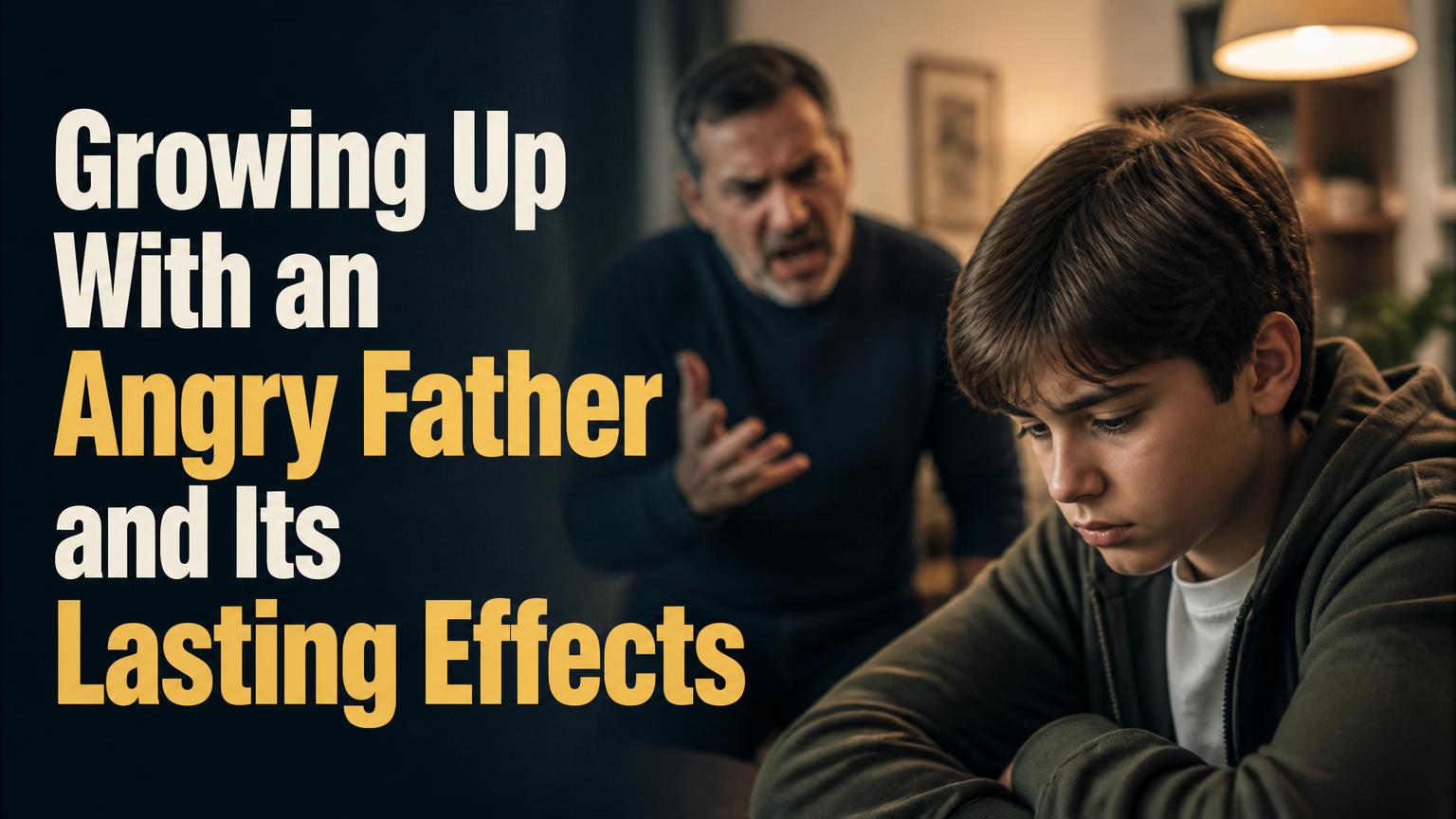
Growing up with an angry father can shape how a child understands safety, love, conflict, and personal worth. When a father’s anger is frequent, unpredictable, or intimidating, children may learn to monitor his moods, suppress their emotions, or avoid situations that could provoke an outburst. These adaptations can influence their relationships and emotional well-being long after childhood.
The lasting effects depend on the severity of the anger, how it was expressed, the child’s experiences, and whether other supportive relationships provided stability. An angry father does not automatically cause lasting psychological harm, but repeated exposure to hostility, fear, or emotional unpredictability can leave patterns that take time to recognize and change.
Growing Up With an Angry Father and Its Lasting Effects
The effects of growing up with an angry father often extend beyond memories of arguments or shouting. Children develop their understanding of relationships through repeated interactions with caregivers. When anger dominates those interactions, they may adopt emotional and behavioral strategies that help them cope at home but create difficulties later.
1. Living in a Constant State of Alertness
Children who cannot predict when their father will become angry may become unusually attentive to changes in his voice, facial expressions, movements, or behavior.
They might listen for footsteps, notice how doors close, or assess his mood before asking a question. This vigilance can become a way of anticipating conflict and reducing the likelihood of confrontation.
Over time, some children become accustomed to scanning their surroundings for possible threats. As adults, they may feel tense around raised voices, interpret neutral expressions as signs of displeasure, or struggle to relax during disagreements.
This pattern is sometimes described as hypervigilance, although being attentive to another person’s mood does not necessarily indicate a clinical condition.
The important distinction is that a response learned in an unpredictable home may continue even when the original threat is no longer present.
2. Difficulty Expressing Emotions
An angry father may unintentionally or deliberately teach his children that certain emotions are unacceptable.
For example, a child who is shouted at for crying may learn to hide sadness. A child whose frustration triggers an angry reaction may stop expressing disagreement.
Suppressing emotions can reduce immediate conflict, but it may also interfere with learning how to identify, communicate, and regulate feelings.
In adulthood, this can appear as difficulty discussing disappointment, discomfort with vulnerability, or a tendency to say everything is fine when something is clearly wrong.
Some people experience the opposite pattern. Having grown up around explosive reactions, they may struggle to express frustration calmly because they had few opportunities to observe constructive emotional communication.
Neither response is inevitable. Emotional expression is a skill that can develop through later relationships and experience.
3. Fear of Conflict and Disagreement
Children who repeatedly witness angry confrontations may associate disagreement with danger rather than ordinary differences of opinion.
They may learn that expressing a preference, questioning a decision, or making a mistake could lead to shouting, humiliation, or punishment.
As adults, they might avoid necessary conversations, apologize excessively, or agree with others to prevent tension.
For instance, someone may remain silent when a partner makes an unfair request because disagreement produces the same anxiety they experienced during childhood arguments.
Others may become defensive at the first sign of criticism, expecting a minor disagreement to escalate.
The underlying difficulty is not necessarily an inability to communicate. It may reflect an expectation that conflict will lead to rejection, intimidation, or emotional distress.
4. Low Self-Esteem and Persistent Self-Criticism
A father’s anger can affect a child’s self-image, particularly when anger involves repeated criticism, insults, ridicule, or blame.
Children often interpret parental behavior personally. A child who repeatedly hears that they are careless, stupid, or disappointing may begin to believe those descriptions.
Even when a father’s anger reflects his own difficulties, the child may conclude that something is wrong with them.
This can contribute to persistent self-criticism, fear of failure, and a strong need for approval.
In adulthood, a person may achieve considerable success yet remain unusually sensitive to mistakes or negative feedback.
However, parental anger and low self-esteem are not automatically linked. The nature of the father’s behavior, the child’s interpretation, and the presence of encouragement from other caregivers all matter.
5. People-Pleasing and Difficulty Setting Boundaries
Some children learn that keeping their father happy is the safest way to avoid anger.
They may become highly cooperative, anticipate his needs, or take responsibility for maintaining peace within the household.
When this becomes a recurring survival strategy, the child may develop a habit of prioritizing other people’s reactions over personal preferences.
In adulthood, this can appear as:
- Agreeing to requests despite feeling overwhelmed.
- Feeling guilty when saying no.
- Taking responsibility for other people’s disappointment.
- Avoiding honest feedback to preserve harmony.
- Believing that being useful or agreeable is necessary to receive affection.
These behaviors may resemble ordinary kindness, but the distinction lies in freedom of choice. Healthy consideration for others allows room for disagreement and personal limits. Fear-driven people-pleasing makes those choices feel unsafe.
6. Difficulty Trusting Others and Feeling Emotionally Secure
A father can be both a source of affection and a source of fear. For some children, this inconsistency creates uncertainty about whether closeness with another person will feel comforting or threatening.
A father might be affectionate one evening and intensely angry the next. Without predictable responses or meaningful repair after conflicts, a child may struggle to understand what to expect from important relationships.
Later, this can contribute to difficulties trusting others, accepting affection, or believing that relationships will remain stable during disagreements.
Some adults become reluctant to depend on anyone. Others seek frequent reassurance because changes in another person’s mood feel especially significant.
These experiences can influence attachment patterns, but childhood experiences do not determine a person’s adult attachment style or relationship outcomes.
7. Anger Problems and Emotional Regulation Difficulties
Growing up with an angry father does not necessarily make someone angry. However, children learn emotional behavior partly through observation.
When a father routinely responds to frustration by shouting, threatening, or blaming, children may have fewer opportunities to observe constructive ways of handling anger.
Some eventually imitate those reactions. They may raise their voices quickly, become overwhelmed during arguments, or struggle to pause before responding.
Others move in the opposite direction, becoming uncomfortable with any expression of anger, including their own.
Both patterns can interfere with healthy emotional regulation.
Learning to recognize frustration, tolerate uncomfortable feelings, and express anger without intimidation can help interrupt these learned responses.
8. Anxiety, Depression, and Other Emotional Difficulties
Persistent exposure to threatening or unpredictable anger can contribute to chronic stress during childhood.
When anger includes intimidation, humiliation, or violence, the psychological consequences may be particularly serious.
Some individuals experience anxiety, depressive symptoms, sleep difficulties, intrusive memories, or heightened sensitivity to perceived rejection.
However, these outcomes are not universal, and they cannot be attributed to a father’s anger alone without considering other influences.
A person can also experience lasting difficulties without meeting the diagnostic criteria for a mental health disorder.
The central concern is whether childhood experiences continue to interfere with emotional functioning, relationships, or everyday life.
Why an Angry Father Can Have Such a Strong Influence
A father’s anger can carry particular weight because children depend on caregivers for protection, guidance, affection, and emotional stability.
Young children have limited ability to leave threatening situations, challenge adult behavior, or understand why a parent reacts intensely.
As a result, they may adapt themselves to the emotional environment rather than recognize that the adult’s behavior is inappropriate.
Three processes help explain the potential influence.
Emotional learning: Children observe how adults handle frustration, disagreement, and disappointment. Repeated exposure can shape what they consider normal emotional behavior.
Stress adaptation: When conflict feels unpredictable, children may develop habits designed to anticipate and avoid it. These responses can become automatic through repetition.
Beliefs about relationships: Children form expectations about how people treat one another. If affection regularly coexists with intimidation, they may struggle to distinguish ordinary conflict from threatening behavior.
These processes interact with temperament, other relationships, family circumstances, and experiences outside the home.
A consistently supportive mother, grandparent, teacher, or other trusted adult may provide an important alternative model of safety and communication.
The Difference Between a Father Who Gets Angry and an Angry Father
Anger is a normal human emotion. A father who occasionally becomes frustrated is not necessarily creating a harmful environment.
What matters is how anger is expressed, how frequently it occurs, whether children feel threatened, and what happens afterward.
| Ordinary Parental Anger | Potentially Harmful Anger Patterns |
|---|---|
| Expresses frustration without threats or humiliation | Uses threats, insults, or intimidation |
| Responds proportionately to the situation | Reacts explosively to minor mistakes |
| Allows children to express disagreement respectfully | Punishes children for expressing feelings or opinions |
| Accepts responsibility for inappropriate reactions | Repeatedly blames children for his outbursts |
| Apologizes and changes behavior after mistakes | Repeats harmful behavior without meaningful repair |
| Maintains predictable expectations | Creates uncertainty about what will provoke anger |
A father may raise his voice occasionally, recognize that his response was inappropriate, apologize, and work to prevent repetition. This differs substantially from a household where children routinely fear his reactions.
Repeated threats, humiliation, physical aggression, or intimidation can constitute abusive behavior. Such conduct should not be dismissed as an ordinary parenting style.
The distinction is especially important because the goal is not to expect parents never to experience anger. It is to recognize that adults remain responsible for how they express it.
How Growing Up With an Angry Father Can Affect Adult Relationships
Childhood experiences may influence how adults approach romantic relationships, friendships, family interactions, and workplace disagreements.
One common difficulty involves interpreting another person’s frustration.
Someone who grew up fearing an angry father may perceive a partner’s irritated tone as a warning that something worse is coming. They might withdraw, become defensive, or urgently try to resolve the disagreement.
Their partner, meanwhile, may see the situation as a minor conflict.
This mismatch can create misunderstandings unless both people learn to recognize what is happening.
Another pattern involves familiarity. Some adults find themselves tolerating excessive anger because similar behavior was normalized during childhood. Others become especially cautious about relationships and withdraw at early signs of disagreement.
Neither pattern means a person is destined to repeat their childhood experiences.
A useful distinction is between recognizing a familiar emotional response and accurately evaluating the present situation. Feeling afraid during a disagreement does not always mean the current relationship is unsafe. Equally, having grown accustomed to intimidation does not make threatening behavior acceptable.
Learning to assess present behavior on its own merits can help people respond more appropriately.
How to Heal From Growing Up With an Angry Father
Healing involves recognizing how childhood experiences may influence current reactions and developing responses that better fit present circumstances.
It does not require forgetting the past, excusing harmful behavior, or rebuilding a relationship with the father.
Recognize Learned Emotional Patterns
Begin by identifying reactions that appear repeatedly in everyday life.
For example, someone might notice that criticism produces disproportionate anxiety, disagreements trigger an urge to withdraw, or another person’s disappointment creates immediate guilt.
Rather than assuming these responses reveal a personal weakness, consider what function they may once have served.
A habit of remaining silent may have reduced conflict at home. Constantly checking another person’s mood may have helped anticipate an outburst.
Recognizing the original purpose of these behaviors makes it easier to decide whether they remain useful.
Separate Past Experiences From Present Relationships
An important part of change involves learning that present-day interactions do not always follow childhood patterns.
A disagreement with a respectful partner is different from being confronted by an intimidating parent.
When an emotional reaction feels unusually intense, it can help to identify what is actually happening.
Is the other person expressing ordinary frustration, making a reasonable request, criticizing unfairly, or behaving threateningly?
The answer should come from observable behavior rather than automatically assuming either safety or danger.
This approach supports more accurate judgments without dismissing genuine warning signs.
Develop Healthier Ways to Express Anger
People who grew up around destructive anger may benefit from learning that anger itself is not wrong.
Anger can signal frustration, disappointment, unfair treatment, or an unmet need. The challenge is expressing it without aggression or intimidation.
Practical approaches include identifying the specific problem, describing its impact, and making a clear request.
For example, instead of shouting during a disagreement or remaining silent out of fear, someone might say, “I felt dismissed when my concerns were interrupted. I would like to finish explaining them.”
Taking a break when emotions become overwhelming can also help, provided the conversation is resumed when appropriate.
These skills require practice, particularly when childhood provided few constructive examples.
Practice Boundaries Without Assuming Responsibility for Others’ Reactions
Adults raised by angry parents sometimes feel responsible for preventing other people’s anger.
Developing boundaries involves recognizing where personal responsibility ends.
A person can communicate respectfully, consider another person’s feelings, and remain accountable for their own actions. They cannot guarantee that someone else will respond calmly.
A boundary might involve declining to continue a conversation while being shouted at, choosing not to discuss certain subjects, or limiting contact when interactions repeatedly become harmful.
For example: “I am willing to discuss this, but I will end the conversation if you continue insulting me.”
Such boundaries describe what the individual will do rather than attempting to control another person’s emotions.
If a person is threatening or violent, directly announcing boundaries may increase danger. In those circumstances, safety planning and outside support may be more appropriate than confrontation.
Reconsider Internalized Beliefs About Personal Worth
Children sometimes absorb negative messages from an angry parent and carry them into adulthood.
Beliefs such as “I always disappoint people” or “Making mistakes means I deserve criticism” may persist even when later experiences contradict them.
Examining these beliefs involves asking whether they describe reality or reflect repeated childhood messages.
It can also help to distinguish responsibility for a mistake from judgments about personal worth.
Making an error may require correction or an apology. It does not justify humiliation.
Developing a more balanced self-image often involves repeated experiences of being respected, accepted, and treated fairly.
Consider Professional Support When Difficulties Persist
Some people gradually change these patterns through reflection, supportive relationships, and new experiences.
Others experience persistent anxiety, trauma-related symptoms, emotional distress, or relationship difficulties that benefit from professional support.
A qualified mental health professional can help identify recurring responses, evaluate symptoms, and develop appropriate strategies.
When childhood experiences involved threats, violence, or severe intimidation, trauma-informed care may be particularly relevant.
Professional support is not a requirement for everyone who grew up with an angry father, but it can be valuable when the effects significantly interfere with daily functioning.
Should an Adult Child Confront an Angry Father?
Confronting a father about his past anger is a personal decision, not a necessary step toward healing.
Some adults want acknowledgment, an apology, or a more honest relationship. Others recognize that discussing the past would be unproductive or unsafe.
Before initiating such a conversation, it helps to consider the father’s current behavior, his willingness to accept responsibility, and the likely consequences.
A father who has demonstrated greater emotional maturity may be capable of listening and responding constructively.
Someone who continues to intimidate, threaten, or dismiss others may respond very differently.
An adult child can choose to communicate their experiences without expecting agreement. They can also decide that maintaining distance is healthier.
Forgiveness, reconciliation, and renewed contact are separate decisions. Forgiving someone does not require accepting further mistreatment, and reconciliation depends on more than one person’s willingness.
Most importantly, emotional recovery does not depend on receiving an apology or acknowledgment from the father.
Can an Angry Father Change?
An angry father can change his behavior, but lasting improvement generally requires recognizing the problem, accepting responsibility, and consistently responding differently.
Anger itself is not something a person must eliminate. The relevant changes involve how frustration is managed, how family members are treated, and whether harmful patterns stop.
Meaningful improvement may include acknowledging previous behavior without excuses, learning emotional regulation skills, respecting others’ boundaries, and repairing damaged relationships through sustained action.
An apology can be valuable, but it does not automatically restore trust.
Family members may reasonably need time to observe whether the father’s behavior has changed, particularly after years of unpredictability.
Change is possible, but adult children are not responsible for making it happen.
Does Growing Up With an Angry Father Affect Everyone the Same Way?
No. Two children raised by the same angry father can develop very different responses.
One child may become conflict-avoidant, while another becomes outspoken. One may struggle with anxiety, while another experiences relatively few lasting difficulties.
Several factors can influence these differences, including:
- Severity and frequency: Occasional frustration differs from repeated intimidation or aggression.
- Age and developmental stage: Children understand and respond to parental behavior differently as they mature.
- Temperament: Individual differences can influence sensitivity to stress and preferred coping strategies.
- Supportive relationships: Consistent care from other trusted adults can provide emotional stability.
- Repair and accountability: A father who acknowledges mistakes and changes behavior creates a different environment from one who repeatedly denies responsibility.
- Later experiences: Supportive friendships, healthy partnerships, and opportunities to develop emotional skills can influence adult adjustment.
The presence of protective factors does not make harmful experiences acceptable. It helps explain why childhood adversity does not produce identical outcomes.
Likewise, experiencing difficulties as an adult does not prove that a father’s anger was their sole cause.
Breaking the Cycle of Anger in the Next Generation
Adults who grew up with an angry father may worry about repeating similar behavior with their own children.
Repeating family patterns is possible, but it is not inevitable.
A useful starting point is recognizing the difference between experiencing anger and expressing it harmfully.
Parents can feel frustrated while still avoiding threats, insults, humiliation, and physical aggression.
They can also model constructive repair after mistakes.
For example, a parent who raises their voice can acknowledge what happened, apologize without blaming the child, and explain how they intend to respond differently.
Consistent expectations, age-appropriate discipline, and opportunities for children to express feelings respectfully can create a more predictable emotional environment.
When a parent struggles with frequent explosive anger, seeking support and learning emotional regulation strategies can help protect family relationships.
Breaking an intergenerational pattern does not require perfect parenting. It requires taking responsibility for behavior and making sustained efforts to provide a safer, more respectful environment.
Final Thoughts
Growing up with an angry father can have lasting effects on emotional regulation, self-esteem, trust, conflict resolution, and adult relationships. These effects often develop because children adapt to the emotional conditions around them, sometimes carrying those adaptations into situations where they are no longer helpful.
However, childhood experiences do not determine an adult’s future. Recognizing learned responses, developing healthier communication skills, and building relationships based on respect and emotional safety can support meaningful change.
The most important distinction is between what a child learned to do to feel safe and what an adult can now choose to do differently.