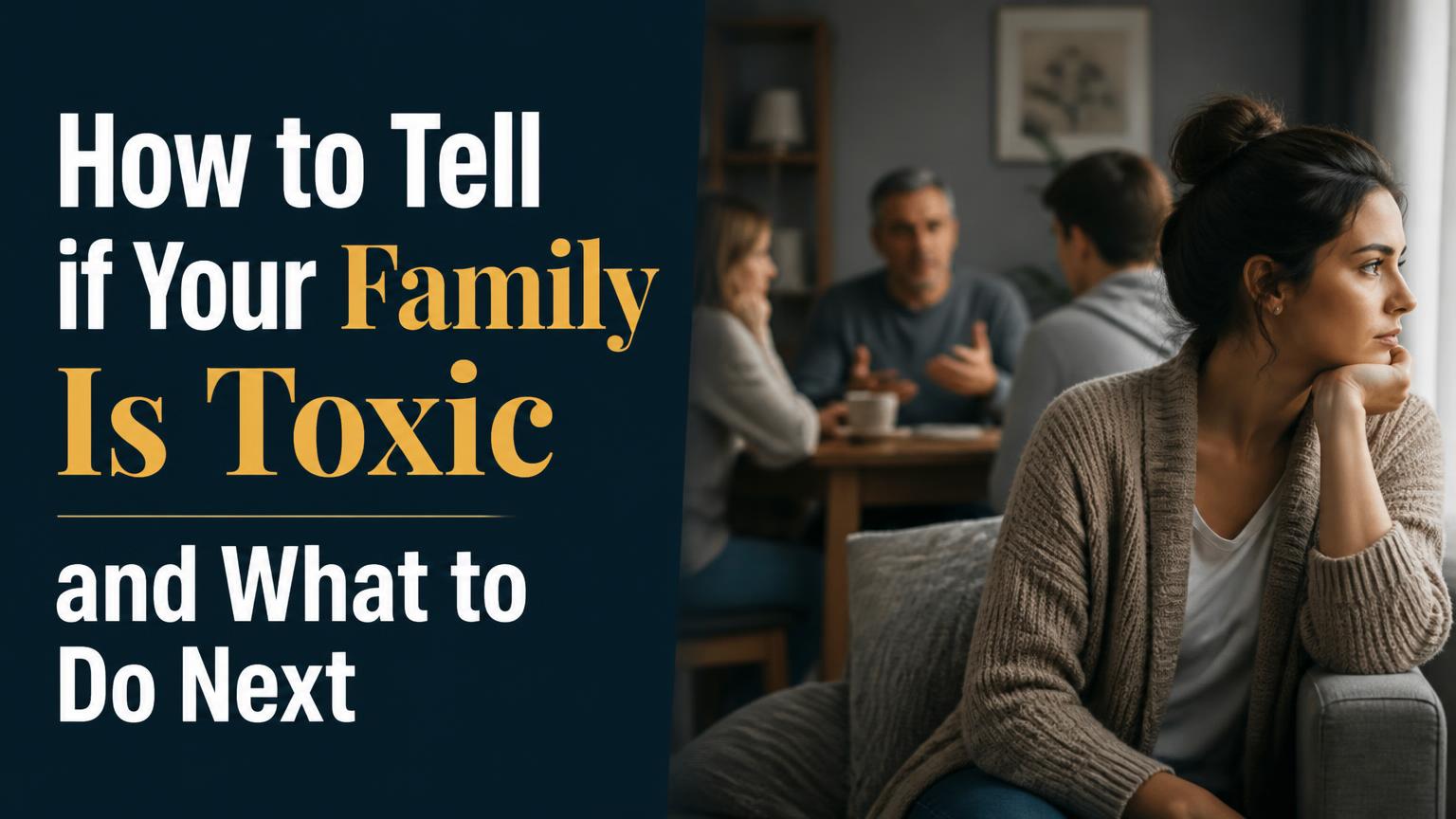
A toxic family is one in which recurring patterns of behavior undermine emotional well-being, personal boundaries, trust, or a person’s sense of safety. These patterns may involve constant criticism, manipulation, intimidation, favoritism, emotional neglect, or pressure to meet unreasonable expectations.
Every family experiences disagreements, misunderstandings, and periods of tension. What distinguishes a toxic family dynamic is the persistence of harmful behavior, its effects on family members, and the difficulty of addressing problems without facing further mistreatment.
Learning how to tell if your family is toxic involves looking beyond isolated arguments and examining how family members consistently treat one another. Recognizing these patterns can help you understand your relationships, determine what needs to change, and decide how to protect your well-being.
How to Tell if Your Family Is Toxic
The clearest signs of a toxic family are repeated behaviors that leave family members feeling disrespected, controlled, emotionally unsafe, or unable to express themselves freely. These behaviors often become so familiar that people begin treating them as normal parts of family life.
No single disagreement proves that a family is toxic. The more revealing questions concern how often harmful interactions occur, whether family members take responsibility for their behavior, and what happens when someone attempts to address a problem.
1. Constant Criticism and Belittling Are Normalized
Constructive criticism helps someone recognize a problem and improve. Toxic criticism attacks a person’s character, intelligence, appearance, abilities, or worth.
A family member might repeatedly make comments about someone’s weight, career, relationships, or personal decisions. Even significant accomplishments may be dismissed or compared unfavorably with those of siblings or relatives.
The distinction lies partly in the pattern and purpose of the communication. Constructive feedback addresses specific behavior while preserving respect. Belittling comments humiliate, undermine confidence, or communicate that someone is never good enough.
Over time, repeated criticism may contribute to self-doubt and make family members reluctant to share their achievements, opinions, or ambitions.
2. Your Feelings Are Regularly Dismissed or Invalidated
Emotional invalidation occurs when someone consistently dismisses, ridicules, or refuses to acknowledge another person’s emotional experience.
Common responses include:
- “You’re too sensitive.”
- “Stop making everything such a big deal.”
- “You have nothing to be upset about.”
- “That never happened the way you remember it.”
- “Other people have real problems.”
Family members do not have to agree about every event to acknowledge one another’s feelings.
For example, a parent might disagree with an adult child’s interpretation of an argument while still recognizing that the conversation was upsetting.
A concerning pattern develops when emotional expression repeatedly results in ridicule, punishment, or dismissal. Family members may eventually stop discussing their feelings because doing so appears pointless or risky.
3. Personal Boundaries Are Consistently Ignored
Healthy family relationships allow individuals to maintain reasonable privacy, independence, and personal preferences.
In a toxic family dynamic, boundaries may be treated as insults, disobedience, or evidence of disloyalty.
Examples include parents reading an adult child’s private messages, relatives demanding access to personal financial information, or family members repeatedly entering private spaces without permission.
The problem becomes particularly clear when someone communicates a reasonable boundary and the family responds with hostility, guilt, or deliberate violations.
Family closeness does not eliminate the right to personal autonomy. A relative may dislike a boundary without having the right to disregard it.
4. Guilt and Obligation Are Used to Control Decisions
Family relationships naturally involve responsibilities, sacrifices, and mutual support. However, these expectations can become unhealthy when guilt is repeatedly used to pressure someone into compliance.
A parent might say, “After everything I’ve done for you, this is how you repay me,” whenever an adult child makes an independent decision.
Another relative might threaten to withdraw affection or stop speaking to someone unless that person follows the family’s wishes.
This pattern can make ordinary decisions feel like moral failures.
The important distinction is between expressing genuine disappointment and using emotional pressure to override another person’s choices. Family members can reasonably request help, but requests become controlling when refusal consistently triggers punishment or threats.
5. Family Members Refuse to Take Responsibility
All families make mistakes. Healthy relationships depend partly on the ability to acknowledge those mistakes, apologize, and change behavior.
In unhealthy family dynamics, responsibility may be consistently avoided through denial, blame-shifting, excuses, or counteraccusations.
For example, a relative who makes an insulting remark might respond to a complaint by saying, “You made me say it because of your attitude.”
Others may insist that the injured person apologize for raising the issue.
An occasional defensive response is not enough to establish a toxic pattern. The concern arises when accountability is consistently absent and attempts to resolve problems repeatedly become arguments about why the person raising the concern is supposedly at fault.
6. Favoritism and Unfair Comparisons Create Division
Persistent favoritism can damage family relationships by assigning different levels of worth, responsibility, or privilege to family members.
One sibling may receive praise and understanding while another faces constant criticism. A parent might excuse one child’s behavior while punishing another for similar conduct.
Families sometimes develop rigid roles, such as the responsible child, the troublemaker, or the family disappointment.
These labels can continue into adulthood even when they no longer reflect reality.
Not every difference in treatment is unfair. Children of different ages or with different needs may require different forms of support. The warning sign is a persistent double standard that humiliates, excludes, or unfairly burdens particular family members.
7. Disagreements Lead to Intimidation or Emotional Punishment
Conflict becomes especially concerning when family members cannot disagree without fearing retaliation.
A relative might respond to disagreement with shouting, threats, humiliation, prolonged hostile silence, or attempts to turn other family members against the person who spoke up.
Some families use withdrawal of affection as punishment, making acceptance conditional on obedience.
There is an important difference between taking time to calm down and deliberately using silence to punish someone. A person who says they need an hour before continuing a difficult conversation is not necessarily behaving harmfully.
Repeated intimidation or punishment for expressing reasonable disagreement, however, can create an environment in which people remain silent to avoid consequences.
8. Your Independence Is Treated as a Threat
Families may struggle when relationships change, particularly as children become adults.
A concerning pattern emerges when family members repeatedly interfere with independent decisions about education, employment, marriage, friendships, finances, or living arrangements.
A parent may insist on approving an adult child’s partner or threaten to withdraw support unless the child follows a preferred career.
Advice and concern are not inherently toxic. Families can offer strong opinions while respecting another adult’s right to decide.
Control becomes problematic when relatives attempt to enforce their preferences through threats, surveillance, financial pressure, or emotional punishment.
9. Private Information Is Used Against You
Trust requires confidence that personal information will not be deliberately exploited.
In unhealthy family relationships, someone may reveal sensitive information to embarrass a relative, use past mistakes during unrelated arguments, or share private conversations to gain influence over others.
A person who confides in a sibling about relationship difficulties might later discover that the information has been circulated among relatives without permission.
Accidental disclosures and differences in privacy expectations can sometimes be resolved through communication. Repeated betrayals, especially after clear requests for confidentiality, indicate a more serious trust problem.
10. You Feel You Must Constantly Monitor Your Behavior
One of the more revealing signs of a harmful family environment is the need to continually anticipate another person’s reactions.
Someone might carefully choose every word, conceal harmless opinions, or avoid ordinary activities because they fear provoking anger or criticism.
This experience is sometimes described as walking on eggshells.
It can develop when reactions are unpredictable or disproportionately severe. Family members may become preoccupied with preventing conflict rather than communicating openly.
Feeling nervous around relatives does not automatically prove that they are behaving abusively. Anxiety can have several causes. However, when fear consistently follows identifiable patterns of intimidation, humiliation, or retaliation, those behaviors deserve serious attention.
What Makes a Family Toxic Rather Than Simply Dysfunctional?
The terms toxic family and dysfunctional family overlap, but they are not formal clinical diagnoses or precisely defined categories.
A dysfunctional family has recurring difficulties in communication, responsibilities, emotional support, or conflict resolution. These difficulties may arise from stress, poor communication habits, unresolved disagreements, or other circumstances.
A family described as toxic generally has persistent interactions that cause significant harm or undermine members’ autonomy and emotional security.
The distinction is not absolute. A dysfunctional family can contain harmful patterns, and a family may have serious problems without every relationship within it being unhealthy.
More useful than choosing a label is evaluating four factors:
- Frequency: Does the behavior happen occasionally or repeatedly?
- Severity: Is it frustrating, humiliating, threatening, or dangerous?
- Accountability: Do family members acknowledge harm and make meaningful changes?
- Impact: Does the behavior interfere with emotional well-being, independence, or everyday functioning?
These questions help distinguish ordinary family imperfections from relationships that require stronger protective measures.
How Toxic Family Dynamics Can Affect Your Well-Being
Repeated exposure to hostile or controlling family interactions can affect how people understand themselves and relate to others.
The effects vary according to the severity and duration of the behavior, the person’s circumstances, and the availability of supportive relationships.
Self-esteem and confidence may suffer when criticism and unfavorable comparisons become routine. Someone who repeatedly hears that their decisions are foolish may begin doubting their judgment even in unrelated situations.
Emotional well-being can be affected by ongoing tension, unpredictability, or fear of conflict. Some people experience anxiety, sadness, irritability, or difficulty relaxing around family members.
Relationship expectations may also change. A person accustomed to having their boundaries ignored might struggle to recognize when others are being intrusive or controlling.
Decision-making can become difficult when independent choices have repeatedly triggered guilt or punishment. Even ordinary decisions may provoke excessive worry about disappointing others.
These experiences do not mean that everyone raised in a harmful family will develop lasting psychological difficulties. Supportive relationships, changing circumstances, and opportunities to develop independence can make a substantial difference.
What to Do When You Recognize Toxic Family Patterns
Recognizing harmful behavior is only the beginning. The next step is deciding how to respond in a way that reflects the seriousness of the situation and your practical circumstances.
Identify the Specific Behaviors That Need to Change
Rather than focusing exclusively on whether someone is a toxic person, identify what they actually do.
For example, replace the broad observation “My family never respects me” with something more specific: “My relatives repeatedly share personal information after I ask them to keep it private.”
Specific observations help clarify the problem and distinguish recurring patterns from isolated incidents.
They also make it easier to determine whether a change has occurred.
Establish Boundaries You Can Maintain
A useful boundary identifies what behavior you will accept and what action you will take if it continues.
For example: “I’m willing to discuss my career, but if the conversation becomes insulting, I’ll end it.”
The boundary does not require another person to agree. It describes your own response.
Begin with limits that are realistic for your circumstances. Someone who lives independently may have more freedom to reduce contact than a person who depends on relatives for housing or financial support.
In relationships involving threats, coercive control, or violence, openly announcing boundaries may increase danger. Safety planning and confidential support may be more appropriate than confrontation.
Adjust How Much Personal Information You Share
When relatives repeatedly misuse sensitive information, reducing disclosure can protect privacy.
This might involve discussing neutral subjects, declining intrusive questions, or sharing important decisions only after they have been finalized.
Selective disclosure is not necessarily dishonesty. People can maintain family relationships without granting every relative unrestricted access to their personal lives.
Decide What Level of Contact Is Appropriate
Family contact does not have to be all-or-nothing.
Depending on the circumstances, someone might shorten visits, reduce the frequency of phone calls, meet relatives in public places, or temporarily limit contact while considering their options.
For some people, maintaining a relationship with clearer limits is possible. Others may find that repeated violations make continued contact harmful.
Ending contact is a significant decision, particularly when children, caregiving responsibilities, shared housing, or financial dependence are involved. It should not be treated as the automatic response to every difficult family relationship.
Seek Support Outside the Family When Necessary
Trusted friends, supportive relatives, counselors, or other appropriate professionals can provide perspective when harmful interactions have become normalized.
Outside support may be especially valuable when someone struggles to assess recurring behavior or feels isolated from people who could help.
If family interactions involve threats, physical violence, stalking, or coercive control, prioritize safety. A domestic abuse support service may be able to help assess risks and develop a practical safety plan, including when the harmful person is a parent, sibling, or other relative rather than a romantic partner.
Can a Toxic Family Relationship Improve?
Yes, some harmful family relationships improve, particularly when the people involved recognize the problem and consistently change their behavior.
Improvement requires more than apologies or temporary periods of friendliness.
Meaningful progress may involve family members listening without retaliation, accepting reasonable boundaries, acknowledging specific mistakes, and changing how they handle disagreements.
Progress is best assessed through sustained behavior rather than promises.
For example, a parent who previously interfered with an adult child’s decisions may begin offering advice only when invited and accepting decisions they dislike.
However, one person’s willingness to improve cannot guarantee that other relatives will cooperate.
Reconciliation also does not require overlooking serious harm. Where abuse or intimidation is present, safety and accountability matter more than restoring the appearance of family harmony.
Is It Possible to Love Your Family and Still Recognize Toxic Behavior?
Loving family members and recognizing harmful behavior are not mutually exclusive.
A person may appreciate a parent’s sacrifices while acknowledging that the parent frequently violates boundaries. Someone may enjoy spending time with siblings while refusing to participate in conversations involving humiliation or manipulation.
Family relationships often contain both positive and negative experiences. Recognizing harmful patterns does not require denying every good memory or assuming that relatives have malicious intentions.
Likewise, understanding that someone experienced hardship or has difficulty managing emotions does not mean accepting repeated mistreatment.
Compassion concerns how a person is understood. Boundaries concern what behavior is acceptable. Both can exist within the same relationship.
When Family Behavior Becomes Abuse
Not every unhealthy family interaction constitutes abuse. However, some patterns extend beyond poor communication or ordinary conflict.
Emotional abuse may involve persistent humiliation, threats, degradation, or intimidation. Coercive control involves patterns of behavior that restrict another person’s autonomy through fear, isolation, monitoring, or other forms of pressure.
Physical violence, sexual abuse, credible threats, and serious restrictions on freedom require particular attention.
The distinction matters because strategies appropriate for ordinary disagreements may be unsafe in abusive situations.
For example, encouraging two relatives to communicate more openly may help resolve a misunderstanding. It may not be appropriate when one person uses threats or violence to maintain control.
In those circumstances, seeking confidential, specialized support and making decisions around personal safety should take priority over attempting to persuade the harmful family member to change.
How to Evaluate Your Family Relationships More Clearly
If you remain uncertain whether your family relationships are unhealthy, consider the overall pattern rather than relying on one particularly upsetting interaction.
Ask yourself:
- Can I express disagreement without fearing threats or humiliation?
- Are my reasonable requests for privacy respected?
- Do family members acknowledge mistakes and attempt to repair harm?
- Am I allowed to make age-appropriate decisions independently?
- Do disagreements lead to discussion, or repeatedly to punishment and intimidation?
- Can I trust relatives with sensitive personal information?
- Are problems improving, remaining unchanged, or becoming more severe?
These questions are not a diagnostic test. They provide a framework for identifying behaviors that deserve attention.
The most useful evidence is often what happens over time, especially after concerns have been communicated and reasonable opportunities for change have been available.
A family does not need to be perfect to be supportive. Respect, accountability, and the ability to disagree safely are more meaningful indicators than the absence of conflict.
Conclusion
Knowing how to tell if your family is toxic means recognizing persistent patterns of criticism, manipulation, disrespect, intimidation, or control rather than judging the relationship by occasional disagreements.
The most revealing signs are repeated harmful behavior, limited accountability, and the consequences for family members’ emotional well-being and independence.
Recognizing these patterns does not require immediately ending relationships or assigning permanent labels to relatives. It provides a clearer basis for deciding what needs to change, what boundaries are appropriate, and what level of contact is safe and sustainable.