
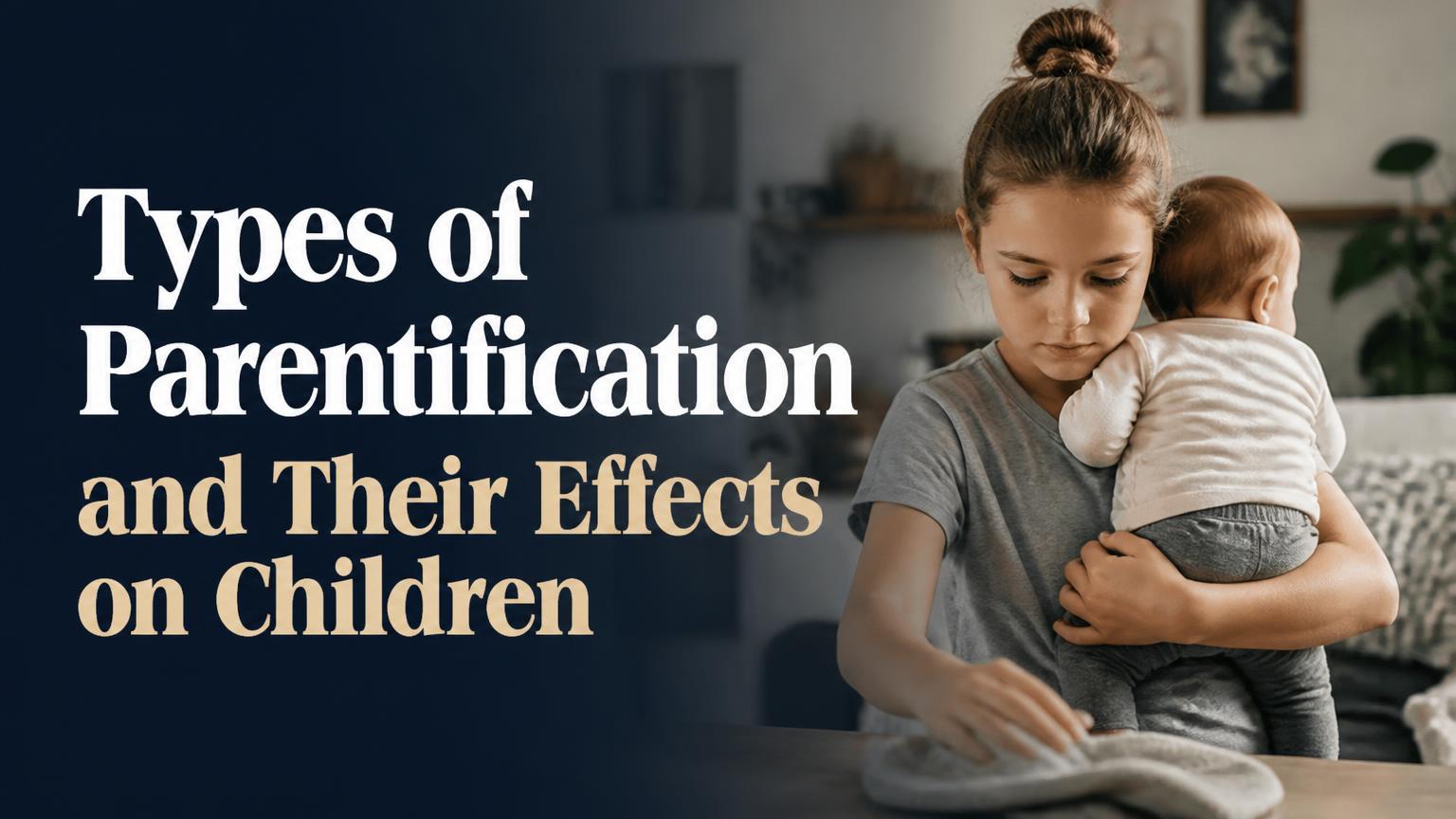
Parentification occurs when a child takes on responsibilities that ordinarily belong to a parent or another adult. Instead of receiving age-appropriate care and guidance, the child becomes responsible for meeting practical or emotional needs within the family. This reversal of roles can affect childhood development, family relationships, and emotional well-being.
The two main types of parentification are emotional parentification and instrumental parentification. Emotional parentification involves meeting the emotional needs of parents or other family members, while instrumental parentification involves managing practical responsibilities that exceed a child’s developmental capacity.
Although helping at home and supporting family members are normal parts of growing up, parentification involves a more significant shift in responsibility. Understanding its different forms helps distinguish healthy family contributions from situations in which children are expected to function as caregivers.
Types of Parentification
Parentification is generally divided into two primary types: emotional and instrumental. Both involve a reversal of typical parent-child responsibilities, but they differ in the kinds of demands placed on the child.
These forms can occur independently or together. A child might become responsible for household management while also serving as a parent’s main source of emotional support.
1. Emotional Parentification
Emotional parentification occurs when a child becomes responsible for managing, supporting, or regulating the emotional needs of a parent or another family member.
Rather than relying primarily on other adults for emotional support, a parent may turn to the child for reassurance, comfort, advice, or help coping with personal difficulties.
For example, a parent experiencing marital problems might repeatedly discuss intimate relationship conflicts with a child and expect the child to provide guidance. The child may feel responsible for keeping the parent calm, preventing arguments, or restoring emotional stability within the household.
Common examples of emotional parentification include:
- Becoming a parent’s confidant: A child regularly listens to adult relationship problems, financial anxieties, or personal frustrations and is expected to provide emotional support.
- Managing a parent’s emotions: A child feels responsible for preventing a parent’s anger, sadness, or distress.
- Mediating family conflicts: A child repeatedly intervenes in disagreements between parents or other family members.
- Providing constant reassurance: A parent depends on the child for validation, encouragement, or a sense of emotional security.
- Suppressing personal needs: A child avoids expressing sadness, fear, or frustration because doing so might upset the parent.
The defining issue is not that a parent occasionally shares feelings with a child. Healthy families allow emotional openness, and children can learn empathy by seeing adults express emotions appropriately.
The problem develops when emotional responsibility becomes excessive, persistent, or one-sided.
A child may begin to believe that maintaining the parent’s happiness is a personal obligation. This can encourage constant monitoring of other people’s moods and discourage the child from expressing independent emotional needs.
Emotional parentification can be particularly difficult to recognize because the child may appear unusually mature, compassionate, or emotionally intelligent.
However, apparent maturity does not necessarily mean the child is developmentally prepared for the responsibilities being imposed.
2. Instrumental Parentification
Instrumental parentification occurs when a child assumes practical caregiving or household responsibilities that would ordinarily be managed by an adult.
These responsibilities may involve maintaining the household, caring for siblings, managing finances, or attending to a parent’s physical needs.
For example, a twelve-year-old might be expected to prepare meals every evening, supervise younger siblings, complete household chores, and ensure everyone gets ready for school because a parent is frequently unavailable.
Common examples include:
- Caring for younger siblings: A child becomes the primary caregiver, regularly supervising, feeding, bathing, or preparing siblings for school.
- Managing household responsibilities: A child handles cooking, cleaning, shopping, or other domestic duties beyond what is reasonable for their age.
- Handling family finances: A child becomes responsible for paying bills, managing household money, or resolving financial problems.
- Caring for an ill or disabled parent: A child provides extensive physical assistance, medication-related support, or other caregiving that exceeds their abilities.
- Managing adult appointments and obligations: A child repeatedly organizes medical visits, communicates with institutions, or handles responsibilities that require adult judgment.
Instrumental parentification differs from ordinary household participation because of the level, frequency, and consequences of the responsibilities.
Children benefit from learning practical skills. Preparing occasional meals, helping younger siblings, and completing chores can promote independence and confidence.
However, these activities become concerning when a child is expected to function as an essential adult caregiver without adequate support.
A child who occasionally watches a younger sibling while a parent prepares dinner is not necessarily experiencing parentification. A child who must consistently miss school to supervise siblings because no adult arrangements exist may be experiencing a serious reversal of caregiving responsibilities.
Instrumental parentification can also interfere with education, friendships, rest, and recreational activities.
The child’s responsibilities may become so extensive that ordinary childhood experiences are treated as secondary to maintaining the household.
3. Combined Emotional and Instrumental Parentification
Emotional and instrumental parentification frequently overlap.
A child may be expected to perform adult household duties while simultaneously providing emotional reassurance to a parent.
Consider a teenager living with a parent experiencing a prolonged period of illness. The teenager might prepare meals, manage household chores, supervise younger siblings, and provide emotional comfort when the parent becomes distressed.
Some of these contributions may be appropriate during a temporary family crisis, particularly when other adults provide support.
However, the situation becomes more concerning when the teenager carries these responsibilities indefinitely, lacks meaningful assistance, or feels unable to express personal needs.
Combined parentification can create competing demands. The child must complete practical tasks while remaining emotionally available to others.
This may leave little opportunity for relaxation, social development, or receiving support.
The combination can also make the family arrangement difficult to change. Other family members may come to depend on the child’s caregiving, while the child may associate personal worth with being indispensable.
4. Sibling-Focused Parentification
Sibling-focused parentification describes a pattern in which a child assumes a parental role toward brothers or sisters.
It is not generally considered a third primary type of parentification. Instead, it describes the person receiving care and may involve instrumental responsibilities, emotional responsibilities, or both.
For example, an older sibling may become responsible for enforcing rules, comforting younger children after family arguments, organizing daily routines, or making decisions about their welfare.
Sibling caregiving is not inherently harmful. Older children often help younger siblings, and these relationships can encourage cooperation and affection.
The distinction lies in whether the older child is expected to replace adult caregiving rather than supplement it.
Sibling-focused parentification may also complicate relationships between brothers and sisters. The caregiving child may develop authority over siblings without having the maturity, resources, or parental support needed to exercise that authority fairly.
Younger siblings may resist the arrangement, while the older child feels accountable for behavior that is ultimately the adults’ responsibility.
5. Parent-Focused Parentification
Parent-focused parentification occurs when a child takes responsibility for meeting a parent’s practical or emotional needs.
Like sibling-focused parentification, it describes the direction of caregiving rather than a separate primary category.
It may involve comforting a distressed parent, managing household responsibilities on the parent’s behalf, or becoming the parent’s principal source of companionship.
Parent-focused emotional parentification is especially relevant when a child is treated as an adult confidant or substitute emotional partner.
In some families, the child becomes involved in decisions or conversations about adult relationships that are inappropriate for their developmental stage.
This is sometimes described as spousification when a child is placed in a spouse-like emotional role. The term does not automatically imply sexual behavior or sexual abuse.
The central concern is that the parent-child relationship loses appropriate generational boundaries. The child is expected to provide forms of support that should primarily come from other adults.
Emotional vs. Instrumental Parentification
The distinction between emotional and instrumental parentification concerns what the child is expected to provide.
| Dimension | Emotional Parentification | Instrumental Parentification |
|---|---|---|
| Primary responsibility | Emotional support and regulation | Practical care and household management |
| Typical activities | Comforting parents, mediating conflicts, providing reassurance | Cooking, cleaning, sibling care, managing household tasks |
| Main burden | Responsibility for others’ emotional well-being | Responsibility for essential practical needs |
| Visibility | Often less obvious to outsiders | May be more observable |
| Potential consequences | Guilt, emotional suppression, difficulty separating personal needs from others’ needs | Fatigue, reduced leisure time, school difficulties, excessive responsibility |
| Common overlap | Practical caregiving may accompany emotional support | Emotional pressure may accompany household responsibilities |
Neither type is automatically more harmful than the other.
The effects depend on factors such as the child’s age, the intensity and duration of the responsibilities, available adult support, and whether the child has opportunities to develop independently.
Emotional parentification may be difficult for adults to recognize because there are no obvious household tasks to observe. Instrumental parentification may be more visible, but it can also be mistaken for admirable responsibility.
Both deserve attention when caregiving obligations consistently outweigh a child’s developmental needs.
What Causes Parentification in Families?
Parentification generally develops when family responsibilities shift toward a child because adult caregiving resources, boundaries, or support are insufficient.
Several circumstances can contribute to this pattern.
Parental illness or disability may increase the practical demands placed on children, particularly when families lack accessible caregiving assistance. However, disability or illness does not automatically lead to parentification. Many families organize appropriate support without making children responsible for adult needs.
Family separation or prolonged conflict can contribute when parents rely on children for emotional reassurance, ask them to take sides, or expect them to manage disagreements.
Substance-related problems or significant mental health difficulties may interfere with a parent’s ability to provide consistent care. In some households, children compensate by managing routines or attempting to stabilize family relationships.
Financial hardship and limited social support can increase the pressure on children to contribute to household functioning. The concern is not poverty itself but whether children must carry responsibilities that exceed their capacities without sufficient support.
Unclear family boundaries may also contribute. Some parents struggle to distinguish appropriate emotional closeness from depending on a child as though the child were another adult.
These circumstances are possible contributing factors, not proof that parentification exists. Families facing serious difficulties may still maintain appropriate caregiving roles.
How Parentification Affects Children
Parentification does not produce identical outcomes in every child. Its effects depend on the nature of the responsibilities, their duration, the child’s developmental stage, and the presence of supportive relationships.
Emotional Stress and Excessive Responsibility
A parentified child may experience persistent pressure to anticipate and meet other people’s needs.
When a child believes that a parent’s emotional stability or a sibling’s well-being depends on personal performance, ordinary mistakes can feel unusually consequential.
Some children develop excessive guilt when they cannot help, even when the situation is beyond their control.
This responsibility can contribute to anxiety, emotional exhaustion, or difficulty relaxing.
Difficulty Recognizing Personal Needs
Children who repeatedly prioritize others may have fewer opportunities to identify and express their own preferences, frustrations, and needs.
For example, a child accustomed to comforting an upset parent may hesitate to share personal problems because doing so could create additional distress.
Over time, some individuals carry this pattern into adulthood, automatically focusing on what others need before considering their own well-being.
This outcome is possible rather than inevitable.
Disruption of Education and Social Development
Instrumental parentification can interfere with school attendance, homework, extracurricular activities, and friendships when caregiving responsibilities consume substantial time.
A child may struggle to participate in ordinary social experiences because family obligations take priority.
These limitations matter because childhood development involves more than acquiring practical skills. Children also need opportunities for play, exploration, peer relationships, and gradual independence.
Effects on Adult Relationships
Some adults who experienced parentification report difficulty asking for help, delegating responsibility, or accepting care from others.
They may feel most comfortable in relationships where they provide support rather than receive it.
Others may struggle with resentment, guilt, or uncertainty about appropriate responsibility in close relationships.
These patterns are not universal, and adult relationship difficulties cannot automatically be attributed to childhood parentification. Later experiences, supportive relationships, and individual circumstances also influence development.
Possible Strengths and Adaptive Skills
Children who take on substantial responsibilities may develop practical competence, sensitivity to others, problem-solving abilities, or independence.
However, the development of useful skills does not establish that excessive caregiving was beneficial overall.
A child can become capable and resourceful while also experiencing emotional strain or developmental restrictions.
The important distinction is between gaining skills through supported, age-appropriate participation and developing them because essential adult responsibilities have been transferred to the child.
Healthy Responsibility vs. Harmful Parentification
Not every child who helps extensively at home is parentified.
Healthy responsibility involves tasks suited to a child’s age, abilities, and circumstances, with adults retaining ultimate accountability.
Parentification becomes more likely when the child is expected to meet essential family needs without adequate adult oversight or support.
Several questions help clarify the distinction:
- Is the responsibility age-appropriate? A teenager preparing an occasional family meal differs from a young child managing the household independently.
- Is adult support available? Children should be able to request assistance without being made responsible for solving every problem.
- Can the child decline or make mistakes? Healthy responsibilities allow for learning. Parentified children may experience intense pressure when they cannot fulfill expectations.
- Does caregiving interfere with development? Persistent disruption of schooling, friendships, sleep, or recreation is a significant concern.
- Are the child’s needs also being met? Family cooperation should not require children to consistently suppress their own emotional or practical needs.
Cultural expectations also deserve consideration. Families differ in how they distribute chores, sibling care, and intergenerational responsibilities.
A child’s contribution should therefore be evaluated in context rather than judged solely by the number of tasks performed.
Nevertheless, cultural norms do not eliminate the need for adequate care, protection, education, and developmentally appropriate expectations.
How to Recognize Signs of Parentification
Parentification may be difficult to identify because responsible behavior is often praised.
A child might appear exceptionally mature while carrying burdens that adults do not fully recognize.
Possible signs include consistently worrying about a parent’s emotions, feeling responsible for family conflicts, regularly missing activities because of caregiving duties, or expressing guilt about pursuing personal interests.
Other indicators may include excessive concern about household problems, reluctance to ask for help, and difficulty behaving spontaneously around family members.
No single behavior confirms parentification.
A responsible child is not necessarily parentified, and a child who enjoys helping family members is not automatically experiencing harm.
Recognition requires examining the broader pattern: what responsibilities the child carries, why they carry them, whether they are developmentally appropriate, and how adults respond when the child needs support.
How Parents Can Prevent or Reduce Parentification
Preventing parentification does not require removing every responsibility from children. The goal is to maintain appropriate roles while encouraging healthy participation in family life.
Parents and caregivers can begin by reviewing which responsibilities genuinely belong to adults.
Children may help with chores, but adults should remain accountable for ensuring that essential household and caregiving needs are met.
Emotional boundaries are equally important. Parents can discuss family difficulties honestly without expecting children to provide adult-level reassurance, resolve marital disagreements, or manage parental distress.
For example, a parent experiencing a difficult separation might acknowledge that the situation is stressful while reassuring the child that the adults are responsible for handling it.
When a child has already assumed excessive responsibilities, change may require gradually transferring tasks back to adults or arranging additional support.
This is especially important when illness, financial difficulties, or other pressures make the family dependent on the child’s contributions.
Parents can also acknowledge the burden without making the child responsible for comforting them about it. A statement such as, “You have been taking care of too much, and I am working on changing that,” recognizes the situation while returning responsibility to the adult.
Where substantial caregiving needs remain, assistance from relatives, community services, schools, or appropriate professionals may help create a more sustainable arrangement.
Can Someone Recover From Childhood Parentification?
People who experienced parentification can develop healthier expectations about responsibility, emotional support, and relationships.
Recovery does not necessarily mean rejecting family members or abandoning a caring personality.
It often involves learning to distinguish freely chosen support from obligations rooted in guilt or fear.
An adult who was expected to manage a parent’s emotions throughout childhood, for example, may need to recognize that listening compassionately does not require solving every emotional problem.
Practical changes might include declining responsibilities that exceed personal capacity, asking for assistance, allowing others to make their own decisions, and developing relationships in which support is reciprocal.
Some people find it useful to examine how childhood caregiving shaped their beliefs about being needed, valued, or responsible for others.
Professional support may be helpful when these patterns contribute to persistent distress or interfere significantly with relationships.
Childhood parentification does not determine a person’s future. Its influence can change as individuals develop new experiences, expectations, and sources of support.
Conclusion
The two primary types of parentification are emotional and instrumental parentification. Emotional parentification places responsibility for another person’s emotional needs on a child, while instrumental parentification involves excessive practical caregiving or household duties. Both may be directed toward parents, siblings, or other family members.
The defining concern is not whether children contribute to family life, but whether they are expected to carry responsibilities beyond their developmental capacity without adequate adult support.
Recognizing this distinction allows families to encourage responsibility and compassion while preserving children’s need for care, emotional security, and opportunities to grow.