
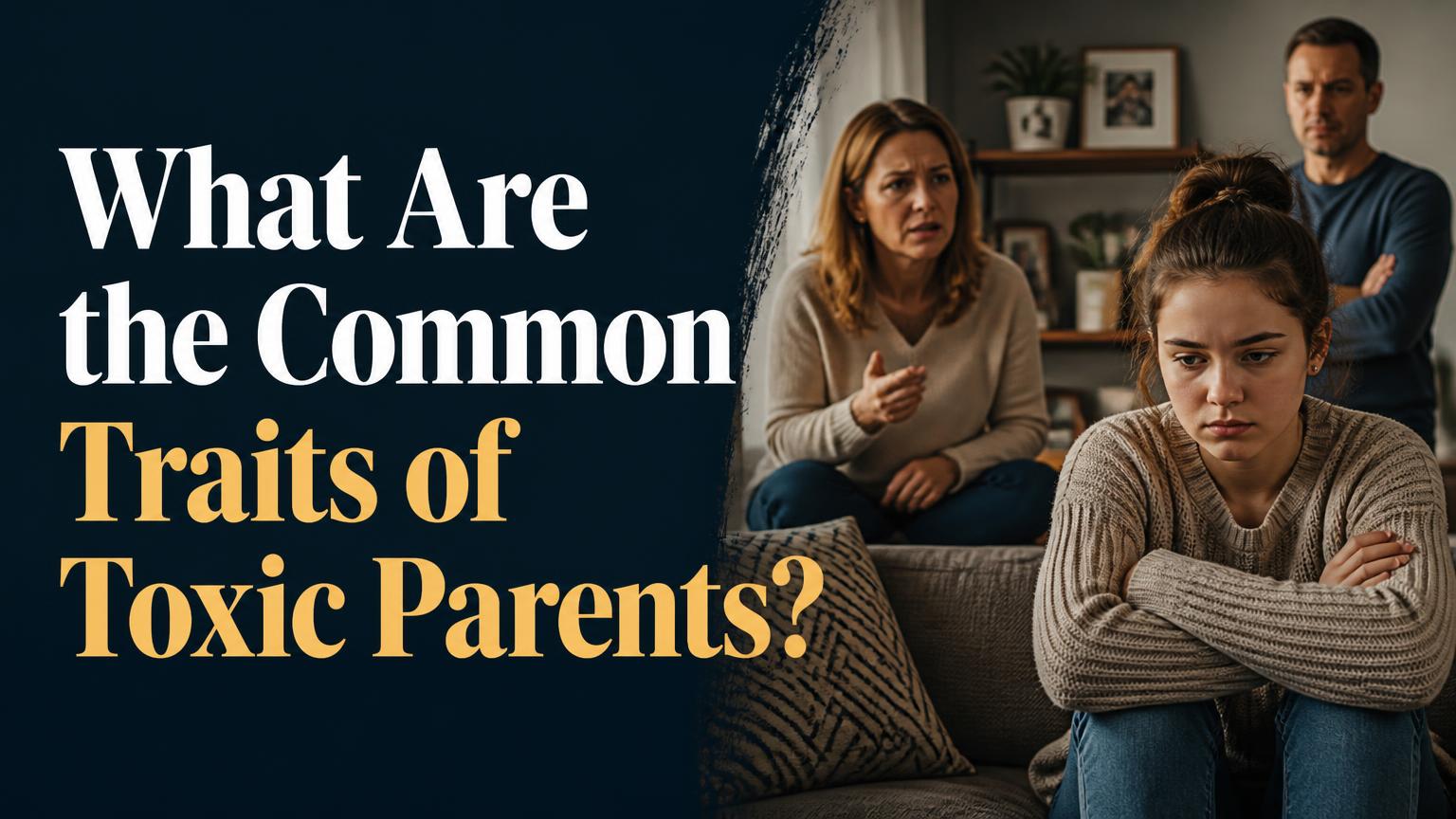
Toxic parents display recurring patterns of behavior that undermine their children’s emotional well-being, independence, or sense of security. Common traits include excessive control, constant criticism, emotional manipulation, disrespect for boundaries, unpredictable reactions, and an unwillingness to take responsibility for harmful behavior.
The term toxic parent is not a formal psychological diagnosis. It describes a pattern of parenting behaviors that can damage the parent-child relationship, particularly when those behaviors are persistent, severe, or resistant to change.
Recognizing these traits requires looking beyond occasional disagreements or parenting mistakes. The central questions are how a parent consistently treats their child, whether the child’s emotional and developmental needs are respected, and what happens when the child expresses disagreement or independence.
What Are the Traits of Toxic Parents?
The most common traits of toxic parents involve patterns of control, criticism, manipulation, emotional neglect, and disrespect. These behaviors may appear individually or together, and their effects depend on their frequency, intensity, and the child’s circumstances.
A parent does not need to exhibit every trait to create a harmful family environment. Likewise, displaying one of these behaviors occasionally does not automatically make someone a toxic parent.
1. Excessive Control Over Their Children’s Lives
Controlling parents attempt to direct aspects of their children’s lives beyond what is reasonable for their age, maturity, or circumstances.
They may insist on choosing their children’s friends, interests, educational paths, careers, or romantic partners. Some also attempt to control personal beliefs, appearance, or everyday decisions.
For younger children, parental guidance and appropriate supervision are necessary. The problem develops when control consistently replaces opportunities to develop judgment and independence.
For example, a parent might discourage an adult child from accepting a job in another city, not simply by expressing concerns, but by threatening to withdraw affection or financial support unless the child obeys.
The distinguishing feature is not parental involvement itself. It is the repeated refusal to recognize the child’s growing right to make independent decisions.
2. Constant Criticism and Belittling
Some parents repeatedly criticize their children’s abilities, appearance, personalities, or achievements.
Rather than offering constructive feedback about specific behaviors, they make negative judgments about the child’s overall worth.
Examples include:
- Calling a child stupid, lazy, worthless, or disappointing.
- Comparing the child unfavorably with siblings or peers.
- Dismissing accomplishments as insignificant.
- Ridiculing mistakes instead of helping the child learn.
- Making humiliating remarks disguised as jokes.
Constructive criticism identifies something that can improve while preserving the child’s dignity. Belittling attacks the person rather than addressing the behavior.
Repeated exposure to harsh personal criticism may contribute to shame, self-doubt, and difficulty developing a stable sense of self-worth.
3. Emotional Manipulation and Guilt-Tripping
Emotionally manipulative parents use guilt, fear, obligation, or emotional pressure to influence their children’s decisions.
They may suggest that a child’s independence represents betrayal or that refusing a request proves a lack of love.
For example, a parent might say, “After everything I’ve sacrificed for you, this is how you repay me,” when an adult child declines a family obligation.
Parents can legitimately express disappointment or ask for consideration. Manipulation becomes a concern when emotional pressure repeatedly replaces respectful discussion and the child is made responsible for protecting the parent’s feelings at the expense of reasonable personal needs.
Over time, children exposed to this pattern may struggle to distinguish genuine responsibility from guilt imposed by others.
4. Disrespect for Personal Boundaries
Toxic parenting patterns frequently involve disregarding reasonable personal boundaries.
Examples include reading private messages without adequate justification, sharing confidential information, entering personal spaces without respecting privacy, or refusing to accept an adult child’s decisions.
The appropriateness of privacy boundaries varies with age and safety needs. A parent supervising a young child’s internet use is not equivalent to a parent secretly monitoring an independent adult child’s communications.
A particularly revealing pattern occurs when a parent reacts to reasonable boundaries with punishment, threats, ridicule, or accusations of disloyalty.
Healthy parental involvement changes as children mature. Respecting boundaries allows the relationship to evolve from dependence toward greater mutual respect.
5. Refusal to Accept Responsibility
Parents who consistently refuse accountability may deny harmful behavior, minimize its consequences, or blame their children for their own reactions.
When confronted about an incident, they might respond by insisting that the child is too sensitive, denying what happened, or shifting attention toward the child’s supposed shortcomings.
An important distinction exists between disagreeing about an event and systematically refusing to consider another person’s experience.
For instance, a parent may genuinely remember a disagreement differently. That alone does not establish manipulation. A recurring refusal to acknowledge clear misconduct, however, makes repairing the relationship difficult.
Accountability involves recognizing specific actions, considering their effects, apologizing when appropriate, and making meaningful behavioral changes.
6. Conditional Love and Approval
Some parents communicate affection primarily when their children meet certain expectations.
Approval may depend on academic success, obedience, social status, religious participation, career choices, or conformity to family expectations.
A child who performs well might receive warmth and praise, while one who disappoints the parent encounters rejection or prolonged emotional distance.
Parental approval of particular behaviors can reasonably be conditional. A parent need not approve of every decision a child makes.
The harmful pattern emerges when the child’s basic sense of being loved and valued becomes dependent on compliance or achievement.
This can encourage children to measure their worth through performance rather than developing confidence in their inherent dignity.
7. Emotional Neglect and Lack of Empathy
Emotionally neglectful parents consistently fail to respond adequately to their children’s emotional needs.
They may provide food, clothing, education, and physical protection while remaining emotionally unavailable.
Common patterns include dismissing sadness, ignoring requests for comfort, discouraging emotional expression, or showing little interest in the child’s experiences.
For example, a child who reports being bullied might repeatedly hear, “Stop complaining and toughen up,” without receiving attention or support.
Not every emotionally reserved parent is neglectful. Temperament, cultural expectations, stress, and communication styles differ.
The concern is a persistent failure to recognize and respond to important emotional needs, particularly when the child has few other sources of support.
8. Unpredictable Anger and Emotional Reactions
Some parents react to ordinary situations with disproportionate anger, hostility, or unpredictable emotional outbursts.
A minor mistake might be ignored one day and provoke intense shouting the next.
Children living with these reactions may become unusually attentive to changes in mood, tone of voice, or facial expression because they cannot reliably predict how a parent will respond.
This pattern can create an atmosphere in which avoiding conflict becomes more important than expressing needs or telling the truth.
Occasional frustration is part of ordinary family life. The greater concern is repeated intimidation, explosive reactions, or punishment that is inconsistent and disproportionate.
9. Favoritism and Unfair Comparisons
Persistent favoritism occurs when parents consistently privilege one child while devaluing another without a reasonable basis.
One sibling might receive encouragement and forgiveness while another faces excessive criticism or blame.
Children have different needs, and equal treatment does not always mean identical treatment. A child with additional support needs may reasonably receive more parental attention.
Favoritism becomes harmful when differences in treatment communicate that one child is fundamentally more deserving of love, respect, or belonging.
Such patterns can damage sibling relationships as well as the individual child’s relationship with the parent.
10. Making Children Responsible for Adult Emotions
Some parents expect their children to provide emotional support that exceeds what is developmentally appropriate.
A child may become the parent’s primary confidant about marital disputes, financial fears, loneliness, or personal crises.
This can involve emotional parentification, in which a child takes on caregiving responsibilities normally expected of an adult.
For example, a parent might repeatedly expect a teenager to mediate arguments between adults or manage the parent’s emotional distress.
Children can offer comfort and contribute to family life. The distinction lies in whether they are being assigned ongoing responsibility for adult problems at the expense of their own needs.
11. Using Silence or Withdrawal as Punishment
A parent may deliberately withhold communication, warmth, or affection to punish a child for disagreement or perceived disobedience.
This differs from taking time to calm down during a conflict.
A constructive pause might involve saying, “I’m upset, and I need some time before we discuss this.”
Punitive withdrawal, by contrast, may involve refusing to acknowledge the child for an extended period without explanation or using affection as leverage to secure compliance.
For dependent children, repeated emotional withdrawal can be particularly distressing because they rely on caregivers for reassurance and security.
12. Undermining Independence and Confidence
Some parents discourage their children’s attempts to become capable, self-reliant individuals.
They may insist that their children cannot succeed without them, interfere with independent decisions, or repeatedly emphasize potential failures.
For example, a parent might dismiss an adult child’s ability to manage money while simultaneously preventing opportunities to learn financial responsibility.
Concern about a child’s readiness can be legitimate. The harmful pattern is a persistent unwillingness to support age-appropriate competence and autonomy.
This behavior can leave children uncertain about their judgment even after they have developed the practical skills necessary for independence.
How Toxic Parenting Differs From Normal Parenting Mistakes
All parents make mistakes. They may lose patience, impose an unfair consequence, misunderstand a child’s needs, or respond poorly during stressful periods.
The distinction between imperfect parenting and a harmful pattern depends on more than whether a particular behavior has occurred.
Several factors help clarify the difference:
| Dimension | Ordinary Parenting Difficulties | Recurring Toxic Parenting Patterns |
|---|---|---|
| Frequency | Occasional mistakes or conflicts | Repeated harmful interactions |
| Accountability | Parent can acknowledge mistakes | Parent persistently denies or shifts blame |
| Respect | Child’s needs and perspective receive consideration | Child’s needs are routinely dismissed |
| Conflict | Disagreements can lead to discussion and repair | Disagreements regularly produce intimidation, humiliation, or punishment |
| Independence | Autonomy increases with maturity | Independence is repeatedly obstructed |
| Change | Parent makes efforts to improve | Harmful behavior continues despite opportunities to address it |
These differences are useful guides, not diagnostic criteria.
A single incident of serious physical violence, sexual abuse, or a credible threat can be dangerous even without a recurring pattern. Conversely, a parent may show several concerning behaviors without every interaction being harmful.
The severity of conduct, its consequences, and the child’s dependence on the parent all matter.
Why Do Some Parents Develop Toxic Behavior Patterns?
Harmful parenting behaviors can arise through several pathways. Understanding possible contributing factors does not excuse mistreatment or establish the motives of any particular parent.
Learned family patterns may influence parenting. Adults sometimes repeat approaches they experienced growing up, particularly if they have never encountered or practiced alternatives.
Poor emotional regulation can contribute to disproportionate anger, impulsive reactions, and difficulty responding calmly to frustration. These difficulties may occur without any diagnosable mental health condition.
Rigid beliefs about authority can also influence behavior. Parents who believe children should never question them may interpret reasonable disagreement as disrespect, making healthy negotiation difficult.
Chronic stress and inadequate support may reduce a parent’s capacity to respond patiently and consistently. Financial strain, relationship conflict, or overwhelming responsibilities can contribute to difficulties, although many parents facing these circumstances remain supportive and responsive.
Unresolved personal difficulties may affect parenting as well. Some parents struggle with insecurity, emotional dependency, substance misuse, or mental health problems. None of these factors automatically makes someone harmful, and no diagnosis can be inferred from parenting behavior alone.
Different parents may display similar behaviors for different reasons. Identifying a possible explanation is not the same as determining responsibility or deciding what behavior should be accepted.
How Toxic Parenting Can Affect Children
The consequences of harmful parenting vary considerably. They depend on the severity and duration of the behavior, the child’s developmental stage, other relationships, and available sources of support.
Effects on Self-Esteem and Identity
Persistent criticism, rejection, or conditional approval may contribute to a negative self-image.
Children can begin to internalize repeated judgments, interpreting mistakes as evidence that they are fundamentally inadequate.
As adults, some may continue to seek approval excessively or feel uncomfortable recognizing their own achievements.
These outcomes are possible, not inevitable. Supportive relationships and later experiences can help people develop healthier beliefs about themselves.
Difficulties With Trust and Relationships
Children learn about relationships partly through interactions with caregivers.
When parental affection is unpredictable or boundaries are repeatedly violated, they may develop expectations that closeness involves criticism, control, or emotional uncertainty.
Some people consequently find it difficult to trust others. Others may tolerate excessive demands because such interactions feel familiar.
However, childhood experiences do not determine adult relationship outcomes. People can develop different expectations and skills through subsequent relationships and intentional learning.
Anxiety, Stress, and Emotional Regulation
Persistent hostility, intimidation, or unpredictability can contribute to chronic stress.
A child who frequently anticipates an angry reaction may become highly alert to possible signs of conflict.
Some children respond by withdrawing, while others become highly compliant or struggle to regulate their own emotions.
These responses can also have other causes. They should not be treated as proof that a particular parent is responsible for a child’s psychological difficulties.
Problems With Independence and Decision-Making
Children whose choices are consistently overridden may have fewer opportunities to practice making decisions, evaluating consequences, and recovering from mistakes.
As adults, they may seek repeated reassurance or experience guilt when making independent choices.
The underlying difficulty is not necessarily a lack of ability. It may reflect limited opportunities to develop confidence through experience.
How to Recognize Toxic Patterns in a Parent-Child Relationship
Recognizing harmful patterns requires attention to specific behaviors rather than relying exclusively on labels or assumptions about intentions.
Useful questions include:
- Does the parent repeatedly humiliate, threaten, or intimidate the child?
- Are reasonable disagreements treated as disobedience or betrayal?
- Does the parent respect age-appropriate privacy and independence?
- Can the child express feelings without routinely being mocked or punished?
- Does the parent acknowledge mistakes and attempt to repair harm?
- Are affection and acceptance repeatedly withdrawn to secure compliance?
- Does the child have to manage the parent’s emotional reactions to maintain peace?
The answers should be considered within the broader context of the relationship.
A parent enforcing reasonable safety rules is not necessarily controlling. A parent disagreeing with an adult child’s choices is not automatically manipulative. Similarly, a child feeling disappointed by a decision does not by itself establish harmful parenting.
Patterns become more concerning when the child’s dignity, safety, emotional needs, or reasonable autonomy are consistently disregarded.
The term toxic can help describe an experience, but identifying the actual behavior is more useful for deciding how to respond.
How to Deal With a Parent Who Displays Toxic Traits
The appropriate response depends on the person’s age, degree of dependence, safety, and the severity of the parent’s behavior.
An adult living independently has options that a financially dependent teenager may not have.
Identify Specific Behaviors Rather Than Arguing About Labels
Describing a concrete behavior can make a concern easier to communicate.
For example, saying, “When you criticize my appearance during family gatherings, I feel embarrassed and want those comments to stop,” identifies the issue more clearly than accusing a parent of being toxic.
This approach may support productive discussion when the parent is willing to listen.
It will not necessarily work with someone who repeatedly intimidates, retaliates, or refuses to respect others.
Establish Boundaries That Can Be Maintained
A practical boundary identifies what behavior is unacceptable and what action the individual can take in response.
An adult child might decide to end a telephone conversation when shouting begins or decline to discuss private financial matters.
The boundary should focus on actions within the person’s control rather than attempting to force the parent to change.
For example: “I’m willing to discuss this when we can speak respectfully. If the shouting continues, I’ll end the call.”
Where confrontation could provoke violence or serious retaliation, safety planning and outside support take priority over directly announcing boundaries.
Adjust Expectations Based on Actual Behavior
Some parents respond positively when concerns are raised. Others repeatedly promise change without demonstrating it.
Evaluating consistent actions over time can help distinguish genuine improvement from temporary reassurance.
A parent who apologizes and gradually changes harmful behavior is demonstrating something different from one who apologizes but repeatedly resumes the same conduct.
Accepting that a parent may not change can help an adult child make realistic decisions about contact, disclosure, and emotional involvement.
Seek Appropriate Support
Trusted relatives, friends, school counselors, or qualified mental health professionals may help individuals understand difficult family dynamics and evaluate available options.
Support can be particularly valuable when someone is uncertain whether their experiences are ordinary conflict, emotional mistreatment, or abuse.
For minors experiencing threats, violence, or serious neglect, seeking help from a trusted adult or appropriate child protection service may be necessary.
When abuse or coercive control is present, safety should guide decisions about confrontation, family counseling, and contact.
Can Toxic Parents Change?
Parents who engage in harmful behavior can change, but improvement requires more than acknowledging that a relationship is strained.
Meaningful change generally involves recognizing specific behaviors, accepting responsibility, learning alternative responses, and demonstrating consistent improvement.
For example, a parent who previously reacted angrily to disagreement might begin listening without interruption, respecting decisions, and apologizing when they respond unfairly.
Progress may be gradual, and setbacks can occur. Nevertheless, repeated behavior over time provides a more reliable indication of change than isolated promises.
Children, including adult children, cannot make a parent change through perfect obedience, repeated explanations, or unlimited forgiveness.
A parent remains responsible for their own conduct.
Conclusion
The common traits of toxic parents include excessive control, repeated criticism, emotional manipulation, conditional affection, boundary violations, emotional neglect, and refusal to accept responsibility.
What makes these behaviors particularly concerning is their severity, persistence, and effect on the child’s dignity, security, and development.
Recognizing toxic parenting does not require labeling every parental mistake as harmful or assigning a psychological diagnosis. It requires examining observable patterns, distinguishing reasonable parental authority from damaging behavior, and recognizing that a child’s need for respect and safety remains legitimate even when the relationship is complicated.