
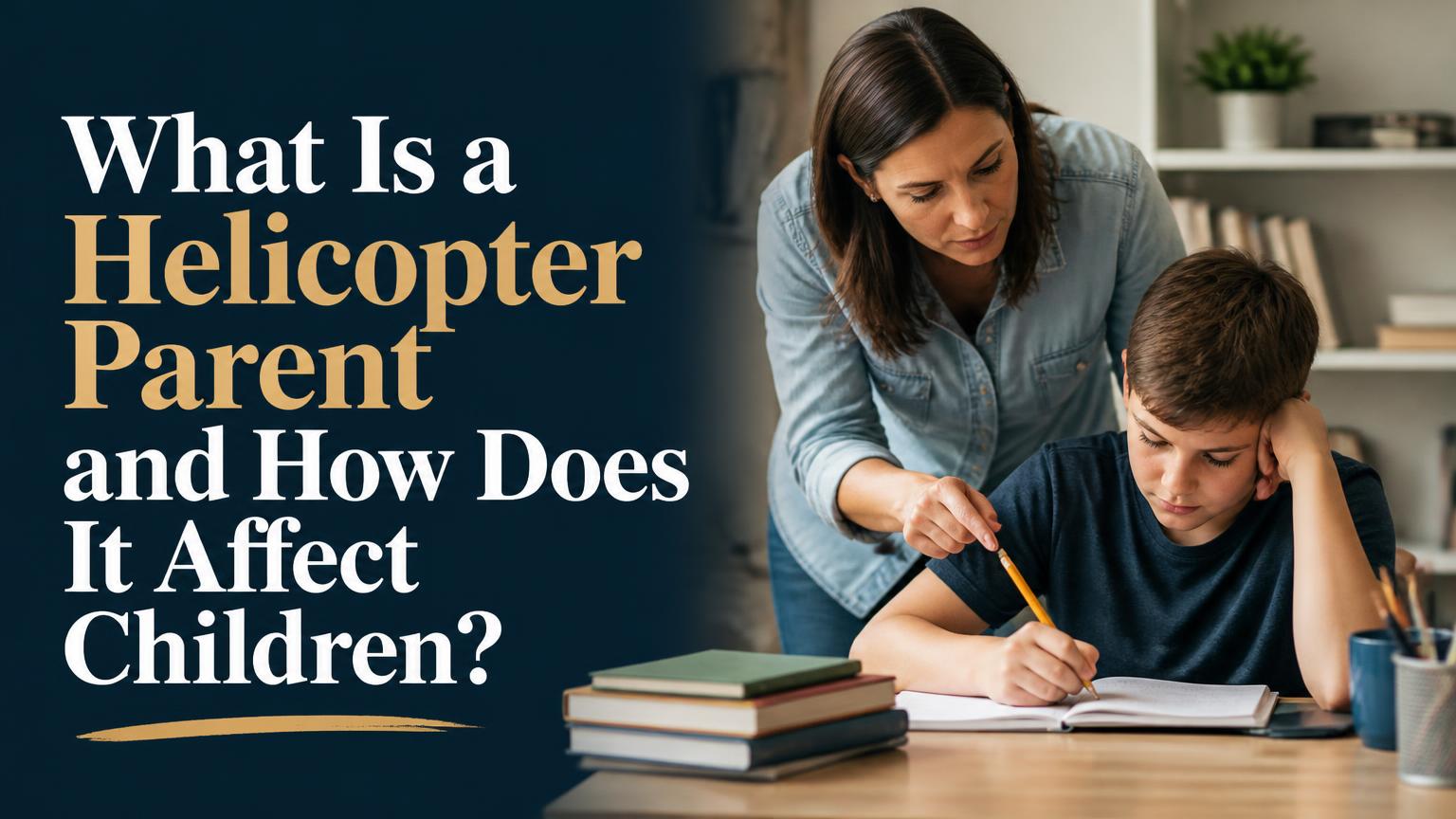
A helicopter parent is a parent who becomes excessively involved in their child’s life, closely monitoring their activities, managing their problems, and intervening in situations the child could reasonably handle independently. The term describes a parenting pattern in which adults appear to hover over their children, often with the intention of protecting them from failure, disappointment, or harm.
Although helicopter parenting usually comes from concern and a desire to help, excessive involvement can limit children’s opportunities to develop independence, confidence, decision-making skills, and resilience. Its effects depend on the child’s age, individual needs, and the degree of parental control.
Understanding what helicopter parenting looks like, why it develops, and how it affects children helps distinguish appropriate parental support from involvement that may interfere with healthy development.
What Is a Helicopter Parent?
A helicopter parent is someone who takes an unusually active role in supervising, directing, and managing their child’s experiences, sometimes beyond what is appropriate for the child’s developmental stage.
The defining characteristic is not simply being attentive or protective. It is repeatedly taking responsibility for tasks, decisions, and challenges that a child is capable of learning to manage.
Helicopter parenting can occur throughout childhood, adolescence, and even adulthood. However, what constitutes excessive involvement changes as children mature. Closely supervising a five-year-old crossing a busy street is responsible parenting. Insisting on accompanying a capable 20-year-old to every routine appointment may represent unnecessary interference.
Excessive Monitoring of Daily Activities
Helicopter parents often maintain unusually close oversight of their children’s schedules, friendships, academic responsibilities, and personal decisions.
They may constantly check homework, request detailed accounts of social interactions, or monitor activities that would ordinarily allow some independence.
For example, a parent might repeatedly contact a teenager throughout an ordinary outing despite having agreed on the destination, companions, and return time.
Monitoring becomes excessive when it is disproportionate to the child’s age, circumstances, or demonstrated responsibility. The concern is particularly significant when supervision prevents children from developing judgment through ordinary experience.
Intervening Whenever Problems Arise
Another characteristic is the tendency to intervene quickly when children encounter difficulties.
A helicopter parent might contact a teacher immediately after a disappointing grade, resolve a minor disagreement between friends, or take over a school assignment because the child appears frustrated.
Such interventions may solve the immediate problem. However, they can also remove opportunities for children to practice communication, persistence, negotiation, and problem-solving.
The distinction lies in whether parental assistance supports the child’s growing abilities or substitutes for them unnecessarily.
Making Decisions on Behalf of Children
Helicopter parenting frequently involves controlling decisions that children could increasingly make for themselves.
Parents might choose extracurricular activities, determine friendships, select academic subjects, or dictate educational and career pathways without allowing meaningful input.
Younger children naturally require more parental direction. As they mature, however, they benefit from opportunities to make age-appropriate choices and experience their consequences.
A parent who continually makes those decisions may unintentionally communicate that the child’s judgment cannot be trusted.
Protecting Children From Failure and Disappointment
Helicopter parents may work extensively to prevent their children from experiencing setbacks.
Examples include persuading teachers to reconsider ordinary grades, ensuring children never lose competitive activities, or completing difficult tasks to prevent frustration.
Protection from serious harm is a legitimate parental responsibility. Preventing every manageable disappointment is different.
Children develop resilience partly by encountering difficulties, experiencing uncomfortable emotions, and discovering that they can recover and try again.
Remaining Heavily Involved as Children Become Adults
Helicopter parenting does not necessarily end when children reach adulthood.
Some parents continue managing university responsibilities, employment decisions, finances, relationships, or routine administrative tasks for their adult children.
For instance, a parent might contact a university professor about an adult student’s grade without the student’s request or attempt to negotiate employment matters on their behalf.
Adult children may appreciate advice and assistance. The distinction is whether support is invited and respects their decision-making authority or is imposed in ways that undermine autonomy.
Common Examples of Helicopter Parenting
Helicopter parenting can appear in ordinary family situations, making it difficult to recognize when helpful involvement becomes excessive.
| Situation | Helicopter Parenting Behavior | More Independence-Supportive Approach |
|---|---|---|
| Homework | Correcting every answer or completing assignments | Helping the child understand instructions while allowing independent work |
| School grades | Immediately challenging every disappointing grade | Discussing what happened and encouraging the child to approach the teacher |
| Friendships | Intervening in every minor disagreement | Helping the child consider ways to resolve ordinary conflicts |
| Sports | Pressuring coaches to guarantee playing time | Supporting effort and helping the child manage disappointment |
| Daily routines | Constantly reminding an older child about every responsibility | Establishing expectations and gradually transferring responsibility |
| College | Managing assignments and contacting professors | Offering advice while allowing the student to manage academic matters |
| Employment | Making career decisions or communicating with employers | Helping the young adult evaluate options and make independent choices |
These examples are contextual rather than absolute rules. A child experiencing bullying, a serious learning difficulty, discrimination, or another significant problem may need direct adult intervention.
The central question is whether parental involvement is proportionate to the child’s abilities and the seriousness of the situation.
Why Do Parents Become Helicopter Parents?
Helicopter parenting can develop for several reasons, and parents may not recognize that their involvement has become excessive.
Fear for Their Child’s Safety and Well-Being
Concern about physical safety, emotional distress, academic difficulties, or social rejection can encourage parents to supervise children closely.
Some parents perceive everyday situations as more dangerous than they are. Others have experienced circumstances that reasonably heighten their vigilance.
When fear consistently outweighs an assessment of actual risk, parents may restrict opportunities for independence even in relatively safe environments.
Pressure to Ensure Their Child Succeeds
Academic competition, career expectations, and social pressure can contribute to excessive parental involvement.
Parents may believe that their children’s future opportunities depend on consistently strong performance.
Consequently, they might manage assignments, extracurricular activities, and educational decisions to minimize mistakes.
The unintended consequence is that children may achieve certain immediate results without developing the organizational and problem-solving abilities needed to sustain success independently.
Difficulty Accepting a Child’s Growing Independence
Parenting responsibilities change as children mature. Tasks that once required direct supervision gradually become responsibilities children can manage themselves.
Some parents find this transition difficult, particularly when they strongly identify with being needed.
Continuing to manage a child’s responsibilities can preserve familiar family routines, even when those routines no longer match the child’s developmental abilities.
This does not necessarily indicate selfishness or a desire for control. It may reflect uncertainty about how to remain supportive while allowing greater independence.
Anxiety About Mistakes and Uncertainty
Parents who struggle with uncertainty may find it difficult to watch children make choices with unpredictable outcomes.
Intervening can temporarily reduce parental anxiety because the adult feels more in control of the situation.
However, repeated intervention may reinforce the belief that ordinary difficulties require parental management.
This explanation applies to some families, but helicopter parenting should not automatically be interpreted as evidence of an anxiety disorder.
How Does Helicopter Parenting Affect Children?
The potential effects of helicopter parenting are most concerning when excessive involvement becomes a persistent pattern that limits age-appropriate independence.
Research has found associations between overprotective or overcontrolling parenting and difficulties involving autonomy, emotional adjustment, and psychological well-being. However, findings vary, and much of the research is correlational.
Parenting does not operate in isolation. Temperament, disability, family circumstances, peer relationships, and other experiences also influence development.
Reduced Independence and Decision-Making Skills
Children learn to make decisions through repeated opportunities to evaluate options, choose actions, and observe consequences.
When parents consistently make decisions for them, children receive fewer opportunities to develop those skills.
For example, a teenager whose parent manages every deadline may struggle to organize university assignments without reminders.
The difficulty may reflect limited practice rather than an inability to become independent.
As responsibilities increase, the gap between the child’s practical experience and the demands of everyday life may become more apparent.
Lower Confidence in Personal Abilities
Confidence develops partly through successful experiences of handling challenges.
When parents repeatedly intervene, children may have fewer opportunities to discover what they can accomplish independently.
Some may begin questioning their competence or seeking reassurance before making routine decisions.
A child who regularly hears a parent say, “Let me handle that,” may gradually come to expect adult intervention whenever a problem appears.
Nevertheless, parental assistance does not automatically damage confidence. Support that helps children acquire skills can strengthen their sense of competence.
The difference is whether assistance builds capability or replaces the child’s own efforts.
Greater Difficulty Managing Stress and Disappointment
Learning to tolerate manageable frustration is an important part of emotional development.
Children encounter disappointment when they lose games, receive criticism, experience disagreements, or fail to achieve goals.
If parents consistently eliminate these experiences, children may have fewer opportunities to practice coping strategies.
They may consequently find unfamiliar setbacks particularly challenging.
This does not mean children should be exposed to unnecessary suffering. Supportive parents can acknowledge distress, offer perspective, and help children recover without removing every obstacle.
Increased Anxiety and Emotional Dependence
Some studies have linked helicopter parenting with higher levels of anxiety, depressive symptoms, and emotional difficulties, particularly among adolescents and university students.
Several explanations are possible.
Excessive monitoring may communicate that ordinary situations are threatening. Constant intervention may also reduce opportunities to develop confidence in handling uncertainty.
However, the relationship can work in both directions. Parents may become more protective because a child already experiences anxiety or difficulty functioning independently.
Therefore, it would be inaccurate to assume that helicopter parenting is the sole cause of a child’s emotional difficulties.
Difficulties With Problem-Solving and Conflict Resolution
Problem-solving requires practice.
Children benefit from learning how to identify problems, consider alternatives, negotiate disagreements, and evaluate outcomes.
When parents routinely take over these situations, children may become accustomed to relying on someone else to resolve difficulties.
For example, a child whose parent always handles minor friendship disputes may have fewer opportunities to practice apologizing, expressing disagreement, or finding compromises.
These skills become increasingly important in adult relationships, education, and employment.
Strained Parent-Child Relationships
Excessive involvement can create tension when children seek greater privacy and autonomy.
Adolescents may interpret constant monitoring as a lack of trust. Adult children may experience unsolicited intervention as disrespect for their independence.
Some respond by arguing or withdrawing. Others avoid discussing problems because they expect their parents to take control.
Yet not every closely involved family experiences conflict. Cultural expectations, mutual agreement, and the manner in which parents provide assistance influence how involvement is perceived.
The relevant issue is whether the relationship allows increasing autonomy while maintaining appropriate support.
Helicopter Parenting vs. Supportive Parenting
Helicopter parenting is sometimes confused with attentive, responsible parenting.
Both can involve considerable time, emotional investment, and concern for children’s well-being. The difference is how parents use their involvement.
Supportive parenting helps children develop the ability to manage their lives. Helicopter parenting tends to manage their lives for them.
A supportive parent may help a child prepare for a difficult conversation, then encourage the child to speak independently.
A helicopter parent may conduct the conversation instead, even when the child is capable of participating.
Supportive parenting also includes setting appropriate limits. Allowing independence does not mean permitting every decision or abandoning supervision.
Parents can establish clear expectations, provide guidance, and intervene when necessary while still encouraging autonomy.
Developmental psychologists often describe a balanced approach as authoritative parenting: combining warmth, responsiveness, clear expectations, and age-appropriate independence.
This differs from authoritarian parenting, which emphasizes obedience and control, and permissive parenting, which provides relatively few limits.
Helicopter parenting is not a separate formal category within that traditional classification. It describes a pattern of excessive involvement that can occur alongside different parenting styles.
Is Helicopter Parenting Always Harmful?
Helicopter parenting is not automatically harmful in every circumstance, and individual acts of close supervision should not be treated as evidence of a problematic parenting pattern.
Children differ in their abilities, developmental needs, and exposure to risk.
A child with certain disabilities, significant medical needs, or substantial difficulties managing daily responsibilities may reasonably require more parental assistance than another child of the same age.
Similarly, direct parental intervention may be necessary when a child faces bullying, exploitation, serious academic barriers, or threats to safety.
Cultural and family expectations also influence how parental involvement is understood. Close family participation in educational and personal decisions does not necessarily mean that children lack autonomy.
The concern arises when involvement consistently exceeds what is needed and interferes with the child’s opportunities to develop appropriate capabilities.
Three considerations are particularly useful: whether the child can reasonably handle the situation, whether intervention is necessary to prevent meaningful harm, and whether the parent’s actions support or replace the child’s developing abilities.
How to Stop Being a Helicopter Parent
Parents who recognize excessive involvement can gradually change their approach without withdrawing emotional support.
The objective is not to become less caring. It is to provide assistance in ways that encourage growing competence and responsibility.
Allow Children to Handle Age-Appropriate Responsibilities
Begin by identifying tasks a child can reasonably perform with less assistance.
A younger child might organize school materials or choose clothing appropriate for the weather. An older child might manage homework deadlines, communicate with teachers, or plan transportation.
Responsibilities should increase gradually, taking account of maturity and individual needs.
Parents can explain expectations, provide initial instruction, and remain available when genuine assistance is necessary.
Ask Questions Before Offering Solutions
Instead of immediately solving a problem, invite children to think through possible responses.
Questions such as “What have you tried so far?” or “What do you think would happen if you chose that option?” encourage independent reasoning.
This approach helps children practice identifying alternatives and considering consequences.
If a child becomes overwhelmed, the parent can offer more structured assistance without automatically taking over.
Allow Manageable Mistakes
Children need opportunities to experience the natural consequences of ordinary decisions.
Forgetting a nonessential item, receiving a disappointing grade, or making an unsuccessful choice can provide useful information about planning and responsibility.
Parents can help children reflect afterward by discussing what happened and what they might do differently.
However, allowing mistakes should never involve withholding necessary protection or exposing children to serious, foreseeable harm.
The goal is learning through manageable experience, not punishment through avoidable suffering.
Reduce Monitoring as Responsibility Increases
Supervision should evolve alongside demonstrated competence.
For example, parents might initially help a teenager plan a weekly schedule, then gradually reduce reminders as the teenager becomes more reliable.
Clear agreements about safety, communication, and responsibilities can make this transition easier.
Rather than abandoning oversight abruptly, parents can adjust their involvement based on the child’s progress and circumstances.
Separate Parental Worry From Actual Risk
Before intervening, parents can consider whether the situation presents a meaningful danger or simply creates discomfort.
A child struggling with a challenging assignment may feel frustrated without being at risk. A child facing persistent harassment may require adult assistance.
Recognizing this difference helps parents respond proportionately.
Parents who experience persistent worry may also benefit from developing their own strategies for managing uncertainty rather than relying on increased supervision to relieve it.
Encourage Independence Without Withdrawing Support
Children should understand that becoming more independent does not mean losing access to parental guidance.
A parent might say, “I think you can handle this conversation, but I’m available if you want to talk through what to say.”
This communicates confidence while preserving connection.
As children mature, parental involvement can increasingly shift from directing decisions toward offering perspective, practical assistance, and encouragement when appropriate.
What Should Adult Children Do About Helicopter Parents?
Adult children dealing with excessive parental involvement may need to clarify which decisions and responsibilities they intend to manage independently.
A useful starting point is identifying specific behaviors rather than making broad accusations.
For example, an adult child might explain that they appreciate career advice but want to communicate with employers themselves.
Clear expectations are often more productive than simply asking parents to stop interfering.
An adult child could say, “I appreciate your concern, but I’ll make this decision myself. I’ll ask if I need advice.”
Consistency matters. If someone requests independence but routinely expects a parent to resolve manageable difficulties, the family may struggle to establish new expectations.
Practical circumstances also matter. Financial dependence, shared housing, disability-related support, and family obligations can affect how responsibilities are negotiated.
Where parental involvement includes threats, intimidation, or coercive control, the issue extends beyond ordinary helicopter parenting. In such situations, safety and access to appropriate support may take priority over direct confrontation.
Can Helicopter Parenting Have Long-Term Effects?
Excessive parental involvement may have implications beyond childhood, particularly when young people enter environments requiring greater independence.
University education, employment, financial management, and adult relationships often demand self-direction.
Young adults who have had limited opportunities to practice these responsibilities may initially experience difficulties with decision-making, managing setbacks, or functioning without reassurance.
However, long-term outcomes are not predetermined.
People can develop independence and practical skills throughout adulthood. New responsibilities, supportive relationships, education, and experience can strengthen abilities that received less attention earlier.
It is also difficult to separate the influence of parenting from other developmental factors. Associations between helicopter parenting and later difficulties do not establish that every affected child will experience lasting problems.
The most useful conclusion is that opportunities for age-appropriate independence matter throughout development, and these opportunities can continue expanding as circumstances change.
Conclusion
A helicopter parent is someone whose excessive involvement can prevent children from developing the independence, confidence, and practical skills they need as they mature.
Although the behavior often reflects genuine concern, repeatedly solving children’s problems, controlling decisions, and preventing manageable setbacks can interfere with learning and autonomy.
The distinction between helpful parenting and helicopter parenting is not how much parents care, but whether their involvement matches the child’s needs and growing abilities. Effective parental support combines appropriate protection with opportunities to make decisions, overcome challenges, and become increasingly self-reliant.